Foreword
This project grew out of a suggestion given to me by Professor George Kish in the spring of 1956. For a period of nearly four years, the project has progressed at a slow but forward pace. I regard the completed dissertation not as the end of the project but as the beginning of other projects concerning the region of the Mediterranean.
I am indebted to a host of people and organizations. Professor George Kish, my advisor for seven years at the University of Michigan, has been a source of friendship, guidance, and encouragement. His interest and his willingness to listen to my problems, academic and personal, are largely responsible for the completion of this project.
The field research for this project was supported by the Foreign Field Research Program conducted by the Division of Earth Sciences, National Academy of Sciences—National Research Council, and financed by the Geography Branch, Office of Naval Research, under contract Nonr-2300(09).
During my stay at the University of Michigan I had the pleasure of obtaining experience and aid from the various faculty members of the Department of Geography. I am grateful for their advice. I am also grateful for the many hours of practical experience received at "The Seven Plum Trees" and "Gosling's Chalet."
During the period of field research in southern Italy, I was welcomed and received as a long-lost relative. It was heart-warming to hear several Italo-Albanians say, "We are of one blood." Besides the host of new friends that I made, I wish fondly to acknowledge Signori Alfredo Braile, Demetrio Mauro, and Emilio Tavolaro, Padre Marco Petta and Padre Sofrone Prence.
This dissertation was submitted in partial fulfillment of the requirements for the degree of Doctor of Philosophy in the University of Michigan, 1960. My doctoral committee consisted of Professor George Kish, chairman. Associate Professors Douglas D. Crary and Ross N. Pearson, and Assistant Professors L. A. Peter Gosling and Roy Pierce.
p. 1Introduction
Between 1448 and 1543 a number of Albanians migrated to Southern Italy and founded new settlements in regions quite remote from Rome and the Po Valley. Today, these villages, 36 in number, represent about 1/5 of the total number of villages in this area and have a combined population of 103,234. This study concerns the survival of this ethnic group. (See Appendix I, Map 1.)
After a 500-year stay in a region where they had little or no contact with their homeland, it remained to be established whether or not the Albanians still retained their ethnic identity. It was found that some of the villages had totally lost their Albanian identity, others were in the process of becoming Italian, and still others had readily identifiable Albanian characteristics. None of the villages had retained all their Albanian characteristics; all had adopted certain aspects of the Italian culture.
The Albanians were not the only people to establish settlements in southern Italy, for since the days of the Greek city-states the lower part of the Italian peninsula had attracted settlers from other lands. Although these other settlers established themselves in the region, today only mementoes of their sojourn remain. The Italo-Albanians are the only ones who today retain identifiable cultural characteristics, whereas the others were either expelled from the region or adopted the native culture.
The presence of this identifiable group of people after a stay of 500 years raises the question of how and why their ethnic identity has survived. The answers involve many factors, some tangible, others intangible. It is difficult to assess the value of one survival factor over the other because each bears upon the other. The perspective used in this research is the survival question as a whole.
The factors, broadly, are physical and cultural, The physical factors include the location and the physical setting.
The cultural factors are many and are more complex than the physical. They involve the manner of arrival of the Albanians, their way of life, the Italian attitude toward them and vice-versa, their religion, and their innate desire to retain their cultural heritage. The retention of certain cultural traits does serve as a means of identifying the Italo-Albanian villages in a region that is overwhelmingly Italian.
These factors indicate to what extent the Albanians have acquired Italian ways. In many respects they are more Italian than they are Albanian. Their economic life is now intermingled with that of their Italian neighbors, they plant and eat similar foods, their dress is similar, and their political loyalty and political expression are the same as those of the Italians. Yet, because of the isolation of southern Italy and of the desire to retain the ways of their forefathers, they have identifiable characteristics which can be used to classify them as Albanians.
p. 2Chapter 1Physical Setting of Italo-Albanian Villages that Have Retained Albanian Characteristics
The Italian peninsula which is some 800 miles long has a mountainous backbone through its entire length, from the Po Valley to the tip of Calabria. These mountains stretch continuously, from north to south, in much the same fashion as do the Rockies or the Andes, along the western sides of their respective continents; and like the latter two, they vary as to their breadth and height. From north to south the Apennines acquire the names of the provinces in which they are located, e.g., Ligurian Apennines, Tuscan Apennines, Umbrian-Marchigiano Apennines, Abruzzi Apennines, Campanian Apennines, Lucanian Apennines, and Calabrian Apennines.1
Not only do the Apennines form the backbone of the peninsula, but they occupy most of its land area. Peninsular Italy (that portion south of the Po Valley) does not contain any extensive plains that would compare in size with that of the Po Valley, but it does have several smaller plains; the largest is the "Tavoliere" in the province of Foggia.
The highest elevations of the Apennines are in the central portion, the Abruzzi Apennines, which rise to a height of 9,585 feet; the southern Apennines have higher average elevations than do the northern ones.
In structure, the Apennines resemble the Alps. They have craggy peaks, steep-walled valleys, and narrow valley floors. They have been folded and warped in much the same fashion as the Alps. The peninsula is an area of volcanic activity, both past and present, and sedimentary rock formations from various geologic periods have been greatly disturbed. The uplifting and folding have contributed to the ruggedness of the Apennines. They have caused an irregular stream pattern, with waters flowing swiftly to the sea. It is in this physical setting that the Italo-Albanian villages of southern Italy are located.
The Italo-Albanian villages of peninsular Italy are in the Lucanian and Calabrian Apennines. The area is some 250 miles south of Rome, and the villages are in the "compartments" of Lucania (also known as Basilicata) and Calabria. Lucania is within the "instep" portion of the Italian "boot"; Calabria represents the "toe." (See Appendix I, Map 2.) Also there are four villages in the western portion of the island of Sicily that will be briefly mentioned in this study; their population is very small compared to those of Lucania and Calabria. (See Appendix I, Map 3.)
p. 3The Lucanian Region
The Lucanian Apennines are separated from the Calabrian by the floodplains of several rivers and by a delta plain (formed by these rivers) called the Sibari Plain. The Lucanian Apennines attain their highest elevations in their extreme southern section, the Pollino Range. In this section there are two Italo-Albanian villages, Casalnuovo Lucano (formerly called San Paolo Albanese) and San Costantino Albanese. These villages are on the southern slopes of the Pollino Range and are situated on either side of the Sarmento River. (See Appendix I, Map 4.)
The Sarmento River has its headwaters in the Pollino Range and flows in a northeast direction into the Sinni River, which in turn empties into the Gulf of Taranto. The Sarmento River has a torrential type of flow; during the summer months the river bed is dry, but during the winter months the volume of water increases sharply and the river becomes a fast-flowing stream.
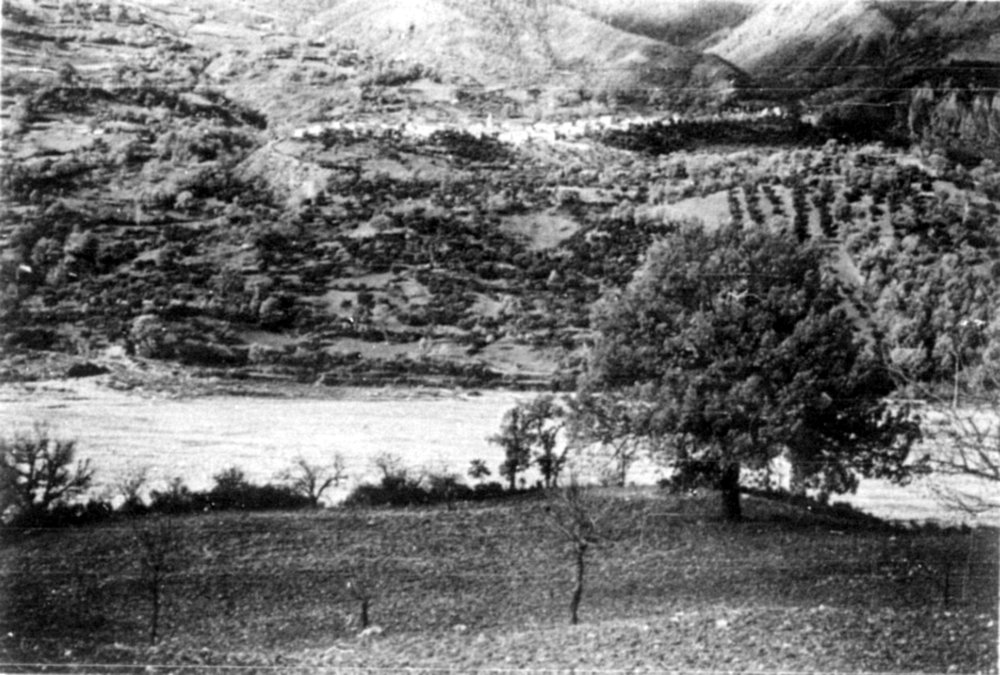
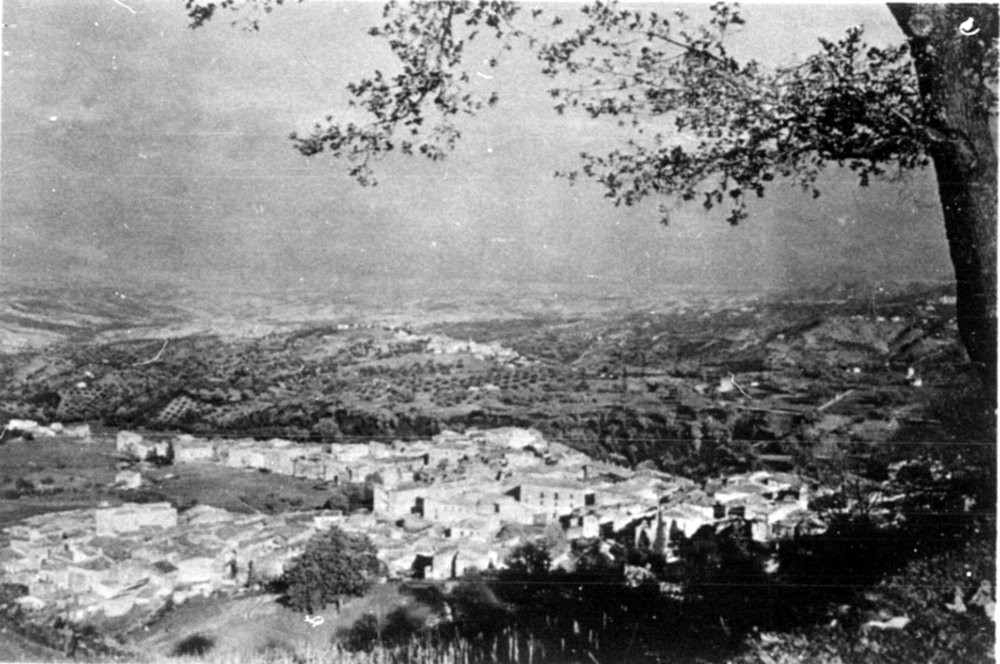
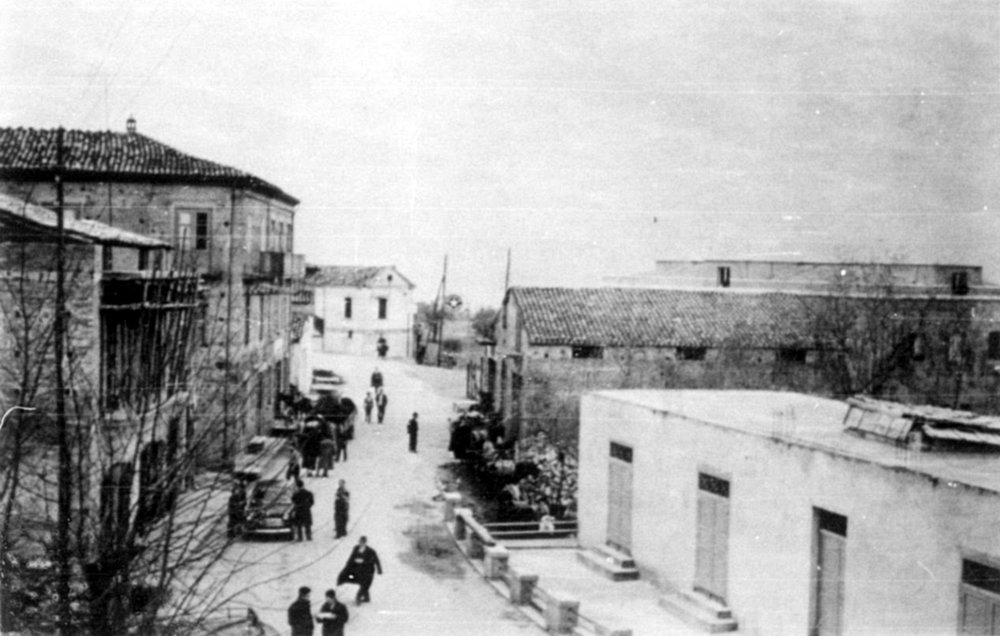
By linear measure, S. Costantino Albanese and Casalnuovo Lucano are less than two miles apart. But they are on either side of the Sarmento River and by road measure are at least five miles distant from one another. The villages are of the hillside type; the dwellings are clustered together on the side of a slope, removed from and well above the banks of the river. (See Figure 1.)
By road mileage, the villages are more than 50 miles from the east coast, where the main lines of communication, both railroad and highway, are found. It has been only since the end of World War II that roads suitable for all-weather traffic have been built to the villages. The dirt road to Senise (the main town in this area, about 20 miles away) was constructed during Mussolini's regime, but; no bridge was built across the Sarmento River to connect S. Costantino Albanese with the main road. The concrete bridge which now spans the river was completed p. 4 shortly after World War II, It was one of the present government's many projects to offer better means of communication to the villages in the interior of the peninsula.
The Calabrian Region
Several regions are located on the southern side of the Pollino Range in the "compartment" of Calabria. These are in the same physical setting as the two mentioned above, but S. Costantino Albanese and Casalnuovo Lucano are located well within the Pollino Range, while those in the "compartment" of Calabria are located on the southern flanks of the range. The villages in Calabria are Castroregio, Plataci, Civita, Eianina, and Frascineto. (See Appendix I, Map 4.) Castroregio and Plataci are fine examples of hilltop towns, both situated on peaks.
Southeastern Section of the Pollino Range
Castroregio is about 2,500 feet in elevation, and Plataci is about 3,000 feet. The villages are only seven miles apart but not directly connected to one another by a road. Access from one village to the other is achieved by traveling down to the main coastal road and then up to the other village, a distance of about 50 miles. Both villages present difficulties of accessibility though they are only 20 miles from the main coastal road that skirts the Ionian Sea. The steepness of the road gradient and the condition of the unpaved roads create difficulties in communication. In winter heavy downpours of rain may wash away the roads and occasionally heavy snowfall may disrupt communications between the villages.
The Southern Flanks of the Pollino Range
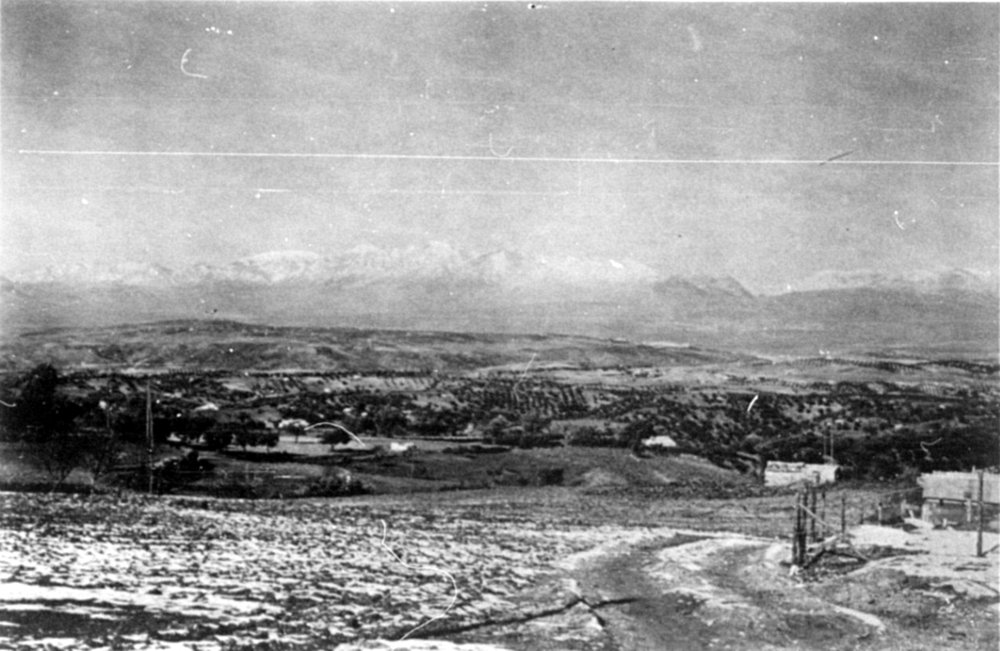
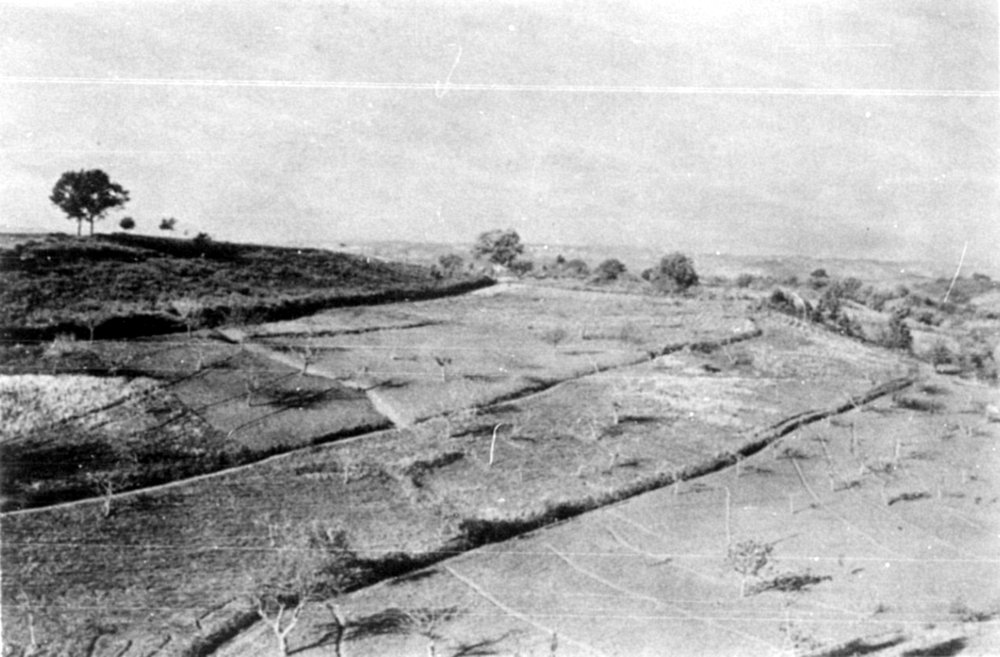
The villages of Civita, Eianina, and Frascineto are located at the southern edge of the Pollino Range. Here the Lucanian Apennines come to an abrupt end, rising above the Sibari Plain. The plain was formed by the Crati River, which flows from the south, and by numerous torrential streams, whose headwaters lie in the Pollino Range, flowing from the north. (See Figures 2 and 3.)
These three villages are accessible by either road or rail because in the vicinity of their location there is a slight discontinuance in the mountainous backbone of peninsular Italy. A paved road has been constructed along the foot of the Pollino Range connecting the eastern and western sides of the peninsula. This road passes through the villages of Eianina and Frascineto, and Civita is only one mile from it. Despite the fact that these villages are on fairly level ground, the houses are grouped closely together in very narrow streets, a pattern usually associated with hillside or hilltop villages.
All three villages are located approximately 1,500 feet above sea level and are situated on the flanks of the Pollino Range. Accessibility has become relatively easy in this century because of an intensive road-building program initiated throughout the country by the former fascist government.
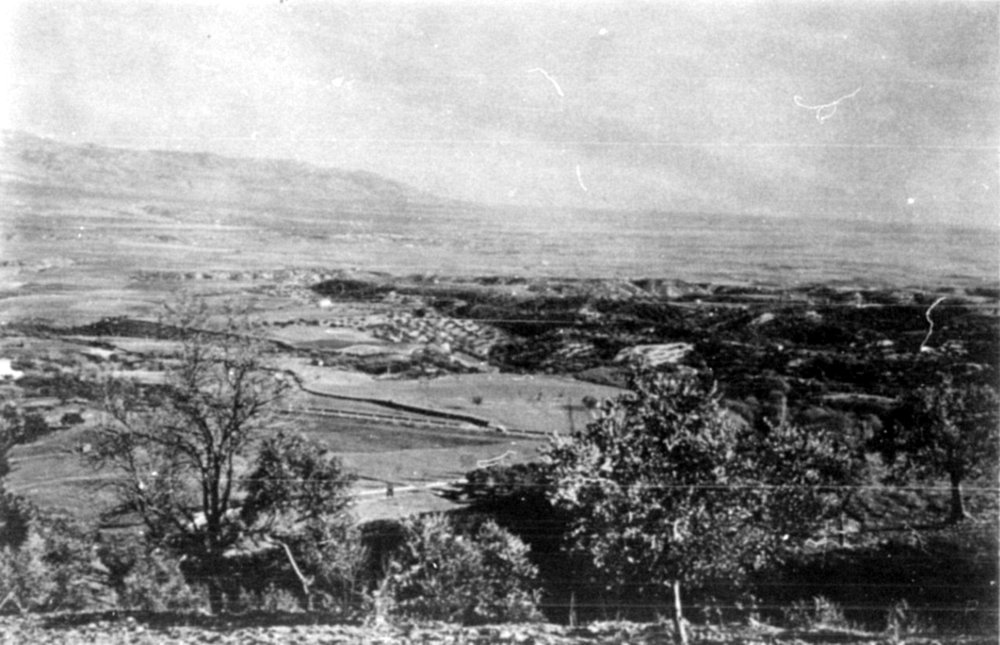
The Northwestern Section of the Coastal Range
Another group of villages that is easily accessible consists of Firmo, Lungro, and Acquaformosa. (See Appendix I, Map 5.) This range, which is on the western side of the peninsula, rises sharply out of the Tyrrhenian Sea, and in many places there is no coastal plain. It slopes more gently on the eastern side, where the three villages are situated close to the head of the Sibari Plain.; p. 6 All three of these villages are on hilltops: Firmo, about 1,100 feet above sea level; Lungro, about 1,968 feet, and Acquaformosa, about 2,500 feet. Even though these hilltop villages are high in altitude, they do not suffer from inaccessibility because they are on the paved road leading from the western to the eastern side of the peninsula. This road originates in the Sibari Plain, passes through the. city of Castrovillari, and then winds through the Italo-Albanian villages to the western coast.
The Central Section of the Coastal Range
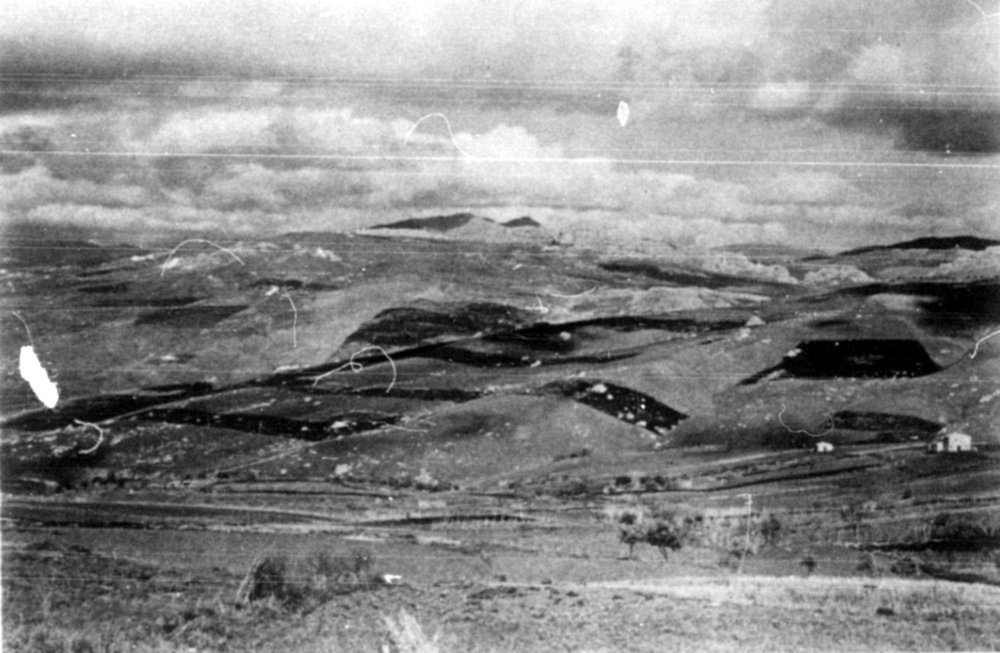
Further to the south, and still on the eastern side of the Coastal Range, ten Italo-Albanian villages are strung out from north to south: Santa Caterina Albanese, Cervicati, Mongrassano, Cavallerizzo, Cerzeto, San Giacomo, San Martino di Finita, Rota Greca, San Benedetto Ullano, and Marri. (See Figure 4.) All are hillside villages with the exception of S. Caterina Albanese, which is furthest removed from the group and is a hilltop village. All these villages, which are approximately on the 1,500-foot contour line, face the interior of the peninsula in the direction of the largest floodplain in the "compartment" of Calabria—that formed by the Crati River and its tributaries. (See Appendix I, Map 6.)
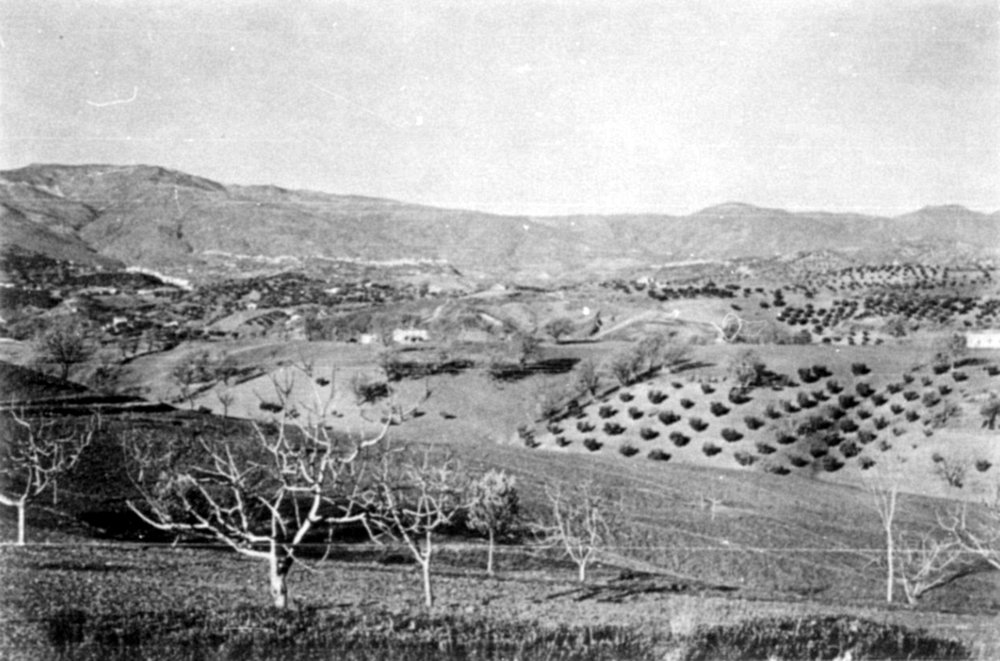
Cervicati, Mongrassano, Cavallerizzo, Cerzeto, S. Giacomo, 5S. Martino di Finita, and Rota Greca are all on, or very close to, a paved north-south road. The villages are strung out on this road, which runs parallel to the Crati Valley, six miles to the east. The Crati Valley contains the main lines of transportation of this area.
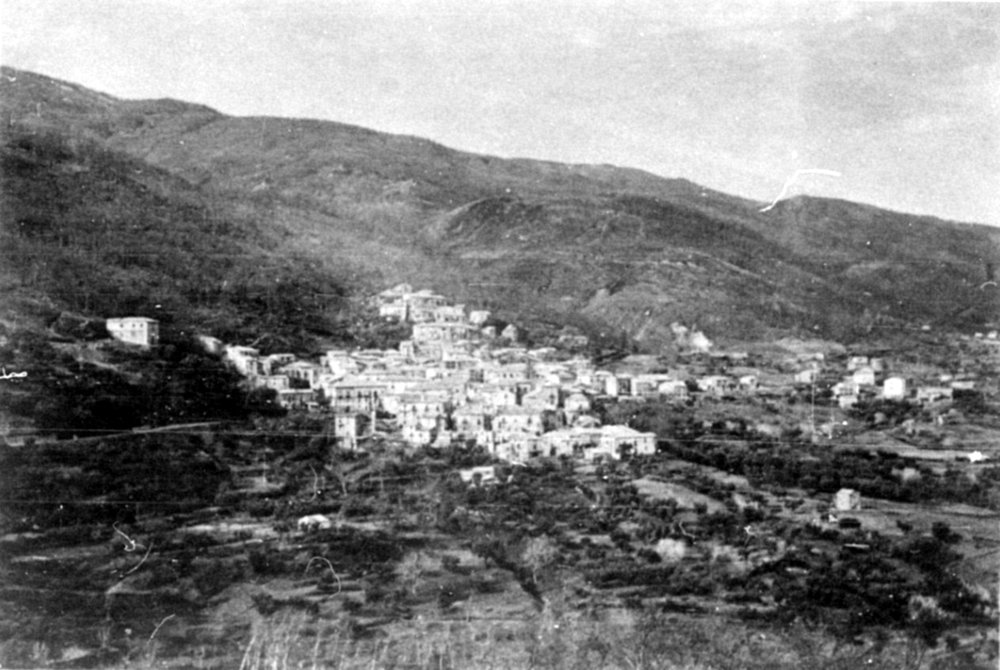
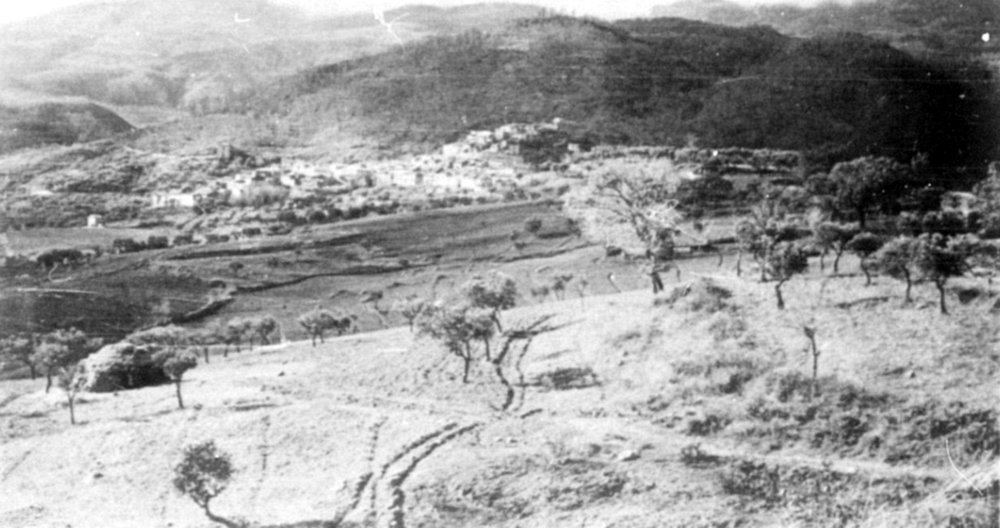
p. 7 San Benedetto Ullano and Marri (see Figures 5 and 6) are indirectly connected to the other eight villages by a lesser road but still within this north-south axis. S. Caterina Albanese, which occupies a peak a mile from a paved road, is reached by way of a winding dirt road.
p. 8Falconara Albanese
About 12 miles to the south of S. Benedetto Ullano is the village of Falconara Albanese. This village deserves special attention because it is isolated from the rest of the Italo-Albanian settlements. It is located within the Coastal Range but on the western side facing the sea, whereas the others in this range face the east. The village is of the hilltop type and is slightly under 2,000 feet in altitude. It is difficult to reach because there is no motor road leading to it from the outside. A short stretch of road, which is Falconara Albanese's only means of access to the outside world, leads from the village to a railroad station at the foot of the peak. Of all the Italo-Albanian villages, this is the least accessible.
The "Sila"
The north central portion of the Calabrian Apennines is a high granite plateau called the "Sila." The altitude of the 'Sila'' averages between 5,000 and 6,000 feet, with the highest elevations in its southern portions. It is separated from the Coastal Range by the floodplain formed by the Crati River and its many tributaries. The headwaters of the Crati River are in the southern part of the "Sila" and the Coastal Range. The floodplain extends along the peninsula in a northeast-southwest direction for a distance of about 35 miles.
The "Sila" is divided into three sections: to the north is the "Sila Greca," the central portion is the "Sila Grande," and the southern portion is the "Sila Piccola." There are no Italo-Albanian settlements within the "Sila," and its interior is rather sparsely populated but there are settlements on its fringes.
The Northern Margin of the "Sila Greca"
At the northern margin of the "Sila Greca," there are seven Italo-Albanian settlements: Spezzano Albanese, Santa Sofia d'Epiro, San Demetrio Corone, Macchia, San Cosmo Albanese, Vaccarizzo Albanese, and San Giorgio Albanese. (See Appendix I, Map 7.) These villages comprise a group and are separated from each other by distances of up to ten miles, except for Spezzano Albanese, which is separated from the other six villages by the Crati River and is situated on a high point of land overlooking the Sibari Plain. (See Figure 3.) It is eight linear miles from the other villages, but the distance by road is at least 25 miles. The village, which is about 1,100 feet in altitude, is on the national highway that connects one of the main cities of Calabria, Cosenza, with Naples.
Five of the other six villages are on a road that skirts the northern-edge of the Sila Plateau. The one exception is San Giorgio Albanese, a hilltop village, isolated from the others by a deep, narrow valley. It is accessible from the main coastal road that skirts the Ionian Sea by means of an unpaved road about eight miles long. Two of the remaining five villages are on hilltops; they are Vaccarizzo Albanese and S. Cosmo Albanese. The other three, Macchia, S. Demetrio Corone, and S. Sofia d'Epiro, are hillside villages. (See Figure 7.) The average altitude of the six villages is about 1,500 feet, and all face northeast, overlooking the Sibari Plain and the Gulf of Taranto.
The Southern Margin of the "Sila"
Ten villages are located on the central and southern margins of the "Sila," more specifically on the eastern margins of the "Sila Grande" and on the southern margins of the "Sila Piccola." These villages are not within the "Sila" itself because the high, rugged, granite plateau has not attracted many settlers. The settlers chose sites at lower elevations, where they could practice the Mediterranean type of agriculture. The Italo-Albanian settlements on the southern edge of the "Sila" are more scattered than those of northern Calabria; yet the villages are in groups of two or three, and within these groups they are not more than ten miles apart.
On the eastern margin of the "Sila Grande," there are three villages: Carfizzi, S. Nicola dell'Alto, and Pallagorio. All are about 1,800 feet in altitude and are on hilltops. They are about ten miles from the national coastal highway, but the road that leads to them is unpaved. The eastern slopes of the "Sila Grande" have been heavily eroded, and the greyish clay that covers the underlying granite has been cut into deep ravines. Landslides are frequent, often carrying away the road, especially during the winter months when heavy precipitation falls in the "Sila."
Twenty miles to the southwest of these three villages are three other Italo-Albanian villages: Arietta, Marcedusa, and Andali. Arietta and Marcedusa are hilltop villages, Arietta at an altitude of 1,000 feet and Marcedusa at 2,000 feet. The villages are located some ten miles inland from the Ionian coastline and are on the southern edge of the "Sila Piccola." They are served by secondary roads but are not directly connected to one another. Arietta is served only by a mule trail connecting it to a highway about five miles away. The ruggedness of the local relief, plus the frequency of the landslides during the rainy months, accentuates the remoteness of these villages. All three are near the paved national highway, but the roads leading to the villages are not paved.
p. 10 Some 25 miles further to the west are three other Italo-Albanian villages: Caraffa, Vena, and Amato. They are about five miles from one another, but no roads connect them directly. Vena and Caraffa are hilltop villages, respectively 800 and 1,200 feet above sea level. Amato, separated from the other two by the Amato River, is a hillside village about 1,500 feet above sea level. The villages are located at the extreme southwest edge of the "Sila Piccola." It is at this point that the "Sila" terminates and the "Serre," a range that occupies the tip of the "toe," begins.
Still further west, and removed from the other Italo-Albanian villages, is the settlement of Gizzeria. Gizzeria, some 20 miles to the west of the last three villages mentioned, is a hillside village at an altitude of about 1,950 feet. It is on a national highway that connects Naples with Reggio Calabria, and is on the western slope that faces the Tyrrhenian Sea. The village is not within the margin of the "Sila Piccola" but on the slopes of a mountain called "Mancuso." This region represents the southernmost extension of the Coastal Range.
The Northwest Region of Sicily
Along the northern coast of Sicily stretch the Siculo Apennines, which rise sharply from the coast and then slope more gradually towards the interior. The highest elevation of this mountain range, which is a continuation of the Apennine system is achieved in the central portion, gradually decreasing towards the east. The interior has the appearance of a roughly dissected plateau. The predominant exposed rock formations are sandstones and limestones, while in the extreme northeast portion there are recent formations of volcanic origin. The softer sandstones and limestones have been extensively eroded and give a rugged appearance to the topography.
Four Italo-Albanian villages are located south of the city of Palermo, which is 175 miles west of the Straits of Messina. These are Piana degli Albanesi, Contessa Entellina, Palazzo Adriano, and Mezzoiuso. (See Appendix I, Map 3.) Although they are in one general location, they do not form a tight group as do the villages on the peninsula. Piana degli Albanesi is ten miles south of Palermo and 30 miles north of Contessa Entellina. Palazzo Adriano is 15 miles east of Contessa Entellina. Mezzoiuso is 30 miles southeast of Piana degli Albanesi. All of the villages are located on, or close to, paved national highways.
The landscape is generally characterized by a rugged, rolling relief in contrast to the rugged, sharp relief of the Lucanian and Calabrian Apennines. The villages of Sicily are usually found on the lower slopes of a mountain—not precariously perched on a peak, or clinging to a steep slope.
Piana degli Albanesi, the northernmost village, is 2,400 feet above sea level, at the foot of a mountain that rises to 4,472 feet. (See Figures 8 and 9.) It is ona national highway that connects the city of Palermo with Agrigento, on the southern coast.
Contessa Entellina is also located at the foot of a mountain. It is connected to a national highway by eight miles of unpaved road, but the road is not hazardous because it is fairly level and does not wind up a steep gradient to the village.
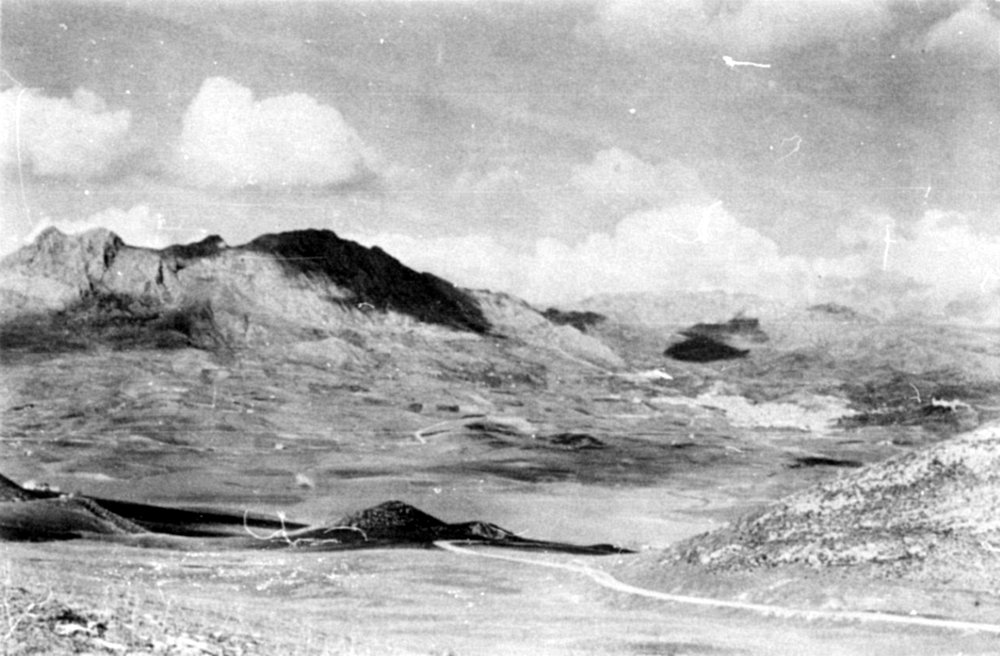
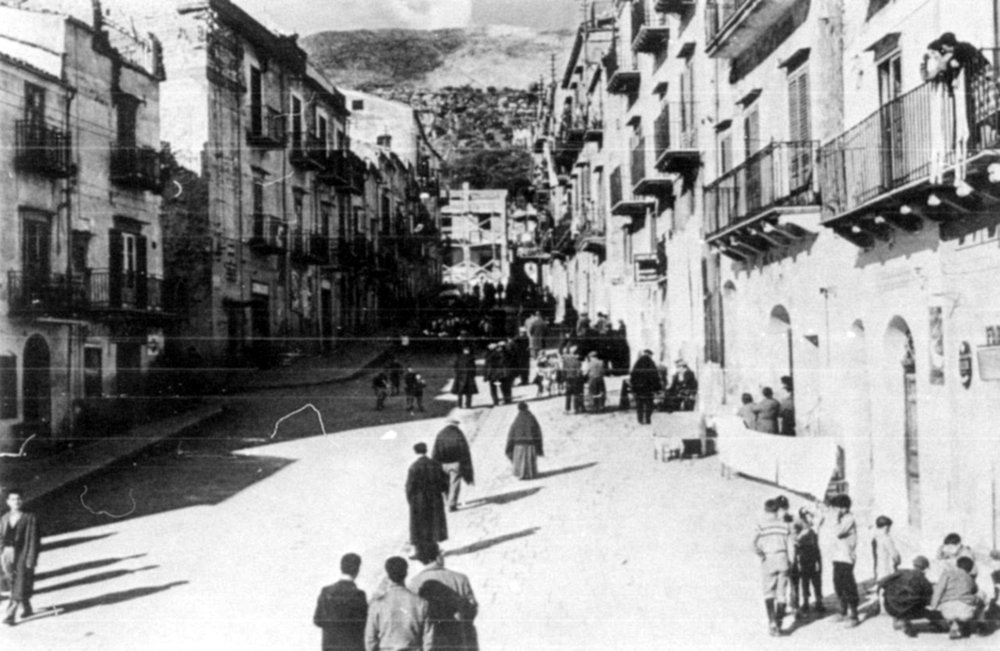
Palazzo Adriano, located in an amphitheater with peaks rising above, is at an altitude of 2,200 feet. The national highway that passes through Piana degli Albanesi also passes through Palazzo Adriano, so that the village is easily reached.
The final Italo-Albanian village in this region is Mezzoiuso, which lies at an elevation of 1,800 feet. It is located on the lower slopes of a high peak that rises to 3,950 feet. The village is about ten miles from an all-weather road and is connected to it by a paved road.
p. 12 None of these four villages presents the problems of inaccessibility of villages of peninsular Italy. For reasons that will be enlarged upon later, these villages occupy sites that are higher in altitude but are more accessible than the villages on the peninsula. Three of them are well within the interior of the island, but they are adequately served, directly or indirectly, by good roads.
Summary of Physical Settings
The Italo-Albanian villages are situated largely in the mountains. The limited plains areas consist of narrow valleys and narrow coastal plains. The streams of Lucania, Calabria, and western Sicily are torrential, reaching peak flow during the winter months; during the summer months the stream beds are dry or reduced to a trickle. The narrow valleys are not suited for the settlement because in many places the valley floor is totally occupied by the stream, and the sudden fluctuations in the volume of water cause the stream to deposit coarse material which prevents agriculture. Physical conditions have forced the inhabitants of the area to select village sites on the slopes or the peaks of the mountains, and agriculture is conducted on the slopes.
Topography has determined the sites of the Italo-Albanian villages. Until recent times these villages had been relatively inaccessible to the outlying areas; some of them still lack modern means of communication. Modern methods of road building have linked most of them to national highways that by-pass mountain crests or slopes where the villages are located. These tributary roads bring the necessities of life or the curious traveler to the villages, but for the inhabitants of modern Italy is still a remote region.
p. 13Chapter 2Climatic, Vegetative, and Soil Patterns
Climate
All the Italo-Albanian villages (in both southern Italy and Sicily) are located in regions with Mediterranean climate, hot, dry summers, and cool, wet winters. There are some slight variations in this general climate pattern in particular villages, due to their sites. For example, the village of Castroregio is located at an elevation of 2,500 feet and experiences heavy snowfall which remains on the ground for at least a week. The abundance of snow makes the road leading to the village impassable.
Other examples are the villages on the leeward slopes of the Coastal Range. These villages receive about 80 inches of rainfall during the winter months. During the same season, those on the northern margin of the "Sila Greca" receive about 25 inches. This local phenomenon is due to the cyclonic storms that move from the west, are forced over the mountain barrier, and then deposit most of their moisture over the Coastal Range.
There are also differences in temperature and precipitation between southern Italy and western Sicily. These differences are attributed more to latitudinal location than to local phenomena. The winter temperatures of western Sicily are higher because the region is further removed from the cold, continental air and the violent "bora" wind. The average annual precipitation of this region is about 20 inches because the area is under the influence of the subtropical high-pressure zone for at least seven months. Both southern Italy and western Sicily have the hot, dry summers attributed to lands with Mediterranean climate, but the average summer temperature is a few degrees higher in Sicily owing to its proximity to northern Africa.
Vegetation
The vegetative pattern of southern Italy and western Sicily is also classified as the Mediterranean type, called "sclerophyllous," but the long period of habitation by man has removed most of the original vegetation. The natural vegetation that remains is found mainly in areas that cannot be cultivated or in areas not suited as sites for villages. These areas are generally mountainous, above the 1,500-foot contour line or along the narrow valley floors in mountainous areas.
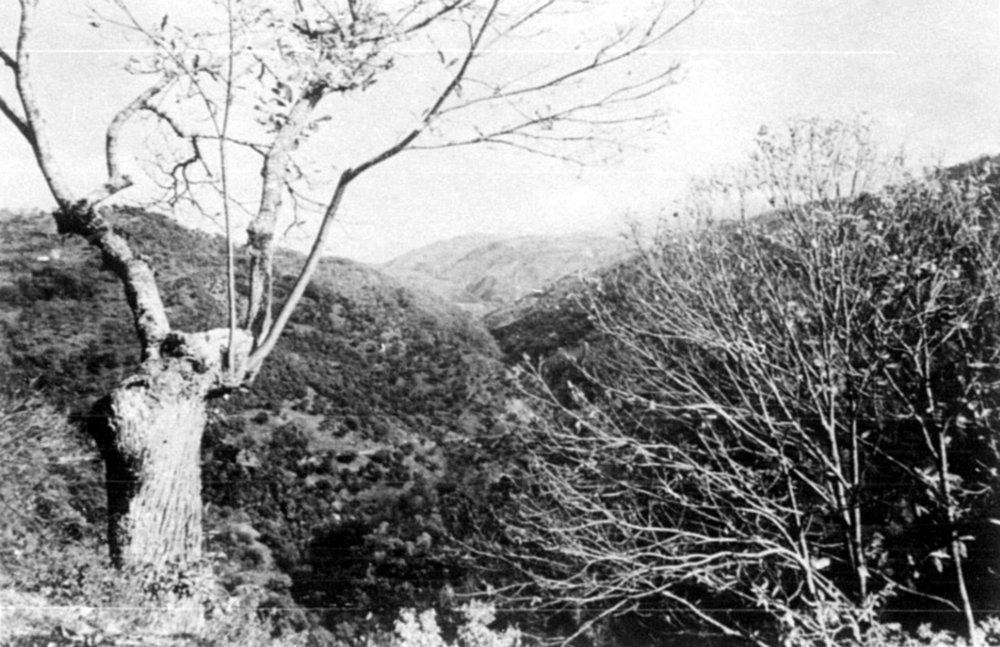
Much of the natural vegetation is found above the 1,500-foot contour line and consists of mixed hardwoods of the deciduous type. The rise in elevation causes a drop in temperature and permits the growth of trees, such as poplar, chestnut, oak, birch, and beech. This type of forest is found above the groups of villages in the Coastal Range, the northern margin of the "Sila Greca" (see Figure 10), and on the slopes of the Pollino Range.
The warmer annual temperature of western Sicily does not permit the growth of hardwood deciduous vegetation. The vegetation is more of the steppe type, with short, scrubby bushes and grasses. (See Figure 11.) It would be difficult to determine the original vegetation of this area because the land has been cultivated for over 2,000 years.
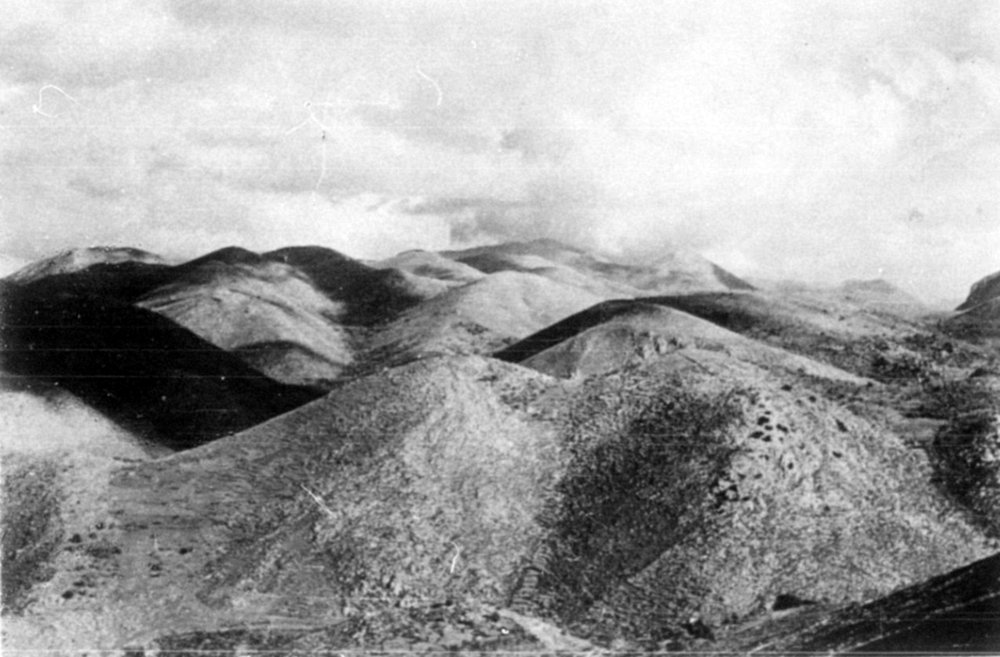
p. 15 The characteristic soil type of Mediterranean lands is laterite, but this general classification cannot be accurately applied to these more specific areas. The mountainous nature of the area and the fast rate of erosion have not allowed the development of a soil horizon (if one ever existed); it has long since been removed by erosion.
The plains areas, such as the Crati Floodplain and the Sibari Plain, have been built of layer upon layer of alluvial deposits.
Clay covers most of the slopes of the hills and mountains, and the parent material is generally limestone and sandstone, with the exception of the "Sila," which is granite.
The original soil horizon is believed to have been a yellowish-red laterite but, with the removal of vegetation centuries ago for the purpose of cultivation, erosion has removed the original top layer of soil. Now the characteristic color of the soil is gray, or yellowish-gray, and in many areas the parent material is exposed.
Summary of Climate, Vegetation, and Soil Patterns
Climate, vegetation, and soil are physical factors that influence man in determining his habitat. The role of these factors is evident in southern Italy because the predominant occupation is agriculture. They determine the types of crops that are grown in a region and, usually, the yields per acre.
There is also a connection between the choice of village sites and these physical factors. Most of the villages are located either on or slightly below the 500-meter contour line (approx. 1,500 ft.) , which represents a climatic division due to a rise in altitude. Below this line the climate is of the Mediterranean type, while above the line it resembles the cold, humid, continental variety. The villages are generally located in the region of the more favorable climate, the more rigorous being avoided as a village site.
p. 16Chapter 3The Physical Setting of Albania
The original settlers of the Italo-Albanian villages in southern Italy came from the eastern side of the Adriatic Sea. Albania is a small area on the Balkan Peninsula, occupying part of the Adriatic Coast. The ancestral home of the Italo-Albanians has physical characteristics similar to their present habitat in southern Italy.
About three-quarters of Albania is mountainous. The Dinaric Alps, which attain elevations of 12,000 feet, occupy the northern and central parts of the country. The Pindus Mountains stretch from the central portion southward into northern Greece. The country has a small coastal plain which has been unfit for settlement because of marshy conditions.
These two mountain systems have formed a physical and cultural barrier for Albania. The valleys are steepsided, the valley floors extremely narrow. Except for the higher elevations of the two mountain systems, it can be said that the physical settings of the villages in southern Italy are quite similar to those in Albania.
Even the conditions of climate and vegetation are similar. The southeastern Adriatic region has a Mediterranean climate, with modifications as the distance from the coast or the elevation increases. The vegetation of the two areas is also similar, because in both regions the original vegetation has been removed as a result of long occupancy. Also, the 500-meter contour line represents the division, in both areas, between the vegetation of the Mediterranean type and the deciduous forest that occupies the higher portion of the mountain slopes.
The physical environment the Albanian settlers encountered in southern Italy was not unlike that of the land which they had left. Therefore, there were no great adjustments to make as they established themselves in this new land. They continued to cultivate the same crops and to construct their houses in the same fashion. Their major obstacles were of the cultural type, and these will be discussed in succeeding chapters.
p. 17Chapter 4Early Migrant Groups of Southern Italy
Southern Italy has known many settlers since the beginning of European civilization. Four ethnic groups, besides the Albanians, that have settled in southern Italy are discussed in this chapter. They are: (1) the ancient Greeks, (2) the Byzantine Greeks, (3) the Saracens, and (4) the Waldenses. Each of these groups established colonies in southern Italy but, for varying reasons, failed to survive. They went to Italy under varying circumstances, remained there as an identifiable group for a length of time, and then their identity was lost. Only the Italo-Albanians have remained as an identifiable group to the present day.
Original Inhabitants
Southern Italy did have indigenous groups at the time Greek civilization was flourishing—the Lucanians and Bruttians. In Sicily, there were the Sicels and Sicans. These people lived away from the coast in the hills, and their livelihood depended on what the forest could offer. They established no civilization, and future settlers were able to exert control over them. Their presence in the interior did not hinder the attempts of the ancient Greeks, the Byzantines, and the Saracens to settle various coastal areas.
The Ancient Greeks
The first permanent settlers of southern Italy were the ancient Greeks, who arrived in the ninth century B.C. They migrated mainly from the region of the Peloponnesus,2 a land that is physically quite similar to southern Italy. The Greek colonies were established along the Ionian Coast from the Gulf of Taranto to the Straits of Messina. Also, the coastal area of the eastern part of Sicily became a permanent site for the Greek colonists.
Several reasons for the migrations of the Greeks to southern Italy have been offered by students of ancient history. One is that the expanding population in the Peloponnesus caused a population pressure which forced migration. This does not explain why the Greeks chose to migrate to southern Italy. Further, it is merely speculative, for it is not known that a population problem did exist in the Peloponnesus.
Another reason takes into account the historical developments of this time which explain the choice of southern Italy for settlement. If the Greeks were looking for new sites at the time, they found that the region of Asia Minor was controlled by the Persians and were therefore forced to migrate to the west. "For the westward p. 18 migration itself was caused by the awakening of the Asian races, that culminated in the conquests of Nebuchadnezzar, Cambyses, Cyrus, and Darius, which was checked at Salamis, and was ultimately thrown back upon itself and annihilated by the Greek Alexander the Great."3
The Greeks met no great opposition from the natives for several reasons. First, the indigenes were hill tribes; second, the Greeks are a maritime people and chose suitable harbor sites; third, the fertile agricultural areas were along the coast and not in the interior. Except for sporadic raids by the Lucanians and Bruttians, the Greeks were not hampered 'n developing city-states similar to those of their homeland. Some of these were Taranto, Metaponto, Sibari, Crotone, Reggio, Syracuse, and Agrigento.
These Greek city-states thrived for a period of 500 years, approximately from the ninth century to the fourth century B.C. After the first century the Greek city-states suffered a rapid decline. This rapid decline has been attributed to the rise of Rome and Carthage, but several historians have attributed it to the Greek character itself.
The Greek is an individualist, and this individualism expressed itself in the formation of his city-states. The Greek city-states of southern Italy were independent of one another, and sometimes even warred among themselves. For example, the city of Sibari was completely destroyed by the Greeks of Crotone.4 This lack of unity was a factor in the downfall of these city-states. The rise of Rome and Carthage finally ended the flourishing Greek civilization in southern Italy during the fifth century B.C. Many of the cities had been sacked by Rome and Carthage at earlier dates, but Rome finally was successful in gaining control of southern Italy.
These Greeks had come as settlers, and their cities had flourished. Their decline was not due to an inhospitable land or climate, but to their inability to unite and present a common front against the intrusions of rival powers.
The reason why greater Greece never became a consolidated empire lay in the Greek character, and not in the lack of enterprise, of military ability, or of a common interest. Had the whole south at any time remained united for a century, it would have easily grown to
be another Carthage. But the Greek had neither the Roman's conception of political unity, nor the Carthaginian's commercial talent. He was as incapable of sinking his highly original personality in the ranks of organization as he was in devoting his whole energies to money making; he was a free lance rather than a trained soldier;
an artist, not a middle class citizen; a man of genius, not a banker.5
Today there is no trace of a Greek ethnic group which is descended from the original Greek settlers. The Greeks have left only mementoes, now in ruins, of their stay in southern Italy. There is the temple at Metaponto, the outline of a city p. 19 at Thuri, a pillar at Crotone, a theater at Syracuse, and a temple at Agrigento. The eradication of the ethnic group was complete, and only traces of the Greek language remain in the Italian dialects spoken by the Calabrians and Sicilians. The Greeks who lived in these city-states during the time of the Roman conquest were either killed or assimilated to the Roman way of life; some managed to escape back to their homeland.
The Byzantine Greeks
There was a lengthy interim period when no migrations arrived in southern Italy. This was the period of Roman domination of the Mediterranean lands. Then, with the decay of the Roman Empire and the instability that accompanies the decay of such a powerful nation, rulers began to seek out territory to occupy and rule. From the seventh to the twelfth century A.D., the southern part of Italy was the scene of struggle between the increasing power of Rome and the gradually decreasing power of Constantinople as the dominant center of the Christian Church.
The struggle had its beginning in Constantinople as an iconoclastic controversy which led to persecution of members of the clergy.6 Italy and Rome became seats of the opposing groups. Previous to this controversy the bishopric of Rome controlled Calabria and Sicily, but, as the struggle heightened, these areas were put under the rule of the Patriarch of Constantinople.7 Thus southern Italy came under the influence of the Byzantine Greeks, and from the eighth to the twelfth century Byzantine culture dominated the region.
It has already been noted that the arrival of the Byzantines was quite different from that of the ancient Greeks. The Byzantines were not searching for new lands to colonize, nor was their domination of southern Italy motivated by a fear of invasions from the East. Byzantium wished to retain a firm grasp on territory that was ruled by the Bishop of Rome.
There are no indications of large-scale migrations to southern Italy from Byzantium, but the Patriarch did send many troops and members of the clergy to southern Italy. This had an influence on the culture of the region and, during their domination, the region had a strong hellenistic character.
... under the imperial government, skillfull in spreading the influence of Hellenism, southern Italy, thanks above all to the Greek clergy and Greek convents, became a veritable "Graecia Magna"—a remarkable proof of the power of expansion, and of the force of civilization that assimilates, which constituted the greatness of the Byzantine Empire in the tenth and eleventh centuries.8
The period of Byzantine rule was not a peaceful one, because the decay of the Roman Empire had left a political vacuum throughout the Mediterranean realm.
p. 20 Byzantine rule of southern Italy slowly weakened, and, by the twelfth century, Byzantium was losing its strong grasp on southern Italy. By the end of that century, all Byzantine rule was removed from southern Italy.
The Byzantines had met no physical obstacles in southern Italy because they had been familiar with the region for along time. Their failure to survive as an ethnic group was due rather to various political factors—strong opposition to the Patriarch of Constantinople by Rome, invasions of southern Italy by the Ostrogoths and Normans, raids on the coastal settlements of southern Italy by the Muslim fleets, and the decline of the Byzantine government. The principal reason for their inability to win the natives over to Hellenism was the fact that they were regarded as a foreign influence which came into direct conflict with the church at Rome.
Today, there are no colonies of Byzantine Greeks in southern Italy. Their influence remains only in the form of art. In the cities of Bari, Taranto, and Palermo, there are churches of Byzantine design, the interiors of which are decorated in the Byzantine style.
The Saracens (Arabs)
From the eighth to the twelfth century A.D., the Saracens exerted an influence throughout the southern part of Italy. The Saracens' home base was the region now divided among Syria, Israel, Jordan, and Saudi Arabia. From the sixth to the ninth century, they gained control of the whole southern Mediterranean coastline, from Suez to the Straits of Gibraltar. On the coast of North Africa the Saracen fleets established bases for their raids on the Italian mainland and Sicily.9 Also from these same bases they launched their successful invasion of Sicily in 827 A.D. By the end of the ninth century, the whole of Sicily was under the Saracens' control. They even captured Bari in 841 A.D. and occupied it for forty years.10
The Saracens arrived in Italy during the period of a struggle between Rome and Constantinople. This struggle weakened any effective opposition to the invaders, who landed on the western tip of the island in 827, and by 878 entered the eastern city of Syracuse and took complete control of the island. Except for the relatively short occupation of Bari, the Saracens were unsuccessful in their attempt to conquer the cities on the mainland, but their fleets made devastating raids on the coastal cities.
The Arab Empire in southern Italy lasted for about 200 years. The physical setting of Sicily was not foreign to them, because the climate is similar to that of the eastern Mediterranean or the northern shore of Africa. Large numbers of Saracens settled in the region of Palermo, giving rise to a high Arabic culture in this region.
The failure of the Arabs to survive was due to strong opposition to the Moslem religion by both the Eastern and Western Churches. Arab decline was also brought about by internal corruption and a resulting decay in government. The Saracens were defeated by the Normans who received encouragement from the Pope. By the end of the twelfth century, all traces of Saracen rule were removed from southern Italy.
p. 21 The remains of Saracen occupation are to be found in architectural styles, agricultural practices, and place names. Today, there are no groups of people who identify themselves with these ninth century invaders. There are churches in the city of Palermo with interiors adorned with Arabic art which are reminders of the Near East. The Arabs are credited with introducing citrus fruits into southern Italy, and also a form of irrigation. Sicily is dotted with Arabic place names, and even in Calabria there is a village called "Saracena," Yet the opposition to the Saracens as a foreign group was so great that their language and religion was not allowed to survive in southern Italy.
The Waldenses
The native habitat of the Waldenses is in the district of the Piedmont, east of the Cottian Alps, in the region that separates Piedmont from Savoy.11 Today, the region is politically part of Italy, but during the Medieval period it was part of the Holy Roman Empire, with bishops and petty rulers exercising local power.
During the twelfth century, a number of Waldenses were induced to migrate from their native land to the northeastern part of Calabria. The reasons given for their migration are that the land of Calabria was more fertile than theirs and, ironically enough, that they were being subjected to religious persecutions at home.12
Calabria at this time was largely underpopulated and its rulers were inducing people to settle there. The King of Naples, Ferdinand of Aragon, offered some land for settlement to the Waldenses, along with freedom of worship.13 The latter offer was attractive to the Waldenses because, even though they considered themselves part of the Roman Catholic Church, they were treated as heretics because of some of their beliefs, e.g., "... in rejecting Purgatory and in cultivating scripture knowledge,"14
Even though they came from the northern part of Italy, the Waldenses proved to be successful farmers in Calabria. They founded the towns of Montalto, San Sexto, and Guardia Piemontese, all in the Coastal Range. For over 200 years they prospered in Calabria; at the beginning of the sixteenth century, their number is estimated to have been between six and seven thousand.15
In 1561, they were exterminated by order of Pope Pius V.16 The physical nature of Calabria, though foreign, had not been a hardship for them. It was their religious belief and culture that brought about their downfall. From the moment of their arrival, they were viewed with suspicion by the natives because their p. 22 religious practices deviated from the norm of the area and their tongue was foreign. They did not celebrate holy days or go on pilgrimages,17 1% and their language was a neo-Latin or a derivation of French.18
They lived rather peacefully in Calabria for 200 years because they did not participate very actively in the Protestant Reformation, but when Protestant ministers began to visit and preach in their towns, the Roman clergy took a firm hand. The Waldenses were brutally massacred in 1561, and the survivors forbidden to practice their religion, or to speak their native tongue.19
All that remains of the Waldenses, beside the historical accounts, is the names of the towns they founded and the women's costumes that are worn only on festival days. No surviving ethnic group can directly relate itself to the immigrants who came to this area between the thirteenth and sixteenth centuries.
p. 23Chapter 5The Albanians
The four groups of migrants to southern Italy discussed in Chapter 4 are examples of foreign groups that settled in that region but failed to survive. This failure was not primarily due to cultural integration but to incompatibility. The ancient Greeks came to grips with the rising power of Rome; the Byzantines clashed with the Papacy; the Saracens were the scourge of the Christians; and the Waldenses felt the fury of the Inquisition.
The Albanians represent a unique group because, even though they came as foreigners, they did not rouse the ire of the natives, and no group desired their elimination or removal. For 500 years they have remained on Italian soil; today their elimination is threatened by peaceful cultural integration rather than by force.
It would be wrong to think of the Albanians as a passive group, living peacefully in southern Italy. Indeed, during the early days of their arrival they practiced brigandage.20 This practice was forcefully suppressed by organized military expeditions, but there was no movement to eradicate or evict the Albanians. The chief aim of the expeditions was to curb the practice of brigandage. Except for these actions, there is no record of a campaign designed to eliminate this foreign element from peninsular Italy, as there was against the other four foreign groups. The record of the Albanian survival on Italian soil dates hack over 500 years from the present date.
Several factors have contributed to the survival of the Albanian group in southern Italy. The first factor to be considered is the geographical isolation provided by the mountainous terrain of that region. The second factor is that the cultural traits of the Albanians did not arouse any suspicion which would have led eventually to their elimination by force. The third factor is intangible, the desire of the Albanians to retain their identifiable cultural traits. Further elucidation of these points will explain the survival of this group, but first it will be useful to summarize the circumstances which brought them to Italy.
George Castriota (Scanderbeg)
In the early half of the fifteenth century, the Turks had brought under subjection nearly all the Balkan Peninsula, with the exception of a small coastal strip along the Adriatic Sea, which is included in present-day Albania. In this region the Albanians, under the leadership of George Castriota (who is also called Scanderbeg), held out against the armies of the Sultan for a period of forty years.
George Castriota has an unusual personal history. His father was John Castriota, ruler of Albania, who was forced to send his four sons (including George) p. 24 te Istanbul in 1421, where they were trained in the Corps of Janissaries.21 Scanderbeg's three brothers were killed at an early age, but he survived to become one of the Sultan's favorite generals. Before one of the battles in Serbia, Scanderbeg defected, and, returning to his native Albania, began the long period of resistance against the armies of the Turks. Because of his successes, he received aid and encouragement from Alphonse I of Aragon, King of Naples.22 A lasting friendship was formed between the two men, a friendship that later paved the way for the migrations of the Albanians to southern Italy.
Many articles and some books have been written about the Italo-Albanians of southern Italy; all are written in Italian or Albanian. Several itineraries of southern Italy, written by English travelers, include chapters about the Italo-Albanian villages. None of the articles, books, and itineraries agree with any of the others as to the specific date of the migrations from Albania to Italy. All generally agree, however, that the period of migration was from the mid-fifteenth century to the early part of the sixteenth century. In my conversations with village historians in southern Italy and a librarian. Padre Marco Petta, at the Grottaferrata Abbey (a Greek-rite abbey near Rome), the most quoted reference sources were books of two authors, Petro Scaglione23 and Domenico Zangari.,24 According to Scaglione and Zangari, the period of migrations took place over a span of nearly 100 years, from 1448 to 1543. Since no reference can be found to establish the existence of any Italo-Albanian villages prior to 1448, it has to be assumed that there were no concentrations of Albanian villages in southern Italy before that time.
Scaglione and Zangari also agree that the Albanians came in three main waves, and they further agree as to the reasons for their arrival.
The First Migration
In 1448, Alphonse I of Aragon appealed to Scanderbeg for aid in suppressing a revolt in the vicinity of the city of Crotone.25 Scanderbeg complied and sent a force under the leadership of Demetrio Reres and his two sons, George and Basil.26 After successfully suppressing the revolt, the Albanian mercenaries asked to stay in Italy because of the troubles with the Turks in their homeland. Their request was granted, and they settled twelve villages in the province of Catanzaro: Andali, Caraffa, Carfizzi, Gizzeria, Marcedusa, Pallagorio, San Nicola dell'Alto, Vena, Zangarona, Arietta, Amato, and Casalnuovo.27
p. 25 George and Basil, the sons of Demetrio Reres, with some of the other Albanian leaders and their troops, settled four villages in Sicily a year later, 1449. These were Mezzoiuso, Palazzo Adriano, Contessa Entellina, and Piana dei Greci (now called Piana degli Albanesi).28
These were the first Albanian villages to be established in southern Italy. Even though the Albanians came as mercenaries to suppress a revolt, the acquisition of land for their villages was sanctioned by the King of Naples. The king felt that their presence would also discourage any further attempt at revolt in these regions.
The Second Migration
The second migration, dated 1459,29 was quite similar to the first one. Alphonse I of Aragon died in 1458, and his bastard son Ferdinand was elevated to the throne, a moved opposed by the House of Anjou. The pretenders to the throne began a revolt in the province of Lecce which Ferdinand found difficult to suppress. He appealed to Scanderbeg for aid, and Scanderbeg embarked for Brindisi with 5,000 troops.30 Ferdinand appointed Scanderbeg as leader of both the Albanian and Italian troops. After two decisive battles, the rebels were beaten and the revolt broken.31 For this service to the King of Naples, the Albanian troops were granted land near the city of Taranto, in the "compartment" of Apulia.
The Albanians settled 15 villages in the low, rolling landscape which lies to the east of Taranto.32
The Third Migration
On January 17, 1468, Scanderbeg died in the Albanian town of Lesh. His son, John Castriota, succeeded him to the throne. For twelve years he kept up the resistance against the Turks, but finally, in 1480, the Albanians were defeated. Venice sent ships to help evacuate some Albanians; others went south to the Pelopennesus, which is now part of modern Greece.33 From the time of Scanderbeg's death to approximately 1480, there were constant migrations of Albanians to southern Italy.
About 1470, the five Albanian villages on the margins of the "Sila Greca" were settled, as well as Spezzano Albanese. From 1476 to 1480, the five villages on the southern edge of the Pollino Range were settled, and also most of the villages on the western side of the Coastal Range.34 p. 26 The third migration was the last sizable movement of Albanians to southern Italy. Only one other migration arrived in such numbers as to form a group of villages; these were the Albanians that had fled to the Peloponnesus after their land was overrun by the Turks. In 1534, these migrants left the Morea and sailed to the Bay of Naples, where the Viceroy of Naples (Don Pedro de Toledo) offered them land in the Lipari Islands. Dissatisfied with this region, they later moved to the Pollino Range, where they founded three villages.35 (Lists in Appendix II.)
In the early accounts of the founding of the Albanian settlements there are no exact figures as to the size of each migration. The accounts merely state the approximate number of troops that arrived with the first two military expeditions that preceded the migration. There is no mention of how many returned to Albania, or what portion of the total remained. Zangari states that there were 5,000 soldiers in Scanderbeg's force, which came to the aid of Ferdinand I in 1459,36 Another pamphlet, published recently, puts the number of migrants at about 400, 000.37 This figure seems farfetched, because, on the basis of the present population figure for Albania (approximately 1,200,000), it would mean that about one-third of the population had migrated to Italy.
Moreover, this figure is far above other census data that were taken at much later dates than the time of migration. For instance, Zangari has listed 40 villages of Albanian origins in Calabria, and cites the population of each by using a census taken in 1842. The total for these 40 villages is 41,400.38 Scaglione has also listed villages of Albanian origin, but his list consists of 82 villages in southern Italy. This is because he includes villages, originally settled by native inhabitants, where a few Albanian families settled later. The total for 80 villages is 251,359; but, if one adds the total population of the 40 villages from Zangari's list, using Scaglione's figures, the total is 75,456.39
There is a definite lack of information about the population of these villages at the early dates. Within three "compartments" of southern Italy and on the island of Sicily, the number of Albanian villages varies between 70 and 80. The present number of inhabitants in these villages ranges from 200 to 2,000, while the average number is about 1,000. (See Appendix II.) If one assumes that the average population per village in the fifteenth century was 500, then the estimated number of migrants for the total period would be between 35 and 40 thousand. This rough estimate indicates that the original settlers arrived in sufficient numbers to perpetuate their identity to the present day.
p. 27Chapter 6Albanian Villages that Have Lost Their Identifying Characteristics
Not ali the villages that were founded by the Albanians have retained their cultural characteristics. There are some whose origin is known to have been Albanian but which now retain only slight traces of their past heritage. For both physical and cultural reasons, the people have become integrated with the Italians of the area in which they live.
The largest group of villages whose people have become integrated with the
Italians is located in the "compartment" of Apulia. In this region there are 15 villages that were settled during the second migration period.
"Compartment" of Apulia
Scaglione lists ten villages (actually there are 15) in the "compartment" of Apulia that were founded by the Albanians during the second migration period.40 In his list he indicates that their religious faith is Roman Catholic and their language Albanian. During 19571 visited the towns of San Marzano di San Giuseppe and San Giorgio sotto Taranto, with two Italo-Albanians from San Demetrio Corone,. Prior to the actual visit they had said that they were not certain whether the inhabitants of these villages still spoke Albanian. Upon arrival in San Marzano di Giuseppe we found no one that spoke Albanian. Only mere remnants of the language had survived, e.g., the use of the Albanian words for bread, salt, shoes, house, et cetera. A similar situation was noted in San Giorgio sotto Taranto. The inhabitants we spoke with stated that Albanian was no longer the language of the home in any of the ten villages located in the lowlands surrounding the Gulf of Taranto.
Physical Description of Taranto Area
The physiography of the Taranto area has played an important role in the disappearance of the Albanian language and customs in the area. The land that surrounds the Gulf of Taranto is a broad and relatively flat coastal plain extending some ten miles into the interior before it encounters the southern extension of the Apennines. The rock formations in this region are sedimentary limestones of recent geologic origin,41 This region escaped the tectonic upheavals which formed the Apennines, and the landscape appears to be rolling plain. Clusters of villages are noted, but the villages are not found on the tops of mountains or p. 28 on steep slopes. They are easily accessible by good motor roads, and are often situated at the crossroads, reminiscent of Midwestern towns in the United States. This region has not physically isolated the population as have the regions of Calabria and Lucania.
The recorded elevations of the villages indicate the low local relief of this region. The village of Roccaforzato has an elevation of about 473 feet, the highest of any of the 15 villages, Foggiano has the lowest—53 feet. The elevation of Foggiano is unusual because it is located in a basin that surrounds the city of Taranto. The other villages have elevations between 200 and 400 feet. There is a marked difference between these elevations and those of Calabria and Lucania, where the elevations range from 900 to 2,500 feet.
The difference is enhanced by comparison of the local relief of both regions. The Calabria-Lucania area is marked by rugged relief that consists of high mountains, steep valley walls, and few or no plains. The area around the Gulf of Taranto is decidedly a coastal plain, which does not present any physical barrier. The area is crisscrossed by main motor roads and railroads that have been constructed through the plains without any decided curves or hairpin turns. Several of the former Albanian villages lie on these main routes of communication. The ease of communication has facilitated trade in this area, and this in turn has hastened the loss of ethnic identification within the villages.
The 15 Albanian villages are located between two large cities, Taranto and Lecce. Taranto has a population of over 100,000, and Lecce has a population of nearly 50,000. Five of the Albanian settlements are located about 15 miles to the east of Taranto; another five are located about 15 miles southwest of Lecce.
This proximity to large cities, plus the ease of communication, has had a decided effect in attracting the small Albanian group to Italian-speaking centers. The accessibility of these cities enabled the people in the surrounding villages to visit them either weekly or monthly instead of only annually, as is done in Calabria and Lucania. The frequent intermingling with the Italians and the obvious necessity to speak their language in order to carry on trade brought a decline in the use of Albanian. The Lucanian-Calabrian villages also have to use Italian, but their remoteness has allowed Albanian speech to survive.
The above illustration concerns one area where a nucleus of Albanian villages did not retain their ethnic identity. There are other Albanian villages outside the "compartment" of Calabria, Lucania, and the island of Sicily where the retention of their ethnic identity is doubtful. These other villages are in the "compartments" of Abruzzi and Campania, in remote regions of their respective provinces. Like the villages in the Taranto area, they are classified as Albanian-speaking villages, but a visit to these villages would be necessary in order to determine whether they actually do speak Albanian, and whether they identify themselves as Albanians or Italians.
p. 29Chapter 7The Italo-Albanian Villages of Calabria and Lucania
Physical Setting
A physical description of sections of Calabria and Lucania has been given in a previous chapter. The type of terrain in these regions creates isolation. The villages are several hundred miles from any large city (e.g., Cosenza is 200 miles from Naples). Their remoteness is enhanced by the ruggedness of the Apennines, which form the backbone of the peninsula. The major cities of Italy are found far to the north of Calabria and Lucania, and the region of southern Italy is considered remote by the northern Italians.
The rugged terrain creates isolation even within the immediate area of the villages. In the "compartment" of Calabria, the Crati River valley provides the only connecting link among the groups of Albanian villages; otherwise, these are isolated communities. In the northern part of Calabria, the Crati valley divides this region in a northeast-southwest direction. The floodplain formed by the Crati rarely exceeds five miles in width, and only where it makes its exit to the Ionian Sea does it widen suddenly to over ten miles. The floodplain is flanked by mountains that rise sharply from the valley floor to heights of over 6,000 feet. The villages are perched on the sides of these hills, and the descent to the valley floor is slow and winding.
In calculating distances between villages, or groups of villages, the linear distance bears no relation to the road mileage. For example, the linear distance between S. Benedetto Ullano, in the Coastal Range, and S. Demetrio Corone, on the northern margin of the "Sila Greca" is 17-1/2 miles; but the road mileage between these villages is 48 miles, nearly three times the linear distance. Therefore, actual distances between settlements in Calabria remain large, thus restricting communication between villages.
A time factor also has to be considered in traveling these distances. For instance, both S. Demetrio Corone and S. Benedetto Ullano are equidistant from Cosenza, the largest city in the area (population 40,100). The road mileage between them and Cosenza is about 50 miles; in the United States, the coverage of this distance involves an hour's drive, but in Calabria it requires three hours by automobile and at least four by bus. The winding road does not permit travel at high speed, and sections of the road are not paved.
Location
All Italo-Albanian villages in Calabria-Lucania are located approximately on the 500-meter contour line (approximately 1,500 feet). (See Appendix I, Map 2.) This elevation for all villages in Calabria and Lucania is not unusual because many of the villages and some of the cities in these regions also occupy high ground.
p. 30 The location of Albanian villages at higher elevations is not a distinguishing factor, but it has contributed to their isolation. Location at the 500-meter contour line has been prompted by events and conditions dating back to the days of ancient Greek settlements in southern Italy, conditions persisting to the present day.
Reasons of Defense
Cities such as Metaponto, Thurii, and Sibari occupied low coastal sites along the Ionian Sea, an area known for its abundant yield of grain. The cities of Thurii and Sibari were in the delta plain formed by the Crati River and its tributaries. These low coastal positions—below the 500-meter level—made the cities vulnerable to sea invasions by neighboring Greek city-states or intrusions from the highlands by the barbaric native inhabitants. Their vulnerability to attack resulted in their eventual downfall. Some of the survivors fled into the interior and founded new settlements there.42
Locations at strategic points either in the southern part of peninsular Italy or on the North African coast (the area now represented by Tunisia) has been necessary for the control of the sea trade in the Mediterranean. The establishment of cities at these points, on the other hand, has also invited invaders, either military forces or pirates. Over the centuries, the continual destruction of coastal towns by invaders or pirates caused their populations to establish their settlements inland while maintaining smaller settlements along the coast.43 The series of events that took place from the days of the ancient Greeks to the end of the seventeenth century helps to explain the isolated settlements.
The Albanians arrived in southern Italy in the middle of the fifteenth century at the time the Ottoman Turks were nearing the peak of their power. The Albanians had just fled their native land because of the militant activities of the Turks and were seeking new land for settlement. It was natural for them to choose a site that could be easily defended rather than to settle on the coast and be exposed to the raids that the Turks conducted along the shores of the Italian peninsula. With few exceptions, the Albanian settlements are several miles from the coasts and on higher points of land.
Malarial Conditions
The unhealthful conditions of the lowlands, both along the coast and in the interior of southern Italy, helps to explain why the Albanians chose to settle in high, remote places. The lowland areas of southern Italy have always been the best agricultural lands because of the alluvial soils, but unfortunately they are also the breeding places for the Anopheles mosquito, the carrier of the malarial parasite to man.
Malarial conditions were known to exist in the delta plain of the Crati River during the days of the ancient Greeks.44 It is not known to what extent this p. 31 hampered the ancient Greeks in their establishment of settlements in this area.
The delta of the Crati was not as choked with silt_then as it is today, and since
that time the Crati has extended its delta plain.45 The drainage pattern has had much to do with the creation of breeding places for the Anopheles mosquito in this area. The upper courses of the rivers in southern Italy are of the torrential type while the lower courses are filled with debris and, from this point on, the streams flow sluggishly to the sea. As the drier summer months approach, the volume of water is decreased, and small bodies of stagnant water provide breeding places for the mosquito. In order to avoid malarial conditions, the majority of the settlements in southern Italy were located at the higher elevations. In the southern part of Italy, the mosquito is not able to hibernate safely above the 500-meter line because of the cooler winter temperature. Therefore, these areas are freer of the malaria-bearing mosquito than are the lowlands.46
In their native land the Albanians had had malarial conditions similar to those in southern Italy. Their desire to avoid the malarial lowlands they noticed in southern Italy was another factor in their choice of sites at higher elevations, a choice entailing isolation.
The danger of destruction of coastal settlements by invaders has been removed. The threat of malaria has not been totally removed, but the Italian government has almost eliminated this danger by draining much of the former marsh and by massive applications of DDT. The government hoped that people in the isolated settlements would begin to move to lower elevations, but the ideas that have been ingrained in people's minds for centuries are difficult to dislodge, and the move has been at a slow pace. Even though the people realize that the danger of invasion has been removed, they are yet to be convinced that the lowlands are now suitable for permanent settlement.
Example of an Isolated Village
The Italo-Albanian village of Castroregio is an ideal example of an isolated village that was founded with defense in mind, and also is located above the reach of the Anopheles mosquito. Castroregio was founded near the end of the fifteenth century by Albanians who had fled from the northern part of present-day Greece, known as the Morea.47 The village is located in the northeastern part of Calabria, on the southern flank of the Pollino Range. (See Appendix I, Map 4.) It is only nine lineal miles from the coast but over twice that mileage via the winding road that leads to it. The village is directly on a hilltop, commanding an unhampered view in all directions. It was well chosen as a defensive site, and its defenses were further strengthened by the construction of a wall around the village. (See Figure 12.)
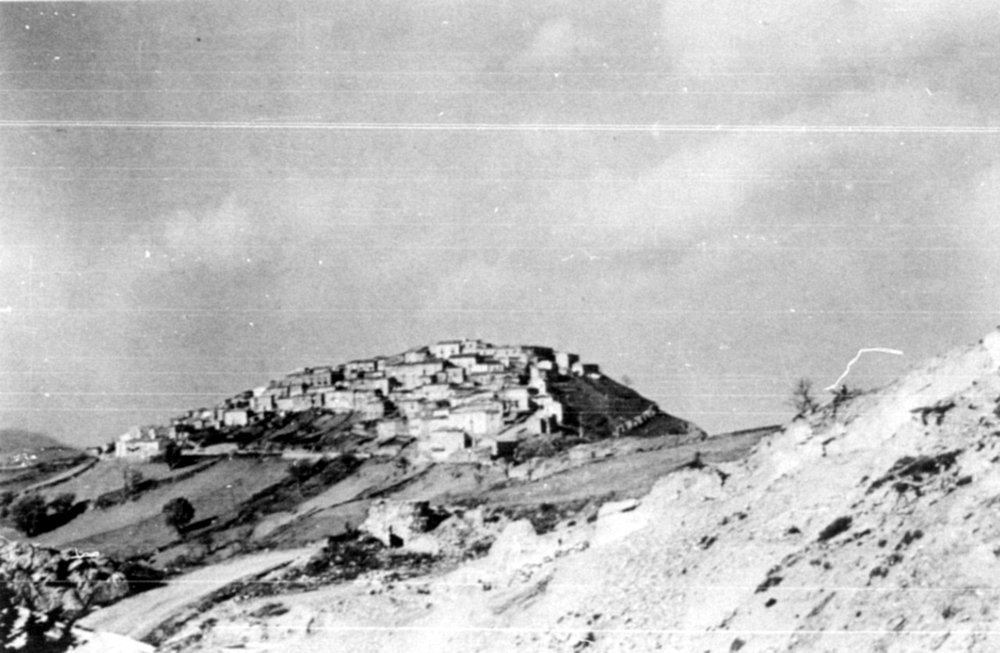
In the past, the site served the purposes for which it was chosen, but now it serves only to isolate the inhabitants both from Italian villages and from other Italo-Albanian villages in the area.48
There are fewer than ten villages within a ten-mile radius of Castroregio, and two of these are Albanian. The largest Italian village is Amendolara, which has a population of about 2,500, and is connected to Castroregio by the winding road that begins at the coast. Although the two towns are only about eight miles apart, the nature and the condition of the unpaved roads make it a momentous journey. Furthermore, there is not a person in Castroregio who owns an automobile, and the only means of public transportation from Castroregio to the outside world is a large automobile that carries the daily mail. The trip on foot or by donkey to Amendolara is not a frequent one; the only person making it daily is the water carrier. The village is without running water, and daily a man takes his pack of donkeys to a spring in the valley below the town, fills some barrels, and sells the water at 100 lire (about $.16) for three litres. The only other regular means of communication with the outside world is a telephone line. There are very few radios because electrification has not yet arrived, and the government has no present plans to deliver electricity. The village represents one of the more extreme forms of isolation.
48.q large portion of the information gathered concerning the Albanian villages in
Bernetrie Mauro of S. Demetrio Corone. Professor Mauro is an Italo-Albanian p. 33 Professor Mauro points out that the people of Castroregio are more like the Albanians of old than the inhabitants of the other Italo-Albanian settlements in Calabria. It was on his insistence that I undertook a visit to Castroregio, accompanied by two Italo-Albanians from S. Demetrio Corone, a priest, Zoti Talarico, ': and a schoolmaster. Professor Alfredo Braile. Their presence was an added assurance that I would be accepted by the inhabitants, who have a great suspicion of outsiders. This suspicion applies even to Italians, who are regarded as agents of. the government. We spent a day in the village talking with the village priest and the village elders. The differences between Castroregio and S. Demetrio Corone were not only in the dress and language of the people but also in the appearance of the village and the houses.
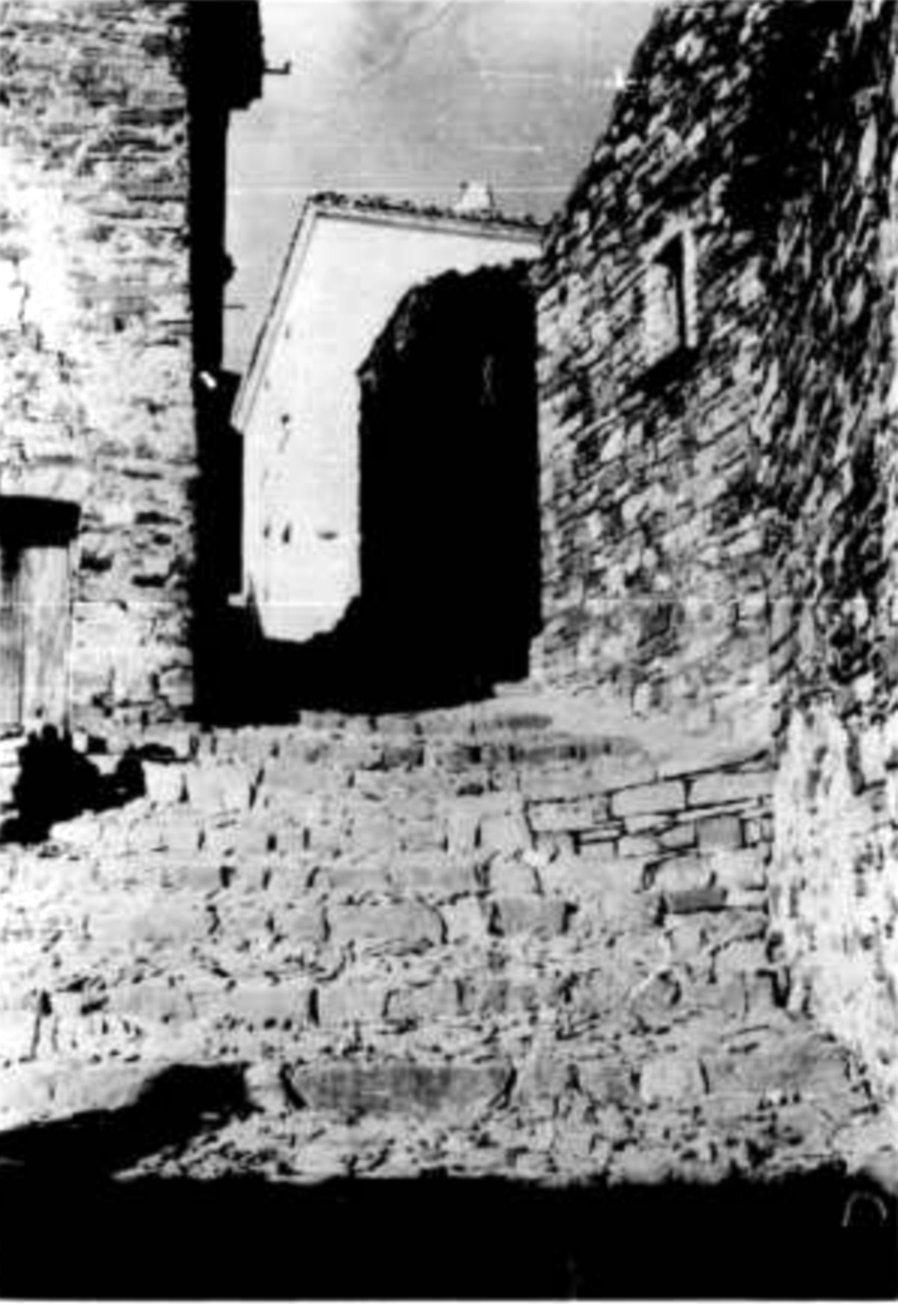
A village elder pointed out that their houses are constructed in rectangular form, the outer walls being very rough because they have not been plastered with cement mortar. (See Figure 13.) These are unlike any other houses I saw in Italy. The elder mentioned that this was the only type of construction in the villages and that it had been brought over by the early Albanian inhabitants. There is no way of verifying this rather vague claim; more likely, this type of construction is due to poverty of the village.
The differences in dress and the use of Albanian words will be discussed in a later chapter.
p. 34Chapter 8Italian Culture of the Italo-Albanians
Although the Italo-Albanians in Calabria, Lucania, and northwestern Sicily retain certain Albanian characteristics, which will be discussed in the following chapters, they are in many ways similar to the Italians of southern Italy. The similarities either have been adopted from the Italians or are practices familiar to inhabitants of Mediterranean lands. For example, there is no visible distinction in the house types,49 the land use, or the staple diet, and the clothing worn by all the men and many of the women is also similar.
House Construction
The large majority of the houses in Italy are constructed of stone and roofed with red clay tiles. (See Figure 14.) The use of this type of building material is a result of a scarcity of lumber. Every village has a quarry nearby, where stone is obtained, and there is widespread manufacture of clay tiles. These construction materials are not unique to southern Italy alone but can be noted in Albania, as well as throughout the whole northern part of the Mediterranean shoreline.
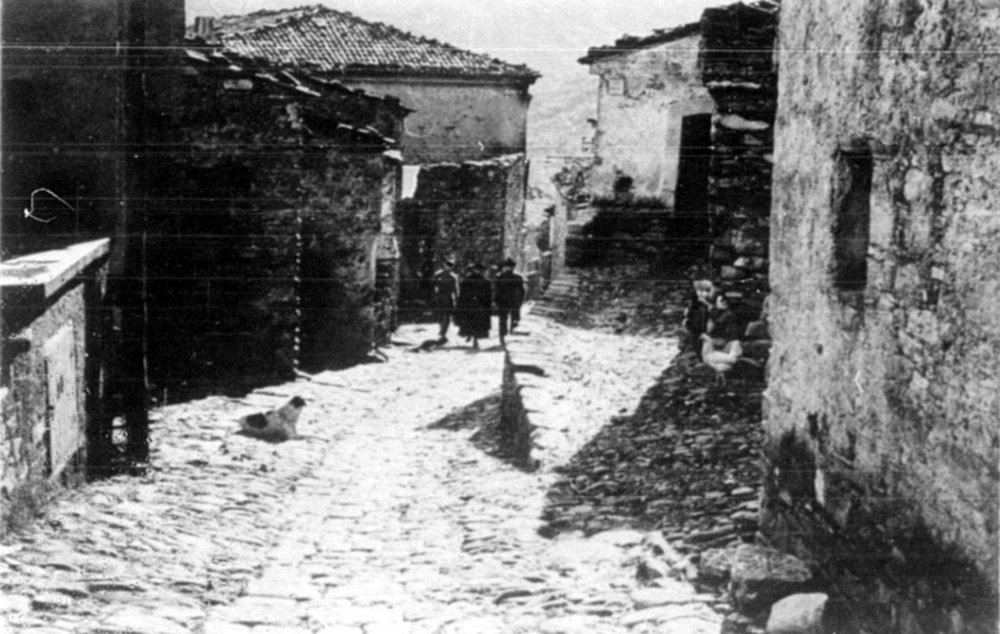
p. 35 Another characteristic of the majority of these houses is that the exteriors are cement-plastered. (See Figures 14 and 15.) Exceptions can be noted in the dwellings in the Italo-Albanian villages of Castroregio, Plataci, and Falconara Albanese, where most of the houses are not cement-plastered. Otherwise, no distinction can be made between construction of houses in Italo-Albanian and; Italian villages. The physical environment of the areas bordering the Mediterranean Sea has brought about this similarity of house types.
Agricultural Practices
Another evident similarity between the Italo-Albanians and Italians is land utilization. The Albanians have never excelled as farmers. Their chief agricultural practices in earlier times were the rearing of goats and sheep, with little effort put into the raising of crops. A large percentage of the Albanian male population was employed in military service, and tilling of soil was a task assigned to the females. Some of the early accounts of the arrival of the Albanians in southern Italy indicate that the males turned from military pursuits to banditry,50 but after
they were suppressed by punitive expeditions they became tillers of the soil.
The crops they grow now do not differ from those of the Italians; the staple crop is winter wheat, and the second most important crop is the olive, which in many cases occupies the same piece of land as winter wheat. At lower elevations, citrus fruit is raised on land belonging to the village, and a variety of vegetables grown near the farmhouse. (See Figures 16 and 17.)
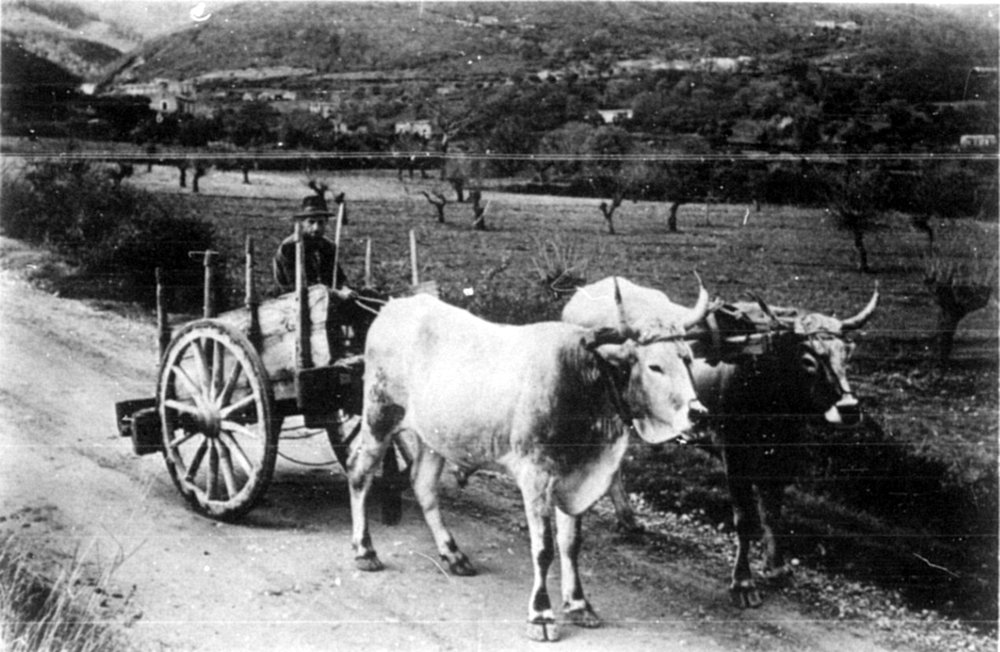
The farm animals are the same as those of the Italians; the soil is tilled by a large, white ox; the pack animal is a donkey. (See Figures 18 and 19.) Many families
SOpouglas, op. cit., pe 37.
keep pigs, which are the source of animal protein throughout southern Italy. All these agricultural practices are similar to those of the Italians. I sought for some unique agricultural practices in these villages, and the only unique thing that was pointed out to me was the pack saddle on the donkey in the six villages on the northern margin of the "Sila Greca." The saddle has cross arms on either end
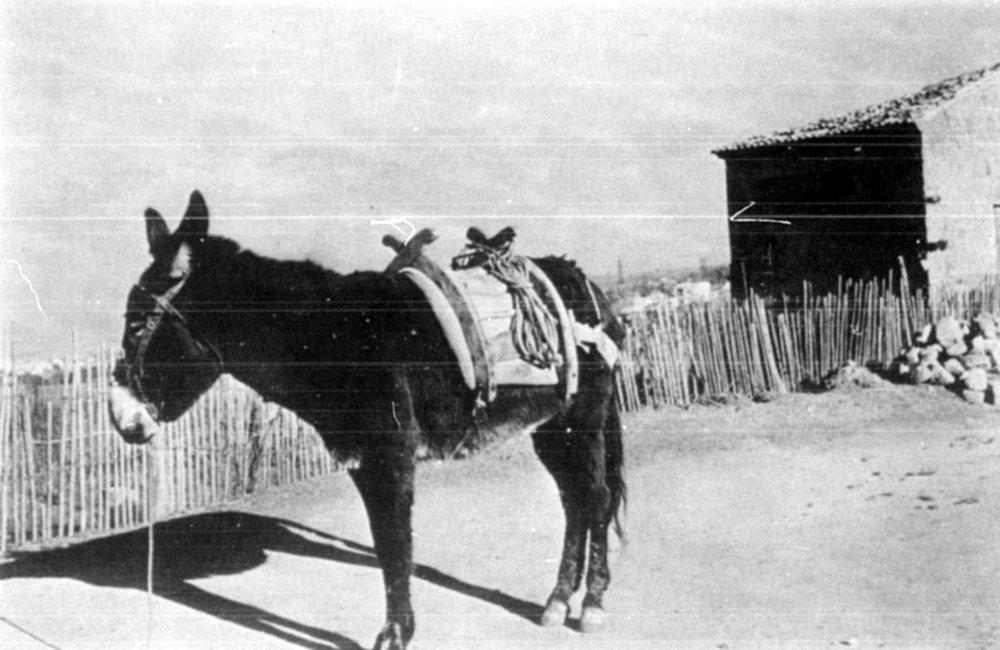
which are used for lashing down bags of grain; this feature is absent from the saddles of the Italian villages. The villagers claim that this innovation came with the settlers from the Morea.
p. 38 The similarity in agricultural practices is in great part due to the similarity of the natural environment of Albania and southern Italy. Even though farming was not one of the chief occupations for the Albanian male, he experienced no great difficulty in adjusting to it when farming became necessary for his survival. Today, the agricultural practices of the Italo-Albanian are the same as those of the southern Italian.
Europe is the home of a large number of minority groups whose origins are obscure, but one of the striking features about them is the holiday dress worn by both men and women. Since the end of World War I, there has been a gradual disappearance of native costumes in all but remote areas. Even in remote areas native costumes are worn mostly to attract tourists.
In the Italo-Albanian villages of southern Italy, men have abandoned wearing of costumes altogether. From the hat to the shoes, there is no distinction in dress between Italian and Albanian males. The Albanian soldier who arrived in southern Italy during the days of Scanderbeg wore a distinctive costume; if he was a "Gheg" (northern Albanian), he wore rather tight breeches and a waistcoat; if he was a "Tosk" (southern Albanian), he wore a "fustanella" (a white pleated skirt) and a waistcoat. Nothing that even resembles these early costumes remains today; not even on festival days do the men dress in costume. It is difficult to determine exactly when the native dress disappeared; however, books written during the early nineteenth century show sketches of Italo-Albanian males in the dress of southern Italians. The first migrants to southern Italy had hoped that some day they would return to Albania, but when this hope faded they began to adjust their ways to the land in which they lived. It was during this time that they began also to adopt the dress of the area.
In female dress there are both similarities and differences; in most villages the Albanian women wear dresses that do not differ from the styles worn by the Italian women. Yet, costumes and native everyday dress can still be seen in these villages. The survival of this characteristic will be discussed in a later chapter.
The adoption of Italian dress has spread with increased contact with the Italians. The younger women in these villages are the first to adopt Italian dress, while the older ones still retain the old everyday costume. Generally, it can be said that the majority of the women wear Italian dress, but in varying degrees the Albanian costume can be noted in all these villages.
Loyalty to Italy
After remaining some 500 years on Italian soil, it is natural that the Albanians should be concerned more with the political activity of Italy than with that of Albania. The establishment of Turkish rule caused the Albanians to become resigned to the fact that there was to be no sudden return to Albania. The change of ruling house in Italy or changes in the fortunes of political parties affected these people just as much as it did the Italians. The Albanians have also overtly expressed their loyalty to the various governments in Italy. This was shown by the willingness of the Albanians to serve in the armed forces and their aid in the revolt started by Garibaldi.
p. 39 From the seventeenth to the nineteenth century, an Albanian regiment served under the King of Naples, and fought in the Napoleonic Wars. It was disbanded in the early nineteenth century by the Bourbon king, Ferdinand.51 This royal house was not liked in Italy because of its foreign origin and its conservative ways. The village of San Benedetto Ullano has a local hero, Agesilao Milano, who gave his life in an attempt to assassinate the Bourbon king in 1848.52 This illustrated the extent to which the Albanians had become concerned with the political events of Italy.
The overt act by Agesilao Milano was not motivated solely by a desire to see Italy freed of foreign rule. It was also motivated by the actions of the Bourbons who were attacking the teachings of a liberal institution, the Collegio Italo-Albanese Di S. Adriano. (See also pp. 44-45.)
The liberal teachings of this institution were counter to the ideas of the House of Bourbon, which had returned to power and restored some of the feudal institutions. The Bourbons referred to the college as a "House of vipers in the midst of our bosom."53 These Bourbon attacks did much to alienate the students (Agesilao Milano attended the "Collegio") and the Italo-Albanians, in general, who were proud of this institution. The Bourbons were not able to close the college because it was supported by the papacy.
One other overt act, which indicates the engrossment of the Albanians in Italian politics, occurred in the summer of 1860. Garibaldi had just overthrown the Bourbon throne in Sicily and had begun his march on Naples through Calabria. As his forces passed through the Crati River valley, the student body of the "Collegio" joined up en masse.54 Garibaldi issued a decree individually praising the student body for its action and the service which it had performed.55 This action showed that the Italo-Albanians were just as interested as the Italians in freeing Italy from Bourbon rule.
During World Wars I and II, many Italo-Albanian soldiers were sent to Albania. The Italian government felt that the presence of Albanian-speaking troops would tend to create better relationships with the people. During World War I, an Allied force composed of French and Italian troops was in Albania, serving mainly as an occupation force. In 1939, Fascist Italy invaded Albania and made it part of the Italian Empire. In both instances, the Italian government launched propaganda
SisScaglione, op.cit., pp. 15-16. p. 40 campaigns pointing out that there were a great many similarities between the Albanians and the Italians, and that both areas should be united and go forward toward a common destiny. This propaganda was effectively backed up by the presence of Albanian-speaking troops who remained loyal to the Italian government.
No Italo-Albanian troops defected in Albania, or expressed a desire to remain in that country. These troops remained loyal to Italy; those who were proficient in Albanian were used as interpreters.56
I had many excellent opportunities to ask questions of the Italo-Albanians who served in Albania. In every village I visited, I met former soldiers who had served in Albania during World War II. As far as the greater part of them were concerned their reactions towards serving in Albania and toward the Albanians was about the same as those of American occupation forces stationed at an undesirable foreign post. They indicated that the standard of living was low in Albania, that the attitude of the Albanians was unfriendly, and that they experienced difficulty in understanding the native language.
Nevertheless, a certain bond does exist between the Albanians of southern
Italy and Albania, as the Italo-Albanians are aware of their past history. The extent to which this bond exists will be noted in the following chapter.
Present-Day Political Alignment
The main political concerns of the Italo-Albanians are those which directly affect them; there remains only a distant interest in the affairs of Albania. Since the end of World War II, there have been four national parliamentary elections in Italy. The voting pattern of the Italo-Albanian villages does not differ from that of the Italian villages. Prior to the end of the war, this area remained loyal to the conservative party, but disillusionment began to set in because much- publicized reforms did not materialize. Ever since Mussolini's regime the poverty-stricken agricultural worker of southern Italy has been promised a brighter future. Among the agricultural workers were the Italo-Albanians, whose lot was equally as miserable as that of the Italians. For a while, the Fascist government was able to divert the people's attention from their misery by an extensive roadbuilding campaign and token efforts at land reclamation. For example, the Sibari Plain was drained during the Mussolini regime, and beef cattle were brought into this reclaimed area. After the downfall of Fascist Italy, the economic situation deteriorated; Italy was suffering from a financial crisis and unemployment was higher than ever.
The newly formed postwar government appealed to the agricultural group because reconstruction plans of the government included a land-reclamation project. This project planned to do away with one of Italy's greatest agricultural evils, absentee landlordism. Southern Italy (known as the "Mezzogiorno") has an economy based solely on the agrarian way of life, but the majority of the farm workers have p. 41 always been either landless peasants who lease land, or day laborers. The new Italian government began to draw plans that would revitalize the agriculturally based economy of southern Italy. This meant not only assigning land to the landless farmers but also introducing modern methods of agriculture,57 This projected reform was to have some effect on the Italo-Albanian villages because several of the estates that were designated for expropriation adjoined land of the villages.
The land-reform program naturally became a political issue. It can be noted that political reaction in the Italo-Albanian villages did not differ from that in the Italian villages. In the national elections of 1953, the Italo-Albanian villages of the "Mezzogiorno" indicated that they were through with the Monarchist party and that they did not care for the slow progress of the coalition government headed by the Christian-Democrat party; all the Italo-Albanian villages of Calabria voted for the Communist Party of Italy (with the exception of S. Giorgio Albanese, Spezzano Albanese, and S. Martino di Finita, which have Christian-Democrat mayors). To avery large degree, the show of Communist strength in these villages is an indication of the people's protest against the government's inaction.
The various land-reform projects have progressed in the "Mezzogiorno," but the Communist Party has gained a foothold in this area and its leaders retain the support of large numbers of people who have not received the benefits of the reform programs. Since the problems that affect the southern Italians are the same as those that affect the Italo-Albanians, the political expressions of the Italo-Albanians do not differ from those of the southern Italians. The Italo-Albanians did vote the Communist line in the 1953 election, not because their ancestral brethren lived in a Communist-controlled country, but because they wanted to protest against the inactivity of the present government.
p. 42Chapter 9Ethnic Survival of the Italo-Albanians: Linguistic Factors
Because of the remoteness of the Italo-Albanian villages in southern Italy, it was not really known whether the Italo-Albanians had survived as an identifiable group.58 58 However, after making contact with them and gaining their confidence, one finds that, under the Italian facade, their Albanian characteristics become quite evident. Although during their 500-year stay in Italy the Italo-Albanians have become assimilated to a certain degree, southern Italy has provided them with a sanctuary where they continue practices that distinguish them from the Italians. This is true of the Italo-Albanian villages of southern Lucania, northern Calabria, and northwestern Sicily.
The Albanian characteristics in these villages are evident in the existence of special terms to designate the Italo-Albanians, the use of the Albanian language, retention of the Greek Orthodox rite, certain customs and traditions, and women's costumes. This chapter will deal with the linguistic evidence.
Terms Designating the Italo-Albanians
Both the Italians and the Italo-Albanians make use of special terms to designate the Italo-Albanians. Without exception, Italians living in the vicinity of Italo-Albanian villages refer to them as "Ghegi" villages and to their inhabitants as "Ghegi;" the northern Italians refer to them as "Italo-Albanese." The origin of the term "Ghegi" is not exactly known, but it probably came into use during the middle of the fifteenth century when Albanian mercenaries were being used by the viceroy of Naples. Some of these mercenaries were "Ghega" (northern Albanians), who settled in villages in southern Italy. After the revolts were put down, these Albanian mercenaries committed acts of brigandage and were feared and distrusted by the Italians. This distrust is illustrated by the following popular saying about the "Ghegi" reported to me by an Italian in Cosenza: "If one comes upon a "Ghegi" and a wolf simultaneously in the woods, shoot the "Ghegi" first because he is more dangerous." However, the term "Ghegi" as now used merely refers to Italo-Albanians and not to a group of brigands and robbers.
The Italo-Albanian makes a point of distinguishing himself as an "Arberesh" (or "Arbresh") and refers to the Italian as a "Latino." On a trip to the village of S. Sofia d'Epiro I gave a ride t> two men, one an Italo-Albanian and the other p. 43 an Italian. I was not aware of this at first, but during my conversation with the Italo-Albanian, he told me that the other man was a "Latino."
The Italo-Albanian paints a worthy picture of himself. He says the Italo-Albanians are more intelligent, industrious, and honest than the "Latinos." He describes the "Latino" as being unscrupulous and not to be trusted. This attitude is revealed in a popular saying: "If a 'Latino' comes to your door and he is cold and hungry, let him warm himself by your fire and feed him, but do not believe a single word he says." There is some indication that a greater dichotomy once existed between the two groups, but now there is merely a slight mutual suspicion.
The term "Arberesh" originated in Albania and is still used by some southern Albanians, although the name "Shqipetar" is becoming popular. The name "Arberesh" is believed to be of Norman origin. When the Normans arrived in Albania during the thirteenth century they called the region "Arborea," and referred to the people as forest dwellers.
The continuing use of the terms "Ghegi" and "Arberesh" sets the Italo-Albanians apart as a separate and distinct ethnic group.
Use of the Albanian Language
The Italo-Albanian of southern Italy is bilingual, speaking both Italian and Albanian. If he went to school, he was taught Italian, and he uses Italian in mixed groups or in places where a common medium of expression is needed. Among his own kind—in the villages, the church, the club, or the home—Albanian becomes the common medium of expression. The language is spoken by all age groups, from the youngest child to aged persons, and is used as a common medium among all Italo-Albanian villages in southern Italy. While it is difficult for a "Calabrese" to communicate with a "Siciliano," it is easy for an Italo-Albanian from S. Demetrio Corone to converse with one from Piana degli Albanesi. In January 1958, I traveled to Piana degli Albanesi with Professor Alfredo Braile of S. Demetrio Corone. We stopped in a store in Palermo, and the proprietor had a difficult time understanding the professor, and vice versa. In Piana degli Albanesi, the conversation flowed freely again because of the sameness of tongue. The survival of Albanian as the common medium of expression can be attributed to several factors
besides physical isolation: lack of adequate educational facilities, the home-bound life of the women, and the intangible factor of the people's desire to retain their language.
Lack of Educational Facilities
The past lack of schools has helped in the survival of the Albanian language. Only since the end of World War II have the schools been established in practically all the villages in northern Calabria. (Castroregio and Plataci have only nursery schools.) The absence of schools naturally led to a high rate of illiteracy; in 1931, it was estimated that about twenty per cent of Italy's population above ten years was illiterate.59 The inadequate educational facilities allowed greater use of Albanian because the people were not able to read Italian books, newspapers, or magazines.
p. 44 Today, educational facilities have been improved. A new school building has been erected at Spezzano Albanese, and one is being constructed at S. Demetrio Corone. These buildings are designed to accommodate ali the village school children up to the age of twelve. If further education is desired, and if the family can afford it, the student tries to enter the Collegio.
The Italo-Albanians have only one advanced educational institution, the Collegio Italo-Albanese di S. Adriano,60 which is located in S. Demetrio Corone. (See Figure 20.) The school was founded in 1732 for the express purpose of providing higher education for children of Albanian descent. Felice Samuele Rodota, the first Italo-Albanian bishop of the Greek Catholic rite, founded the school and held classes in S. Benedetto Ullano.61 Like most institutions of higher learning at that time, it was supported by the church, the students receiving instruction about the Mass according to the Greek rite,62 The Collegio was moved to S. Demetrio Corone in 1794 under the guidance of one of the succeeding bishops, Francesco Bugliari, and was housed in the Basilian monastery of S. Adriano.63
One of its distinguished students was Girolamo De Rada (1814-1891), who became one of Italy's famous poets and did much to further the use of the Albanian p. 45 language in this area. He devised an Albanian alphabet and published an Albanian newspaper in the city of Cosenza.64 He wrote many poems and articles about the history of Albania, George Castriota, and the Italo-Albanians. Castriota's spirit is kept very much alive in the Italo-Albanian villages and in the Collegio.
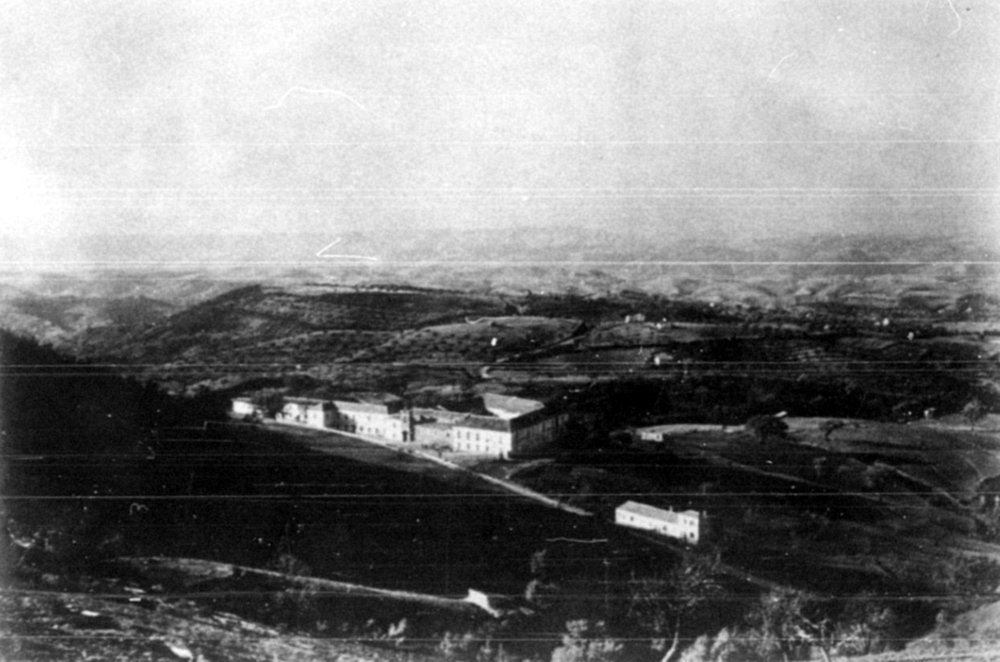
This school, the only institution of higher learning in these villages, has been referred to as one of the "hearths" that keeps the Albanian spirit alive. The students today are a mixture of Italo-Albanians and Italians. The curriculum, still taught along the classical lines of the days when it was founded, serves to make the students aware of the past history of the region and the founders of the villages. Even though the Albanian language is not taught, many of the professors are clergymen or laymen who have grown up in these villages.
Influence of the Home
The Italo-Albanian does not acquire his language through formal education because there are no schools that offer courses in Albanian. He learns the language in the home, chiefly from his mother. The women are housekeepers and do not compete with the males for any other occupation. Besides taking care of the house, they are expected to help with some agricultural activities, but their major responsibilities are housekeeping and child-rearing.
While the male of the household is away from the house all day, engaged in his occupation, the woman is at home performing her household tasks and taking care of the children. The woman's position is such that she rarely comes into contact with any people other than those of her village. Her language is generally a purer form of Albanian than that spoken by the men, and it makes use of fewer alien words. She talks to her children in Albanian, and sings Albanian lullabies to them that have been handed down from generation to generation.
Many of the lullabies are epic poems telling the story of Albanian heroes who lived before the time of the migration. Many of these epic poems have been collected by the educated people of the village and published in Italian. Girolamo De Rada had many of these poems published in both Albanian and Italian. Padre losif Ferrari of Frascineto, who teaches Albanian at the University of Bari, recently published in Albanian a collection of poems which the villagers chant during the Mass,65 Another clergyman, Emmanuele Giordano, has collected some epic poetry, and has recently published a pamphlet that includes the story of "Kostandini," which every Italo-Albanian child has heard. This pamphlet is printed in both Italian and Albanian.66
Other lullabies tell the story of "Beautiful Morea," which is a lamentation for their homeland,67 It is through the mother that the children first become aware of their Albanian heritage; this is a factor that distinguishes them from the Italians p. 46 in the region. It is also from the mother that the children hear about the legendary heroes of Albania, and the foes whom they supposedly fought. They hear especially about George Castriota (Scanderbeg), a real hero, and they learn how he successfully defeated the "Terrible Turk," (See Frontispiece,) There is not a child in these Italo-Albanian villages that is not familiar with the exploits of Castriota and how he kept Albania free from the Turk for 40 years. All this awareness of their past comes largely from the home; it has been handed down by word of mouth from generation to generation.
The continuing use of the language has contributed to a large degree to the intimacy of the home, because a common, written Albanian alphabet was not universally accepted until the late nineteenth century,68 The Albanian that is now spoken in these villages is an archaic form and not the modern Albanian presently spoken in Albania.
Desire to Retain the Language
Among foreign groups, such as the Italo-Albanians, there generally arises a desire to preserve their heritage. The most distinctive characteristic of the Italo-Albanians is their language, because this is their common medium of expression, A person may travel from one Italo-Albanian village to another where he is a total stranger, but from the moment he speaks a few Albanian words he is accepted as a brother.
In October 1957, I traveled to S. Demetrio Corone with only a letter of introduction to Professor Demetrio Mauro, Prior to this I had never met an Italo-Albanian and was apprehensive about the manner in which I would be received. My first few words to Prof, Mauro were in Italian, and he regarded me skeptically, I asked him in Albanian if he spoke Albanian, and he immediately replied, "We are of one blood," Because of our common background, the hospitality and aid that I received from him is immeasurable. The language is a common bond, and if the language is lost, the feeling between villages becomes distant. When I took a trip to the Italo-Albanian villages in the province of Taranto with Professors Mauro and Braile, both expressed disappointment that the people had lost their Albanian tongue. They referred to them as "lost Albanians," and it was evident that a common bond had disappeared.
The desire to keep the Albanian language alive has been expressed through actions by the educated people of the village. When Girolamo De Rada was living inS. Demetrio Corone, he taught Albanian, but today no such classes exist for children of elementary school age in any of these villages. At the University of Bari, Padre Ferrari conducts a class in Albanian for any student, Italian or Italo-Albanian, who desires to learn the language. Classes were held in some of these villages in the pre-Fascist days but, as the Fascist movement increased in strength, they were discouraged by the government.
p. 47 The desire to retain the language remains foremost in the minds of the Italo-Albanian intelligentsia, who find this link with the historical past interesting and unique. The majority of the people use their common language in communication with the inhabitants of other Italo-Albanian villages. The strength of this majority group is bound to decrease as Italian is introduced in modern mass media. Several generations will have elapsed before this takes place, however, because the Albanian lullabies and epic poems will still be remembered by many, and loyalty to one's native village remains steadfast. The desire to retain a language is an intangible factor and can be fully appreciated only by a foreign group experiencing the disappearance of this common bond.
p. 48Chapter 10Influence of the Greek Catholic Church
Religion is another factor that helps to distinguish the Italo-Albanians from the Italians, but this is not a conclusive factor because, of the villages that are distinctively Albanian, 24 practice the Greek Catholic rite and 23 practice the Roman Catholic rite.69 However, the Greek Catholic clergy has been closely associated with the Italo-Albanians, while the Roman Catholic clergy has not interested itself in affairs that are distinctively Albanian. It is not just coincidence that in certain villages, such as those in the provinces of Taranto and Lecce, where the clergy are Roman Catholic, the Albanians have lost their identifying characteristics, while in the villages where the Greek Catholic clergy are installed the Albanian characteristics have prevailed.
The origin of the practice of the Roman Catholic rite among the Italo-Albanians is not entirely clear. The Venetian Republic did have control of the port city of Durrés (Durrazo) until the conquest of that area by the Ottomans, but it is not certain whether or not the cause of Roman Catholicism was furthered during Venetian rule. It is certain, however, that before and up until the conquest of Albania by the Ottomans, the Eastern Orthodox rite was practiced by the Albanians. (Later many became Moslems.) It is suggested that those who arrived with the earlier migrations "perhaps found it politic to profess their union with the Pope when they arrived in Italy."70 It was not easy for a schismatic group to live in Italy at this time and to practice their rituals without being regarded suspiciously. It is also possible that the early arrivals were already Roman Catholics because this group originally came from the region of central and northern Albania which was already under the influence of the Venetian Republic.
Many of the other Italo-Albanian villages adopted the Roman Catholic rite at a much later date. The adoption was not of their own volition but stemmed from necessity. A few generations after their arrival in southern Italy, there remained very few Greek Catholic clergymen, and parishes that were previously of this rite became staffed by clergymen of the Roman Catholic rite.71 p. 49 Another factor that helps to explain the nearly equal division of these two rites among the villages is that the Greek Catholic rite had no bishop until 1732. In 1732, Pope Clement XII appointed Felice Samuele Rodota as the first bishop of the Greek Catholic rite. The powers of the bishop extended only to those churches that practiced the Greek Catholic rite, but, if parishes that were formerly Greek Catholic had become Roman Catholic and now desired to return to the Greek rite, the bishop had the right to appoint a priest of the Greek rite. I visited two churches where this change had taken place; 5. Athanas church in S. Sofia d'Epiro and S. George's church in S. Costantino Albanese. In both instances, the returning Greek Catholic clergy renovated the interior of the church and erected an Eastern Orthodox altar.
Many of the villages that adopted the Roman Catholic rite failed to return to the Greek; these included six of eleven villages in the region of the Coastal Range. The Mass in these villages is recited in Latin, and many of the religious customs are not carried on by the Roman priests because of their ignorance of local ways. In losing some of these customs, these Italo-Albanians became more Italian than the villagers who had priests of the Greek rite.
The Greek Catholic Rite
When the Byzantines occupied southern Italy during the ninth and tenth centuries, the Basilian monks established many monasteries throughout this region. One of their saints, S. Nilo, established the monastery at Grottaferrata in the tenth century.
Today there are two monasteries where young men from Albanian villages can train for the priesthood. One is the Badia di Grottaferrata (See Figure 21.) , which is near Rome; the other is the Italo-Albanian college located in Piana degli
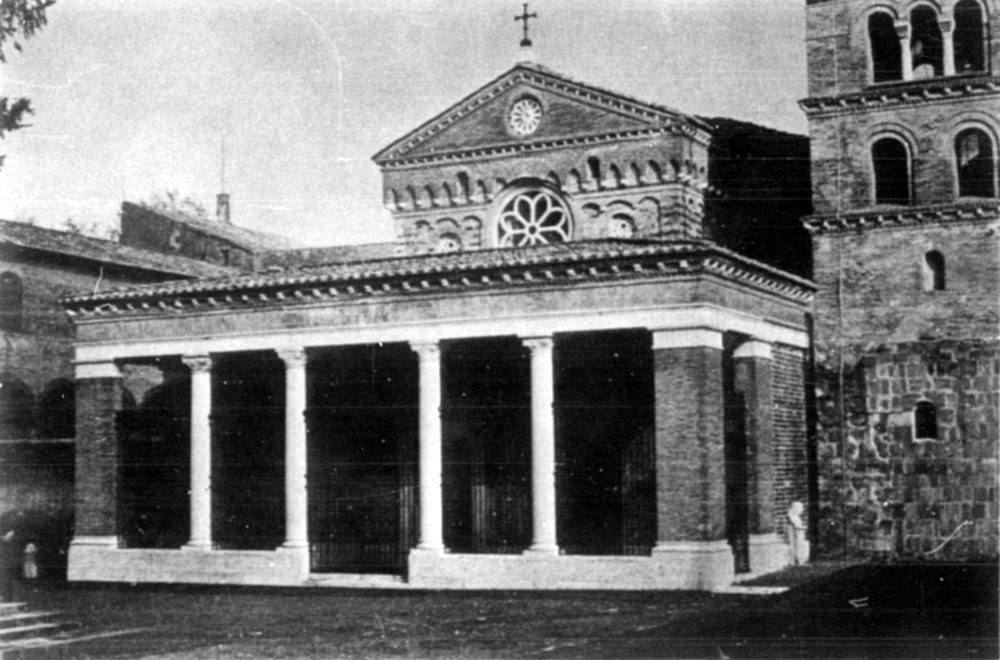
Grottaferrata, a SSS el SSS SS SS
p. 50 Albanesi. There are also two bishops of the Greek Catholic rite, one in charge of the diocese of Lungro (Cosenza), the other of Piana degli Albanesi (Palermo).72 The principles taught to the clerical aspirants were founded by St. Basil. The language used for the Mass is Greek. Not all the young boys entering this monastery come from the Italo-Albanian villages, but they are in the majority.
Because of its close surveillance by Rome, the Greek Catholic rite has adopted some Latin features; yet it has retained many characteristics by which it can be distinguished. These characteristics are seen in the various parishes that are found mainly in the Italo-Albanian villages.
Clothing of the Clergy
The members of the Greek Catholic clergy wear clothes identical to those of the Eastern Orthodox rite. (See Figures 22 and 23.) The distinctive feature of their daily clothing is the tall black hat that resembles a top hat. Both priests and monks wear the hat, but the monk's headgear lacks the extending lid that is present on the priest's. The rest of the daily garb is identical to that of the Latin clergy in Italy, who wear long black gowns. (See Figures 24 and 25.)
The vestments worn during the Mass are also identical to those used in the Eastern Orthodox rite. The chasuble is of gold and green brocade, and the back of the cape has a large golden cross embroidered on it. The vestment used in the Greek rite differs from that used in the Latin in that it is more of a robe that covers
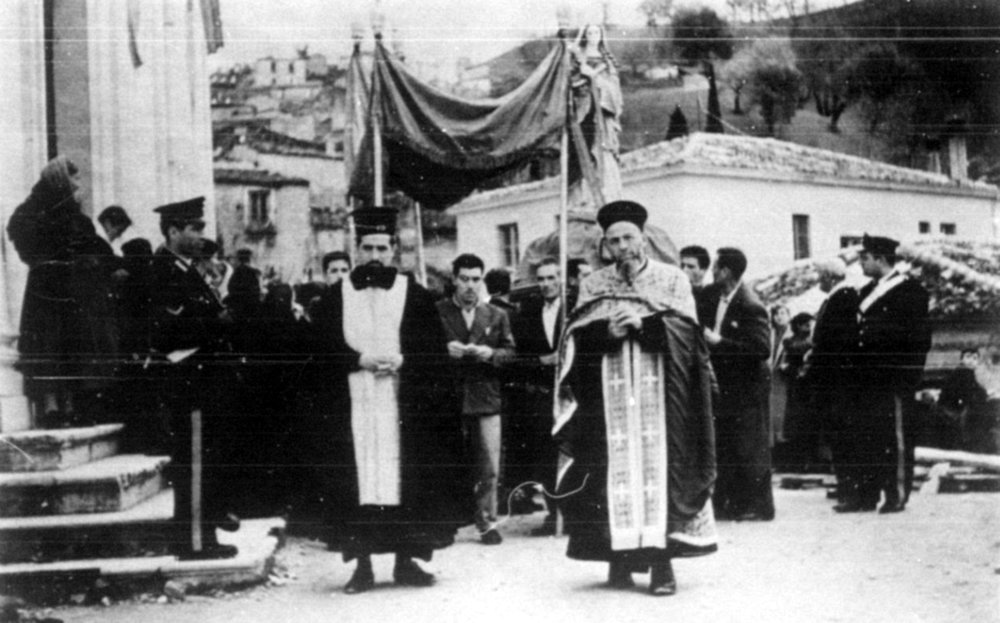
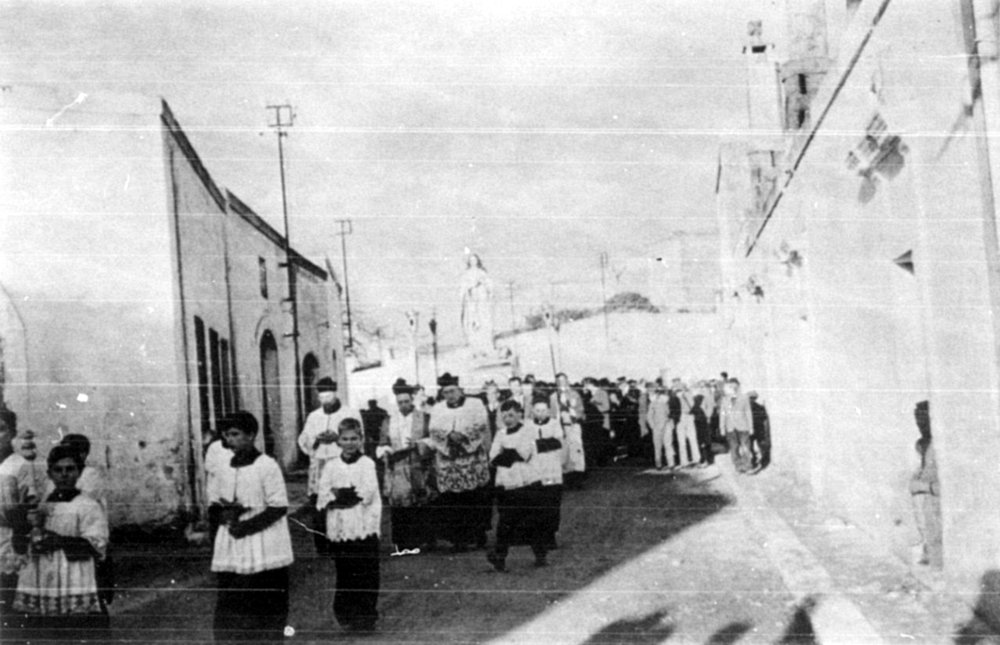
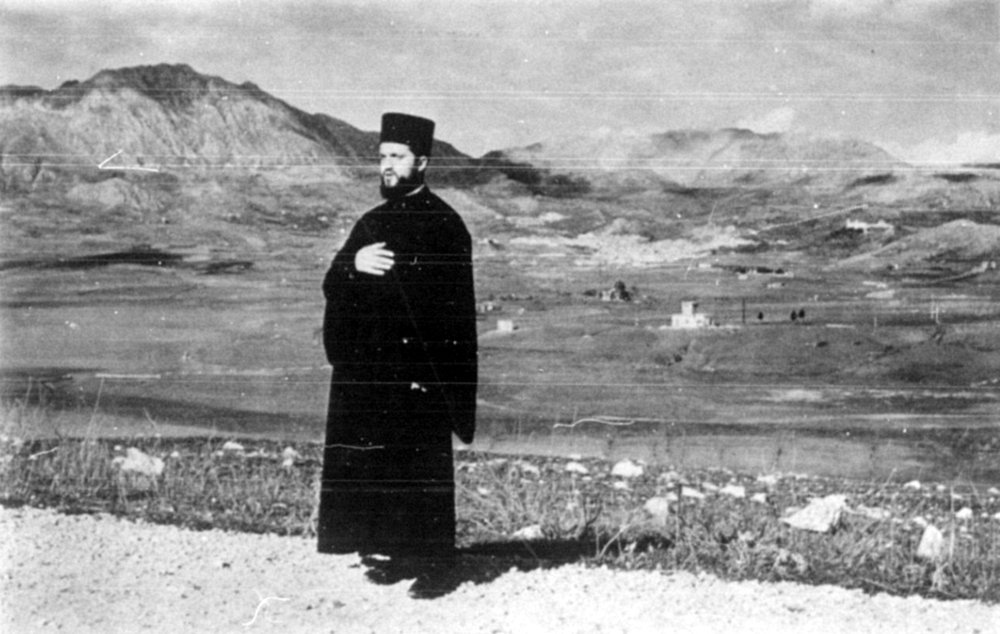
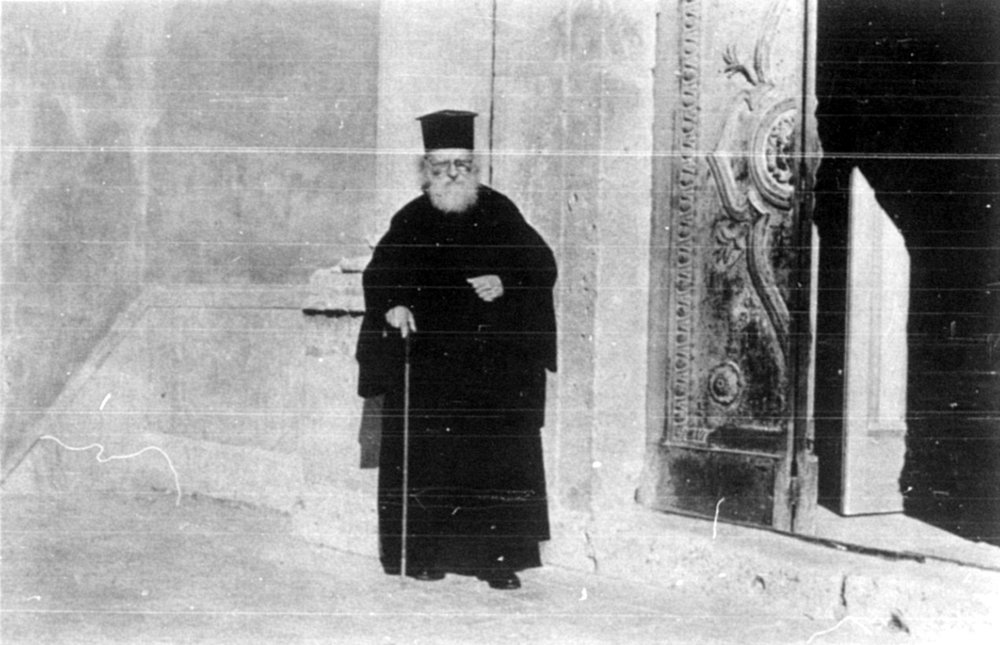
the shoulders and does not cover the front part of the body. These vestments are of Byzantine origin, and their use has been continued by members of the Greek Catholic clergy.
Marriage of the Clergy
In the beginning of the twentieth century, many of the Greek Catholic clergy were married and had families. This practice also had its origin in the Eastern Orthodox rite. In the Greek Catholic church the priests, but not the monks, are allowed to marry. Married clergy cannot be elevated to the rank of bishop. The practice of marriage among priests was frowned upon by Rome, and in 1928 Pope Pius XI issued a strong request that priests not marry. Even before the issuance of this request, many of the Greek Catholic priests were not marrying, and the general feeling among the Italo-Albanians/ and the Greek Catholic clergy is that priests should not marry. Today, there are only two married priests of the Greek Catholic church, both in Sicily. Both of them were married before they were ordained as priests. It is also the accepted custom that married priests should wear street clothes after they have performed their priestly duties. The number of married priests has been gradually reduced, and the present Greek Catholic hierarchy does not encourage married males to train for the priesthood.
Wearing of Beards
One of the most obvious distinctions of the Greek Catholic clergy is the wearing of beards. Formerly, it was obligatory among all members of the clergy, but now this order is not strictly enforced. This practice is also reminiscent of the Eastern Orthodox clergy and differs from that of the Latin clergy, who are predominantly smooth-shaven. Even though this rule is not strictly enforced, I saw only two priests that were clean-shaven, and both were young.
p. 53Interior and Exterior of the Church
The interiors of the Greek Catholic church are decorated in a style that resembles that of Eastern Orthodox churches. While the Latin churches make liberal use of statues placed throughout the church, the Greek rite has only one or two statues; one is that of the patron saint. Also, by means of inconostasis (partitions), the altar is separated from the congregation. It is behind the iconostasis that the priest prepares the communion and then brings the wine and bread to the communion recipients.
The exterior styling of the Greek Catholic churches does not differ from that of the Latin rite churches. (See Figure 26.) With few exceptions, no great emphasis has been placed on the styling of the small village churches. Many of these were constructed when the clergy were of the Latin rite and did not concern themselves with the aspects of the Greek rite. The highest point in the exterior of the Eastern church is the part above the altar, while in the Latin churches it is usually at the front entrance.
When a clergyman of the Greek rite was appointed to a parish in which the church had been built during the stay of a Latin priest, the Greek clergyman usually busied himself with changing the exterior styling if possible. (See Figure 27.) The altar would be placed beneath the highest point of the church, and facing toward the east. A new front entrance at the eastern side of the church would also be built. Statues would be removed and the walls and ceilings adorned with paintings of the Madonna and saints in the Byzantine style. I have seen two churches that are undergoing a rather complete restoration. One is the Greek Catholic Cathedral, La Martorana, in the city of Palermo. The other is located in the village of S. Costantino Albanese. In the latter, an eastern entrance was constructed and the position of the altar was changed so it would face east.
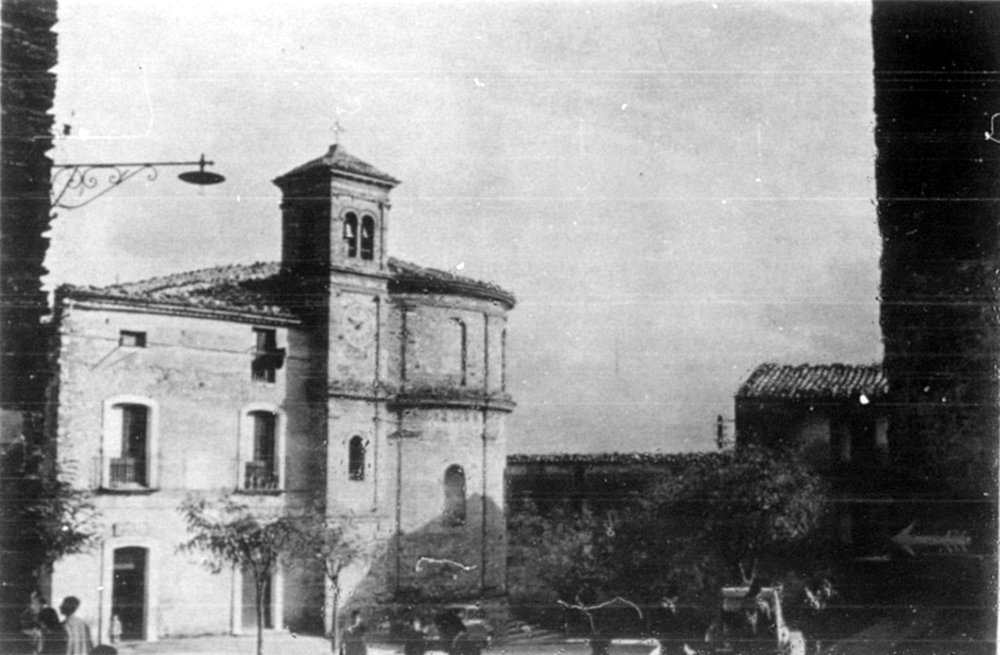
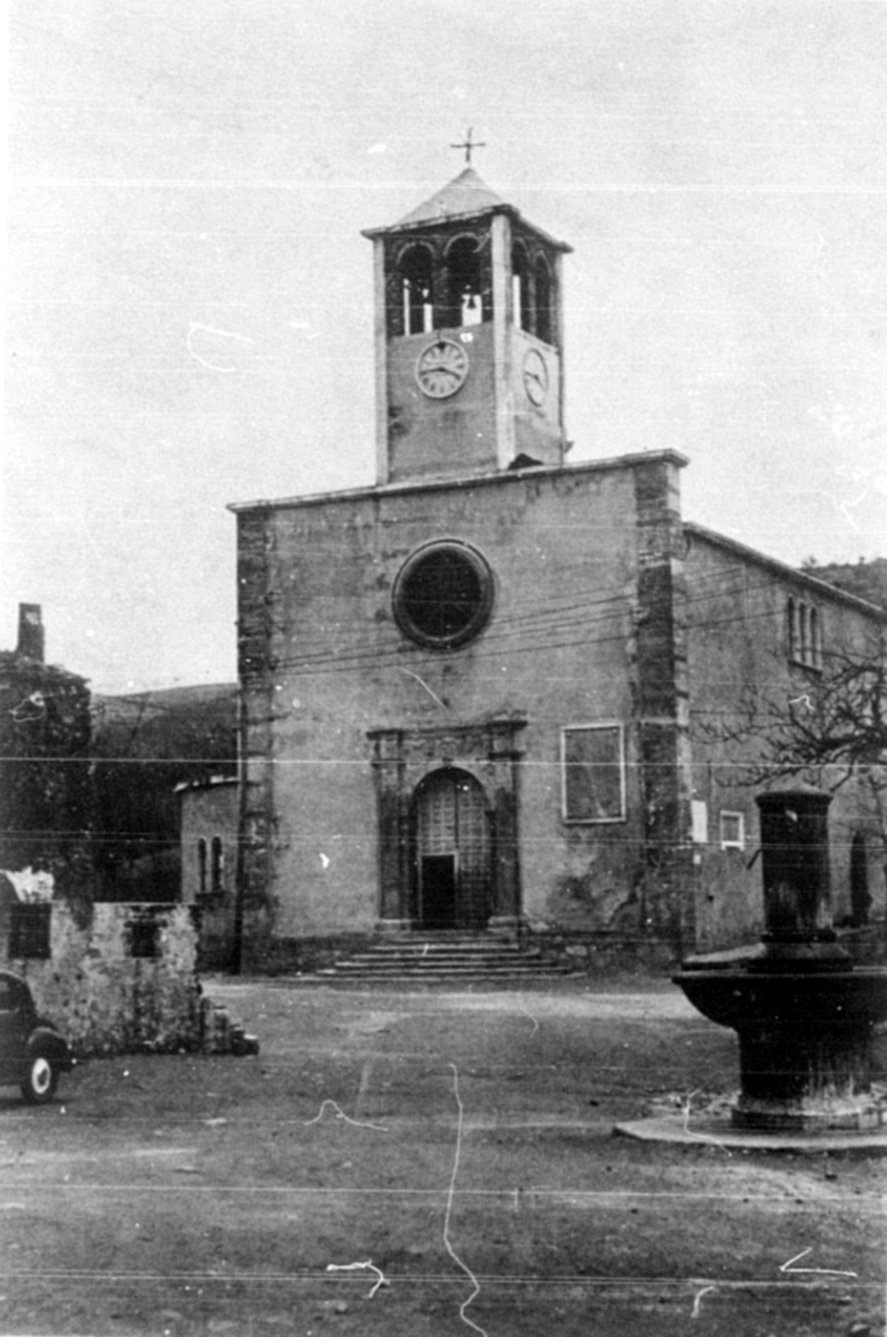
Such alterations are accomplished through the efforts of the Greek clergy and fulfill the desires of the people, who wish familiar surroundings. In many cases, the lengthy stay of the Latin clergy has removed these desires.
The Mass
The Mass of the Greek Catholic church is said in Greek, differing from the Latin service of the Roman Catholic church. Another difference is that the worshippers participate in the mass by uttering the responses in unison in Greek. The worshippers memorized the responses when they were children; their teachers were either nuns or monks. In some parishes, the priest recites the Mass in Albanian, and some of the older members give the responses in Albanian, in Piana degli Albanesi, I heard the Mass recited in Albanian by a monk, P. Sofrone Prence, who wished to prove to me that the congregation would respond in the same language; but the Mass is usually said in Greek.
p. 55 The form of giving communion differs from that of the Latin rite in that unleavened bread is used. The bread is taken first, and then a spoonful of wine is offered to the communicant, according to the practices of the Eastern church. During the early period of their arrival, the Albanians were regarded with suspicion for practicing these rites.73
The Marriage Rite
One other distinguishing feature between the Greek and Latin rites is the marriage ceremony. The services are about the same except that the priest places individual crowns, tied together with a long ribbon, upon the heads of the bride and groom. As the priest performs the service, he places the crowns on the heads of the bride and groom signifying the unity of the couple as husband and wife. This marriage ceremony is still performed in Greek Catholic and Eastern churches, but not in Roman Catholic churches.
Unifying Aspects of the Greek Catholic Church
The Greek Catholic church in the Italo-Albanian villages has helped the people to retain their identifying characteristics. In these remote villages, the church plays an important role because it is, and has been, the center of social life of the village. From birth until death, all the important social events that concern an individual are invariably within the realm of the church.
In the villages observing the Greek rite, the villager is accustomed to hearing, seeing, and participating in things that pertain to the Eastern church rather than the Western. He also becomes more closely identified with the land of his forebearers, where the Eastern rite is more widely practiced than is the Western rite. If an Italo-Albanian who followed the Greek rite were to attend a service in an Albanian Orthodox church, he would be in more familiar surroundings than in a Roman Catholic church in southern Italy.
The Greek Catholic clergy has made no concerted effort to bring together the Italo-Albanians and the Albanians of Albania, but, because of their scholarly interest and their desire to retain the Greek Catholic rite, they naturally have made the Italo-Albanians aware of their past history. It is this awareness which causes the people to realize that they are Italo-Albanians, distinguishable from the Italians around them.
p. 56Chapter 11Traditions of the Italo-Albanians
The Italo-Albanians have managed to retain some traditions which were brought to southern Italy by their ancestors. Most of these traditions are connected with religious festivals because the church represents (and in a sense regulates) social activity within the Italo-Albanian villages. The meanings and origins of some of the traditions have become obscured in the minds of the villagers. The traditions are practiced annually, but the people are not sure of their meanings, and, when they are questioned about their origin, they simply reply that they come from Albania. Whatever their meaning or origin, these traditions are unique to the Italo-Albanian villages and serve to distinguish this particular group.
Holiday Traditions
Easter is celebrated in the Italo-Albanian villages in accordance with the date set by the Roman Catholic church. This was another concession made by members of the Greek Catholic rite when they accepted recognition of the Pope as head of the church. Even though the date coincides with that of the Latin rite, the observance is different. At midnight, in those churches which follow the Greek rite, the parishioners conduct a candle-lit procession through the town. The town of Piana degli Albanesi attracts many tourists during the Easter season because it is about twenty miles south of Palermo. This practice is still observed in Orthodox Eastern churches in many parts of the world.
In the town of S. Demetrio Corone, the parishioners have a long candle-lit procession which begins at the village church and proceeds upward to a shrine located on a hill above the village. Also in the Italo-Albanian towns on the northern margin of the "Sila Greca," the people practice a custom which is called simply "Carrying the Water." After the long Easter procession to the hilltop shrine, the people go to the village fountain, or spring, and take a mouthfull of water; then they try to reach the church without spilling a drop of it. This becomes an amusing divertissement, because those who are going to the fountain for their mouthful of water attempt to make those who have their mouths full laugh, and cause them to spill the water. The origin of this custom is traced back to the first Albanian settlers, but its meaning is unexplained.74
The second great holiday of the year, Christmas, is observed by the Italo-Albanians with some of their own traditions. Many of these have been handed down from generation to generation, and their meanings have become obscure.
p. 57 For this holiday, the Italo-Albanian housewives bake special pastries enriched with eggs and given a coating of syrup.?75 The housewives make large amounts of this pastry because this is the time for visiting one another, and each visitor is urged to eat the pastry.
In the Italo-Albanian towns on the eastern side of the Coastal Range, the young boys of the village begin gathering pieces of wood the day before Christmas and piling them in the middle of the town square. On Christmas Eve, the pile is lit, and the young men of the village stand around the fire and sing until dawn.76
Religious holidays are festive occasions during which the people are in a gay and forgiving mood. This is a time when grievances are forgotten, and everybody is greeted with a kiss on both cheeks. The isolation of the villages has allowed them to retain customs and traditions that are different from those of the Italian villages. Some of these traditions are based on religious beliefs, but practically all traditions are observed during the religious holidays. The differences in the observance of certain customs between Albanian villages are due either to their point of origin in Albania or to their development in southern Italy. Many of these traditions are barely discernible, but they do serve to point out differences between the Italians and the Italo-Albanians.
Honoring of George Castriota
Another way in which the Italo-Albanian has maintained his ethnic identity is his homage to the Albanian national hero, George Castriota. Although there are no statues of him, every village has a Via Castriota or Piazza Castriota. Less important streets may be named after Italian notables such as Garibaldi or Mazzini, but the main thoroughfare or square is dedicated to Castriota. (See Figures 9, 14, and 15.)
It has been the Italo-Albanians rather than the Albanians themselves that have kept the memory of Castriota alive. The people of Albania were forbidden by the Turks to write in Albanian or to process Albanian literature. During this period of stagnation of Albanian culture, the Italo-Albanians kept it alive, producing several works. The poetic scholar Girolamo De Rada, in particular, wrote numerous articles about the history of Albania, and a three-volume biography of Castriota, published in 1871.
In the minds of the Italo-Albanians, Castriota has been kept very much alive and commands greater respect than the Italian heroes.
p. 58Chapter 12Women's Costumes
One of the colorful identifying characteristics of the Italo-Albanians is the costumes of the women. These costumes can be seen as part of the daily clothing in some villages and are also worn on festive occasions. The daily clothing is rather plain, but the festive clothing is highly decorative.
The survival of ethnically identifiable women's clothing and the disappearance of the men's can be used as a measure of the women's social position in relation to that of the male. Women are not engaged in trade, nor do they travel far from their villages. Their activities confine them to their villages, or to that and the neighboring village. This limited movement has allowed little change in women's dress, but the men's wardrobe has completely assumed the Italian style. The women's costumes are today worn mainly by the older women, but in the more remote villages they are worn by all the women.
Women's Daily Dress
The daily dress of the older Italo-Albanian women, which differs slightly among the Italo-Albanian villages, is a means of distinguishing women of the Italo-Albanian villages from Italian women. There is a similarity of women's daily dress in the ten villages on the eastern side of the Coastal Range and the six villages on the northern side of the "Sila Greca." These women wear a white blouse, a short black vest, a long red skirt, a black apron, and a black kerchief. The whole dress is very simple and devoid of ornamentation, but some of the white blouses may have fancy needlework. In these villages, the younger girls have not retained this costume but have adopted Italian dress.
The women in the two villages in the southern part of Lucania, S. Costantino Albanese and Casalnuovo Lucano, have retained the traditional dress among all age groups. (See Figure 28.) The style of dress worn by these women is nearly identical to that worn by the women in the previously mentioned villages. The only differences are that the white blouses worn by these women are more decoratively embroidered and they wear a white kerchief.
The Italians from this region can very readily identify the Italo-Albanian women by their daily dress because it differs from the everyday dress of most Italian women. Even though this distinctive dress is not as common as it was in the past, it is not a rare sight in these villages and is a point of distinction between the Italians and the Italo-Albanians.
Festive Dress
The festive dress has been retained in all the Italo-Albanian villages because it is a very colorful costume. The style varies among the Italo-Albanian villages.
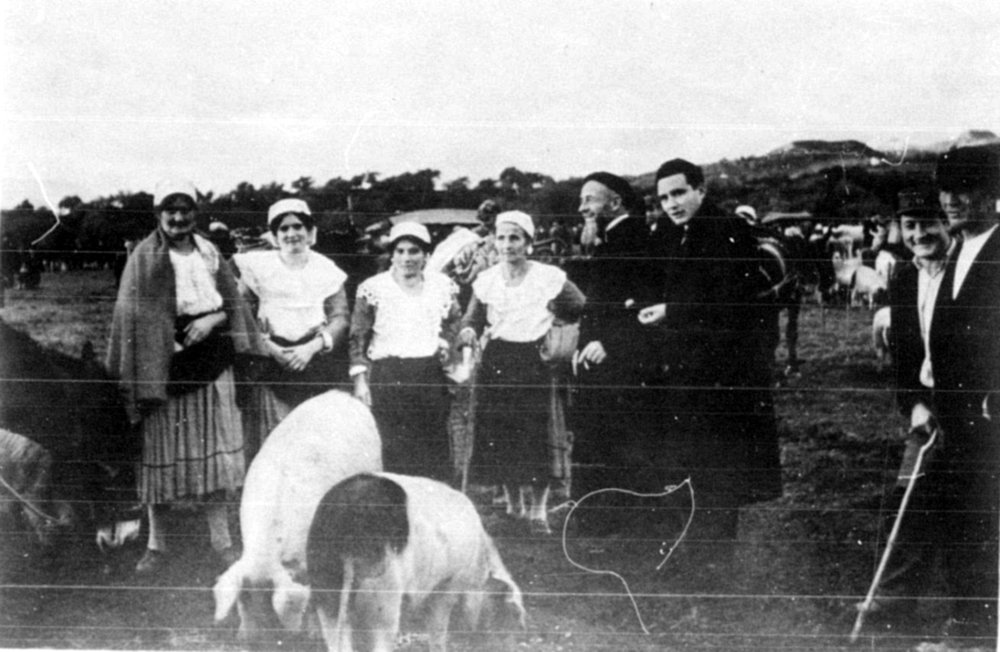
depending upon the region of former habitation in Albania. Costumes are worn on festive days such as Easter or Christmas, or they are worn for wedding ceremonies, (See Figure 29.) They are much rarer than the daily dresses and are treasured highly by those who own them.
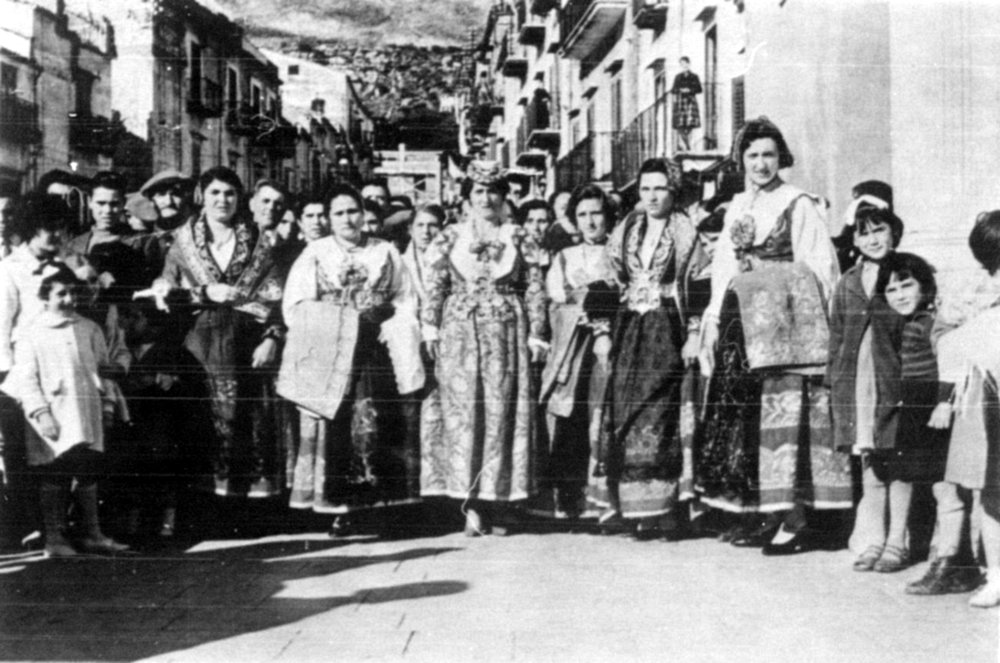
p. 60 The festive dresses in Piana degli Albanesi are dyed with bright colors, predominantly red, and are richly ornamented and embroidered with either gold or silver thread. The costume is composed of a long red skirt, an embroidered white blouse, an ornamented red vest, and ornamental black apron, and an embroidered blue shawl. It also includes a metal belt with a large buckle that is mainly ornamental. The over-all style of the various costumes in Piana degli Albanesi is the same, but there are differences in the ornamental needle work. (See Figure 30.)
The festival costume in the village of Castroregio is different from that of Piana degli Albanesi, but not radically so. The costume of Castroregio has the long red dress, an embroidered white blouse, and a white shawl. This costume lacks' the rich ornamentation so evident in the costumes of the Piana degli Albanesi because it lacks the metal belt, and gold and silver thread is not used as a decoration. (See Figure 31.)
Various styles of costumes are found in the villages, depending upon the point of origin of the people in Albania. The ornamental style, with the metal belt.
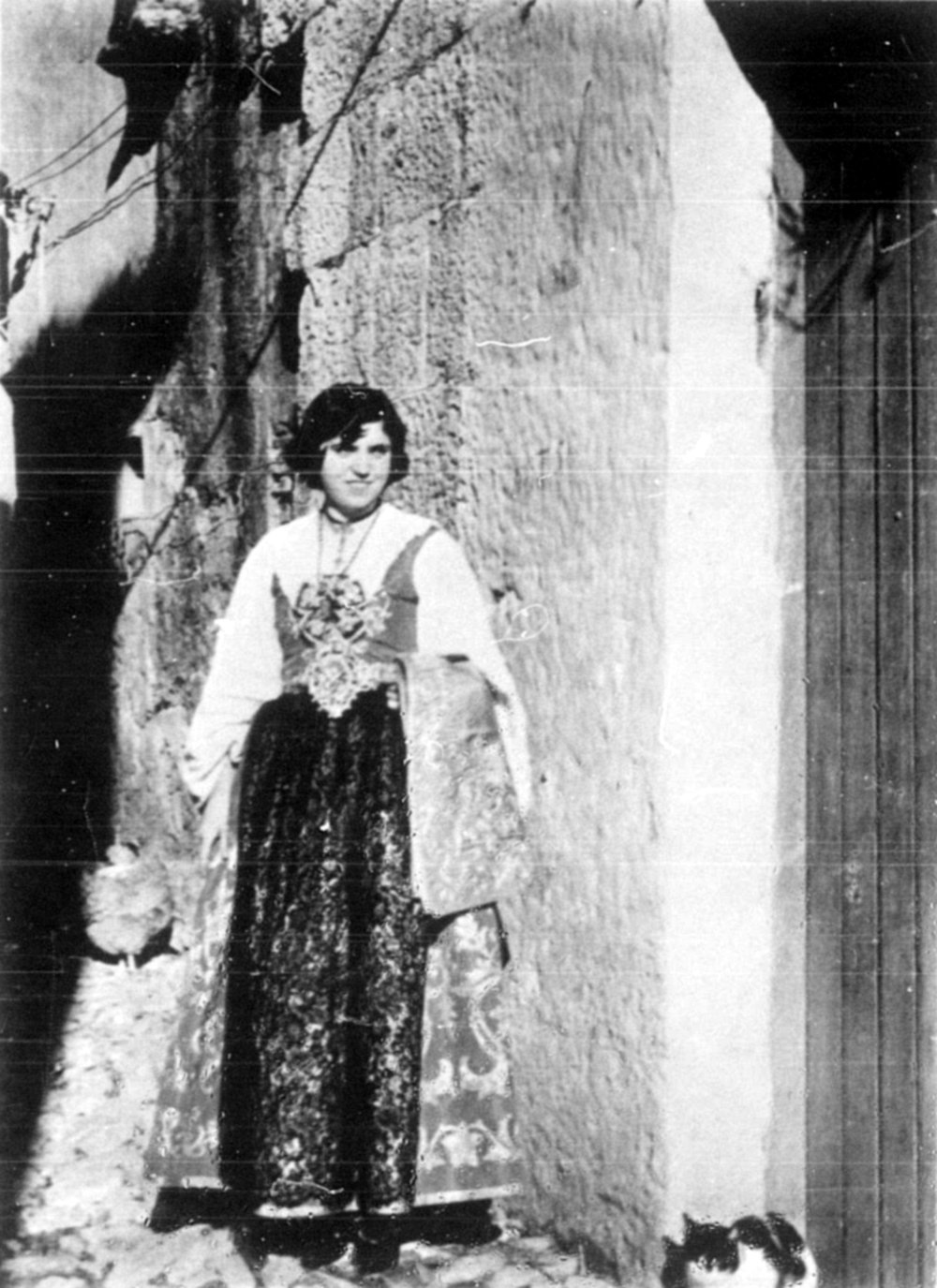
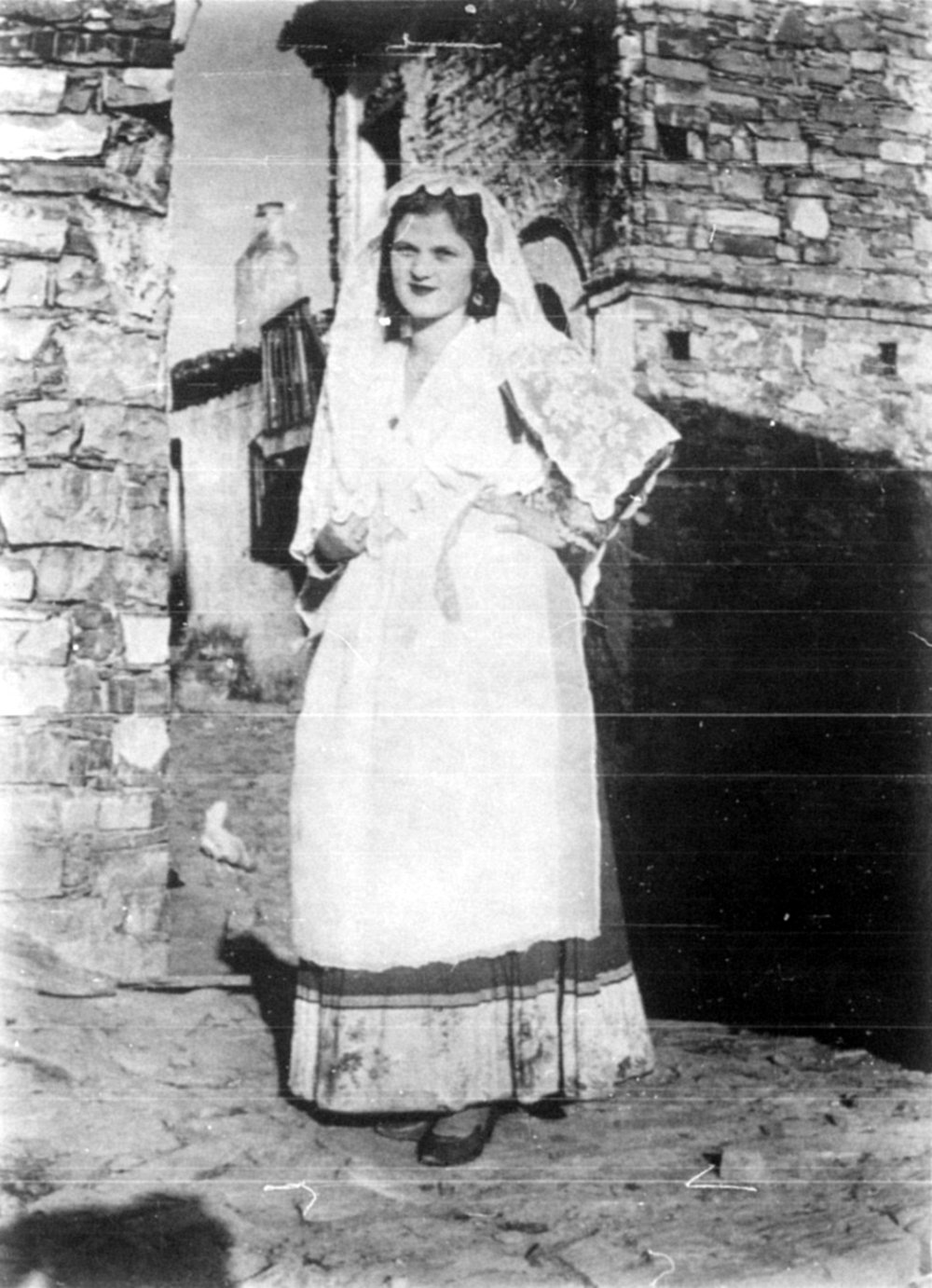
Castroregio.
indicates that the people of Piana degli Albanesi originated from northern Albania, while the simpler style of the Castroregio costume indicates that these people came from the southern part of Albania. The festival dress has survived because of its colorfulness and because the people treasure it as an heirloom. Even in the villages where the people have lost their Albanian identity, the festival dress has survived, but it is not seen as often as in the villages that have retained their Albanian character. The festival dress has remained distinctively Albanian and is part of the heritage that denotes the origin of these people and distinguishes them from the Italians.
p. 62Chapter 13The Chances for Future Survival of the Italo-Albanians
One of the unique facts concerning the Italo-Albanians is that they have survived as an identifiable group in a region where they are completely surrounded by Italians. Their survival can be attributed largely to the physical isolation of the region of southern Italy in which they live, and the fact that their arrival did not upset the political, economic, or religious status quo. Even today, their presence does not cause great concern among the political leaders of Italy, for they have proved to be as loyal to the Italian government as have the Italians. The attitude of the southern Italian and the government seems to have been one of "laissez-faire," or even unconcern, towards the Italo-Albanian.
Factors Promoting Assimilation
Even the remotest village has increasingly become aware of the advantages offered by modern civilization and, naturally, the people wish to secure these advantages. As the Italo-Albanian adopts the ways of modern civilization, he begins to shed his heritage and become more Italian. As long as he remains isolated on the hillsides or hilltops in the uplands of southern Italy, he is, to a large degree, self-sufficient; but when he becomes a part of modern civilization, he has to adopt Italian ways in order to compete with the Italian.
Government Projects
Since the beginning of this century, the government has shown greater concern about Italy's "southern problem." It is improving transportation facilities, constructing hydroelectric plants, building new schools, financing the construction of new houses (and in some cases the construction of new villages), and encouraging investors to establish industries in the south. Undoubtedly, this awakened interest in the south will be felt in the Italo-Albanian villages, and will cause the younger people to pursue occupations other than the traditional ones: farming, selling, teaching, the religious ministry, and government service at the village level. The traditional occupations are all within the scope of the village, but as modernization sets in the villager will be able to travel with greater ease beyond the influence of the village. As his range of travel increases, the Italo-Albanian will find it to his advantage to learn Italian ways and to speak Italian.
Assimilation also increases with the development of better schools. Schools in these villages now are no more than single rooms in old houses, accommodating only one class in the morning and another in the afternoon. Even though education is now compulsory, the facilities and the number of teachers are inadequate and, therefore, the delinquency of children is neglected. Better school buildings and more teachers will increase attendance in schools where Italian is used, and gradually the following generations will use Italian because Albanian is not part p. 63 of the curriculum. Students who have the means to obtain a higher education will probably not return to their villages after completion of their education, because only few professional positions are available.
The construction of hydroelectric plants, besides bringing lighting to the homes, also permits the use of radios, and more recently, television sets. These two mass media have reached villages that were formerly isolated, not only from central and northern Italy, but from one another. Today, many Italo-Albanian homes have radios, and there are several television sets in the villages, either in the wealthier homes or at the local clubs. This broad, and yet personal, means of communication reaches the Italo-Albanian within his village and introduces him to things that are Italian.
The construction of government housing is also affecting the traditional Italo-Albanian way of life. Most of the new houses are away from the intimacy of village life and in regions designated for land reform. The Italo-Albanian villages affected by this government program are to the north and south of the Sila Plateau. The government, in effect, is actually encouraging some people to leave their villages and settle in new farmhouses constructed on expropriated land. The total number of Italo-Albanians affected by this influence is small in relation to the total Italo-Albanian population, which is about 100,000, Eighty-two families were resettled from three villages on the northern margin of the "Sila;" and 169 families were resettled from villages on the southern margin of the "Sila."
Since the areas of resettlement are about five to ten miles from the respective villages, the newly settled Italo-Albanians do not visit their villages frequently. These people, lacking participation in the intimate contacts of village life, will become oriented toward the activities of the new settlement, which includes families from the Italian villages. Future generations of Italo-Albanian families will not be as fully aware of their past heritage because they have been moved away from the Italo-Albanian villages.
Industrialization of the south is still in the planning stage; there is nothing approaching modern industry in either Calabria or Lucania. Southern Italy has only one attraction for industry—a large labor force. There are several disadvantages that outweigh this attraction: lack of skilled labor, poorly developed communications, lack of resources, a poor agricultural base, and an industrialized north that would seriously compete with any goods produced in the south. If industries were established in the south, it would be several generations before their effects were felt in the remote villages.
Migrations
Before and immediately after World War I, Italo-Albanians emigrated mainly to the United States and Argentina; but, since then, immigration regulations in these two countries have been tightened and the number of migrants has been drastically reduced. Today, Italo-Albanian migrants are leaving for Australia, Canada, and northern Italy. The effect of the migrations has not reduced the total population of Italo-Albanian communes, but it has affected the natural rate of increase. According to the census of November 4, 1951, the total population of the 36 Italo-Albanian p. 64 communes was 101,878.77 On December 31, 1958, the estimated population of these same communes was 103,234, an increase in population of only 1,356.78
(See Appendix II.) These figures represent a steady flow of people from the villages, either out of the country or to the industrial north. The people that migrate from
the villages to another part of Italy will retain some of their cultural traits, but the descendants of these people will naturally follow the ways of the Italians.
Factors Retarding Assimilation
Within this decade, a group of Italo-Albanians became increasingly aware of the fact that the Italo-Albanians were gradually losing their cultural traits and were being assimilated by the Italians. They proposed that an Italo-Albanian festival be held annually and the people from the villages be encouraged to attend.
The site chosen for this annual festival is a mile and a half north of Spezzano Albanese, just on the edge of the Crati floodplain, near the interior national highway that connects Cosenza with Naples, This area is famous for its mineral baths, and a fair-sized hotel is situated here.
The second weekend of October was selected for the folklore festival, which has been held annually since 1953, This event represents the first of its kind among the Italo-Albanians, bringing together the Italo-Albanians from all the villages in Lucania, Calabria, and Sicily. Previously, the educated Italo-Albanians concerned themselves with affairs only in their immediate locale and seldom met people from other villages.
The purpose of the festival was not merely to introduce people from the different villages to each other, but also to collect and publicize the cultural traits of Italo-Albanians. The founders of the festival did this by encouraging the people to perform the dances of their respective villages, sing their songs, and have the women wear their festival costumes.79 There may be some doubt as to whether the festival has checked assimilation of the Italo-Albanian, or created an interest in Albanian culture in the minds of the young people. The festival does show, however, that there still remains an Albanian culture in these villages, which forms an intangible bond among the Italo-Albanian people. How much longer this will be true lies in the realm of conjecture.
p. 65Summary
Since ancient times, various peoples have settled in southern Italy: ancient Greeks, Byzantine Greeks, Arabs, Waldenses, and Albanians. Of these, only the Albanians have survived as an ethnic group. Posing some threat to the native culture, the other groups met with antagonism. On the other hand, largely because their way of life did not disturb the status quo, the Albanians were accepted. Aside from minor troubles and suspicions, they have lived rather peacefully in southern Italy for nearly 500 years.
Some Italo-Albanian villages have lost their Albanian characteristics; others, while considerably Italianized, still retain recognizable Albanian traits. The completely assimilated villages are in the "compartments" of Abruzzi, Campania, and Apulia. The assimilation of the Apulian villages can be explained by the fact that they are situated in the accessible lowlands and rather close to the large cities of Taranto and Lecce. The villages retaining Albanian characteristics are situated in Calabria, Lucania and northwestern Sicily, in remote, mountainous regions which are just beginning to be reached through modern means of transportation and communication.
To a large extent the Italo-Albanian of southern Italy follows the Italian way of life. There has been some intermingling and even intermarriage. His towns, dwellings, agricultural practices, food, clothing, and economy resemble those of the Italians. Within his village, however, he has been able to speak Albanian, maintain the Greek religious rite, glorify his own heroes, hold his own festivals, retain some costumes, and perpetuate the folklore of his ancestors.
Present conditions point to the hastening of acculturation. No new migrations have occurred to strengthen the ties with the homeland. The Italian government does not regard the Italo-Albanians as a minority group needing separate treatment, but offers them the same opportunities it offers the Italians. The advent of modern transportation and communication, land resettlement, and increased educational opportunities will bring the Italo-Albanians closer and closer to a completely Italian way of life.
p. 66Bibliography
Alberiti, Luigi. Il Vescovato ed il Collegio Italo-Greco degli Albanesi della Calabria. (Publisher and date are unknown.)
Andriulli, G.A. Le Colonie Albanese d'Italia. Perugia: Unione Tipografia Cooperativa: 1912.
Argondizza, Antonio. Collegio Italo-Greco di S. Adriano. Corigliano Calabria: 1884.
Baird, Robert. Protestantism in Italy, Including a History of the Waldense, Boston: Perkins and Marvin, 1845.
Benoist-Michlin, Jacques P.M. Arabian Destiny. Translated by Denis Weaver, London: 1957.
Biancotti, Angiolo. Giorgio Castriota, detto lo Scanderbeg. Torino: G. B. Paravia & Co., 1940.
Bosford, George W. and Robinson, Charles A. Jr. Hellenic History. 4th ed. New York: 1948.
Byng, Edward J. The World of the Arabs. Boston: Little, Brown & Co., 1944.
Capalba, Francesco. Di Alcune Colonie Albanesi della Calabria-Citra. Napoli: 1919.
Chetta-Schiro, Papas Francesco. I Castriota-Principi d'Albania, Nell'Ordine Sovrano e Militare di Malta. Valletta: 1929.
Coco, F. A. Primaldo. Casali Albanesi nel Tarentino. (Estratto dal Roma e l'Oriente.) Grottaferrata: 1921.
Conforti, Prof. Gerardo. Il Patriarcato Greco. Napoli: Pontificia degli Artigianelli. 1919.
——— Il Contributo degli Arbreshi alla Letteraturo Albanese. Associazione-Italiana per i rapporti culturali tra l'Italia e l'Albania, Roma: 1955.
Crawford, Frances M. The Rulers of the South, Sicily, Calabria, Malta. Vols. I & II. London: Macmillan Co., 1900.
Cuniberti, F. L'Albania ed Il Principe Scanderbeg. Torino: 1890.
Cutolo, Alessandro. Scanderbeg. Milano: Istituto per gli Studi di Politica Internazionale, 1940.
p. 67 Dickenson, Robert E. The Population Problem of Southern Italy. Syracuse University Press: 1955.
Diehl, Charles. History of the Byzantine Empire. Translated by George B, Ives. Princeton: Princeton University Press, 1925.
Dorsa, Vincenzo. La Tradizione Greco-Latina negli Usi e nelle Credenze Popolari, 2nd ed. Cosenza: 1884.
Douglas, Norman. Old Calabria. London: William Clowes & Sons. 1923.
Drizari, Nelo. Spoken and Written Albanian. New York: Hafner Publishing Co. Inc., 1947.
Enan, Muhammad Abdullah. Decisive Moments in the History of Islam. 3rd ed, Lahore: 1949.
Enciclopedia Italiana di Scienze, Lettere, ed. Arti. Vol. VII. Milano: 1919.
Estratto di Verbale del Consiglio Communale di S. Demetrio Corone. Corigliano Calabria: 1888.
Ferrari, P. Iosif. Kaljimere. Castrovillari: Eduardo Patitucci, 1946.
Finlay, George. The History of Greece, from its Conquest by the Crusaders to its Conquest by the Turks and of the Empire of Trebizond. Edinburgh and London: W. Blackwood & Sons, 1851.
La Flora. Conosci L'Italia. Vol. II. Milano: Touring Club Italiano, 1958.
Fortescue, Adrian. The Uniate Eastern Churches. New York: Frederick Ungar Publishing Co., 1923.
Frasheri, Avv. Pandi M. La Famiglia Albanese, Fonte della Civilta Europea. Spoleto: 1947.
Freeman, Kathleen. Greek City-States. London: Norton, 1950.
Galanti, Arturo. L'Albania Nei Suoi Rapporti con la Storia e con la Civita d'Italia, Castello: Casa Editrice S. Lopi, 1916.
Gibson, Rev. James D.D. The Waldenses. London: 1909.
Giordano, Sac. Emanuele. Folklore Albanese in Italia. Cosenza: Casa Jonio, 1957.
Gissing, George. By the Ionian Sea. London: Chapman & Hall, 1901.
Gualtieri, Vittorio G. Girolamo de Rada. Poeta Albanese. Palermo: Remo Sandron, 1930.
Hitti, Philip K. History of the Arabs. London: Macmillan & Co., Ltd., 1937.
Hussey, J.M. The Byzantine Empire in the Eleventh Century: Some Different Interpretations. Transactions of the Royal Historical Society. Fourth Series, Vol. XXX. London: 1950.
p. 68 Istitutio Centrale di Statistica-Ministero Dell'Interno. Annuario Statistico Dei Communi Italiani. Roma: 1958.
——— Elezioni Amministrative Del 1956. Vol. II. Roma: 1959.
——— Elezioni Del Senato Della Repubblica (7 Giugno 1953). Vol. VII. Roma: 1954.
L'Italia Fisica. Conosci L'Italia. Vol. I. Milano: Touring Club Italiano, 1957.
Italia Meridionale, Campania, Basilicata, e Calabria. Guida D'Italia. Vol. II. Milano: Touring Club Italiano, 1929.
Jakova-Mertury, Prof. D. Gaspare. Il V Centenario Della Nascita di Giorgio Kastriota-Skanderbeg (1404-1904). Roma: Sallustiana, 1904.
Jones, William. The History of the Christian Church. From the Birth of Christ to the XVIII Century; Including the Very Interesting Account of the Waldenses and Albigenses. Dover: 1837.
Kish, George. Land Reform in Italy: A Geographer's View. Papers of the Michigan Academy of Science, Arts, and Letters: Vol. XLI, 1956.
——— "The 'Marine' of Calabria," The Geographical Review, October 1953, Vol. XLII, No. 4.
Libardi, Cav. Camillo O.MP. I Primi Moti Patriottici Albanesi, Nel 1910-1911- 1912. (Parte Prima). Trento: Libreria Moderna, 1935.
Lorecchio, Anselmo. Il Pensiero Politico Albanese, in Rapporto agli Interessi Italiani. Roma: Operaio Romana, 1904.
Lucania e Calabria. Guida D'Italia. Milano: Touring Club Italiano, 1938.
Marchiano, Da Angelo. Memoria Sul Collegio Di S. Adriano. Cosenza: Tipografia dell'Indipendenza, 1886.
Marchiano, Dott. Francesco. Collegio Italo-Albanese in S. Demetrio Corone. Castrovillari: Eduardo Patitucci, 1935.
Marini, Ciro. Appunti Storici Intorno a S. Demetrio Corone. Catanzaro, 1913.
Mazziotto, Giuseppe. Monografia del Collegio Italo-Greco di Sant'Adriano. Roma: Tipografia Italia, 1908.
Monti, Gennero M. Due Documenti Sconosciuti Sulla Albania Di Alfonso I Di Aragona. Studi Albanesi. Roma: Istituto per L'Europa Orientale, Vol. I, 1931.
p. 69 Orsi, Paolo. Le Chiese Basiliane in Calabria. Firenze: ist. ed. 1929: 2nd ed. 1941.
Petrotta, Rosolino. P. Giorgio Guzzetta. Piana degli Albanesi: 1956.
Petrotta, Gaetano. Poeti Siculo-Albanesi. Palermo: Scuola Tipografica 'Boccone Povero,' 1950.
Pounds, Norman J.G. Europe and the Mediterranean. New York: McGraw-Hill Book Co., 1953.
Scaglione, Petro. Historia e Shqipetarevet t'Italise. New York: Saravulli, 1921.
Scena Illustrata. Anno 72, N. 10. Firenze: Ottobre 1957, p. XII.
Scheville, Ferdinand. A History of Europe, (revised) New York: Harcourt, Brace & Co., 1949.
Scura, Antonio. Gli Albanesi in Italia e i Loro Canti Tradizionali. New York: Francesco Tocci, 1912.
Sicilia. Guida D'Italia. Milano: Touring Club Italiano, 1953.
Skendo, Stavro. Albania. New York: Published for the Mid-European Studies Center of the Free Europe Committee, Inc., by Frederick A. Praeger, 1958.
Studi Silani. Napoli: Fondazione Politicania per il Mezzogiorno D'Italia, 1937.
Thorndike, Lynn. The History of Medieval Europe, (revised edition). New York: Houghton Mifflin Co., 1928.
Tocci, Guglielmo. Di Francesco Saveiro Elmo e il Collegio Italo-Greco di Calabria. Torino: 1877.
——— Notizie Storiche e Documenti Relativi ai Communi di S. Giorgio, Vaccarizzo, S. Cosmo, Macchia, S. Demetrio. (in appendice alle due memorie sulle questione de scioglimenti de promiscuita con Acri). (Publisher and date are unknown.)
Vanutelli, Vincenzo. Le Colonie Italo-Greco. Roma: 1890.
Van Valkenburg, Samuel & Held, Colbert C, Europe. New York: John C. Wiley & Sons, 1952.
Von Helmuth, Kanter. Kalabrien. Hamburg: 1930.
Zangari, Domenico. Le Colonie Italo-Albanesi di Calabria. Storia e Demografia Secoli XV-XIX. Napoli: Casella, 1940.
Wylie, James A. History of the Waldenses. London: 1880.
p. 70Maps
Carta Della Utilizzazione Del Suolo D'Italia. Consiglio Nazionale Delle Ricercehe. Nos. 19, 20, 21. 1:200 000. Milano: Touring Club Italiano, 1956.
Carta Automobilistica. Nos. 22, 23, 24, 25. 1:200 000. Milano: Touring Club Italiano, 1955.
Carta Automobilistica, Italia Meridionale. 1: 500 000. Milano: Touring Club Italiano. 1955.
Appendixes
Appendix I. Maps
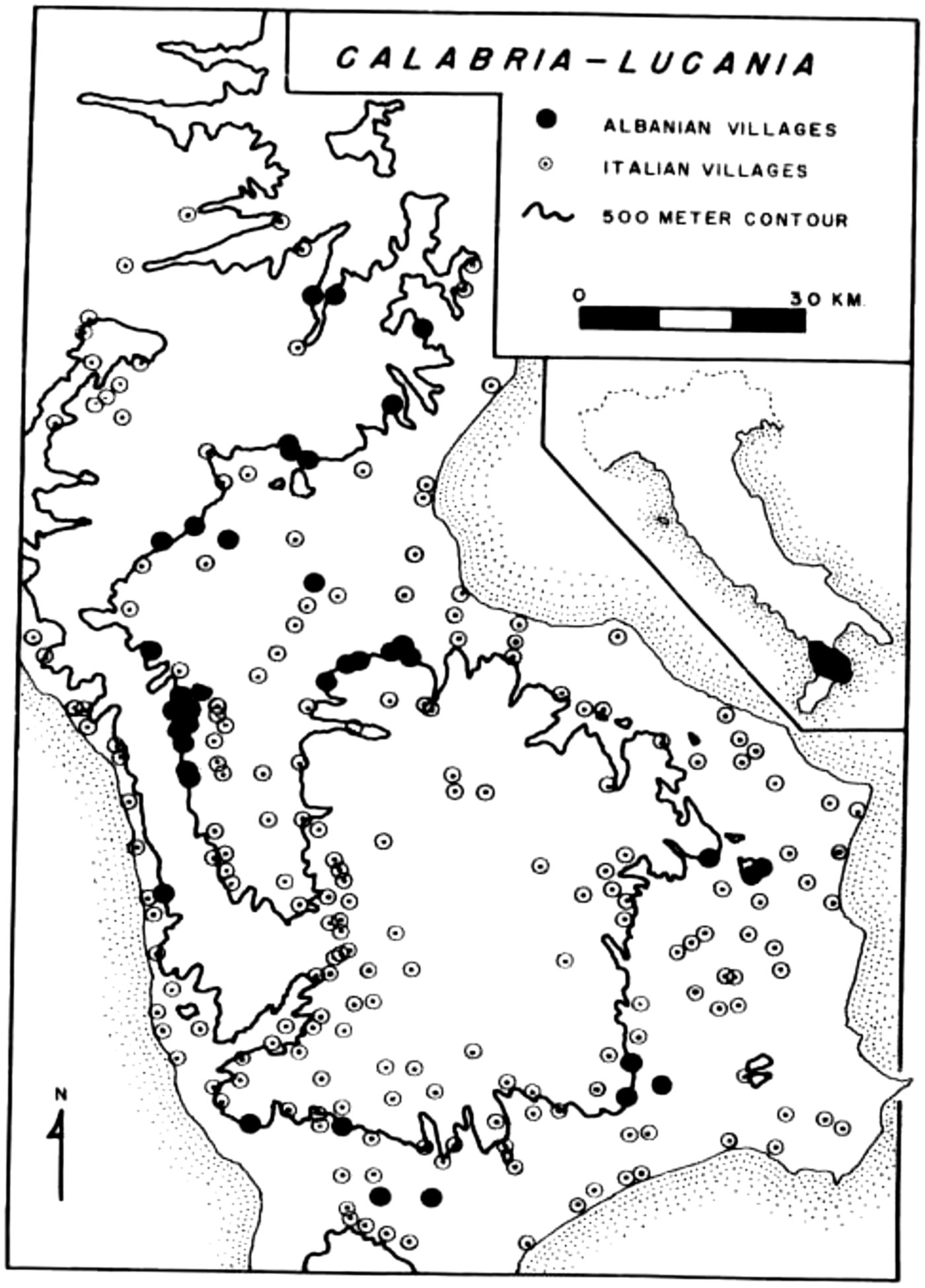
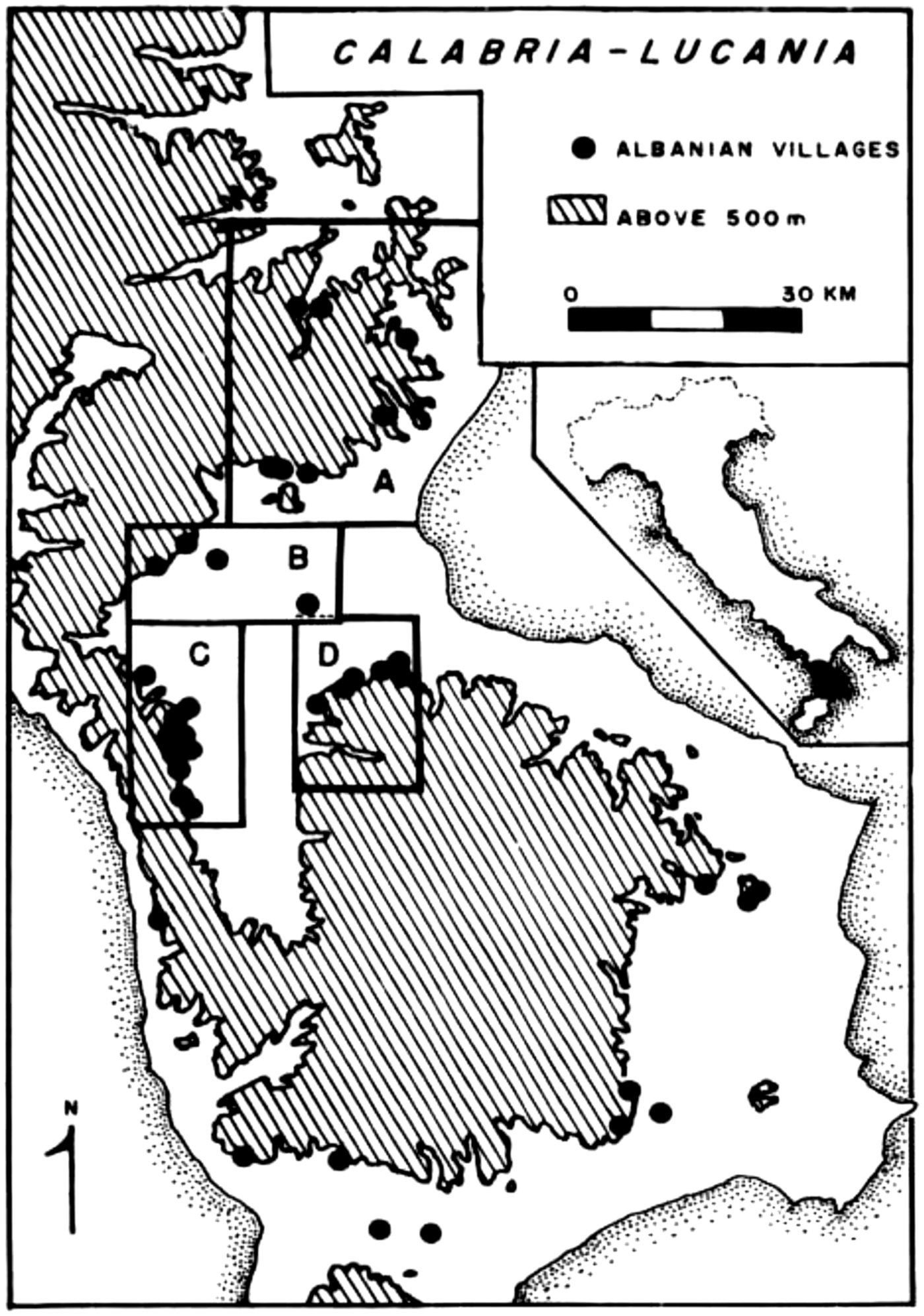
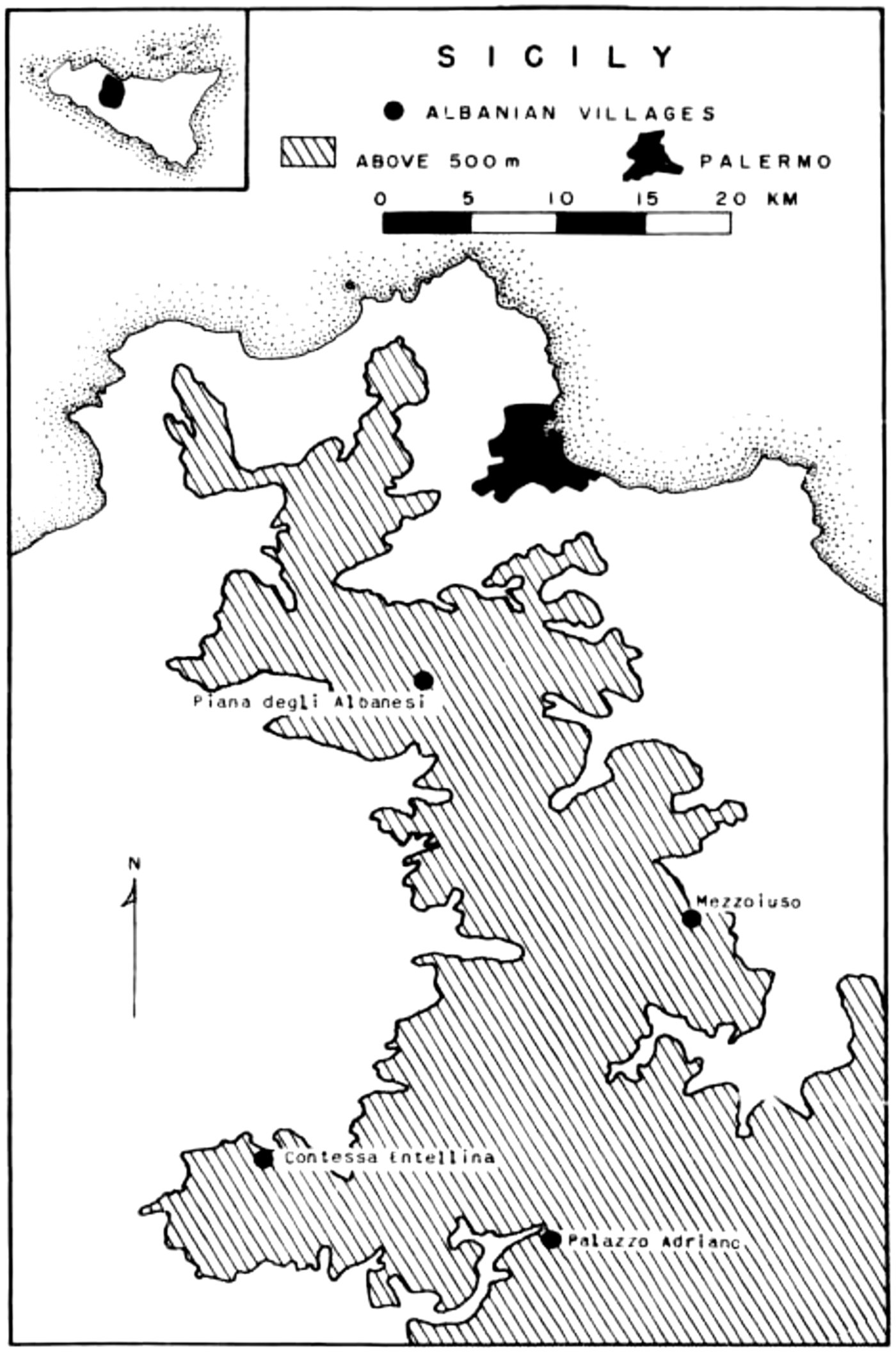
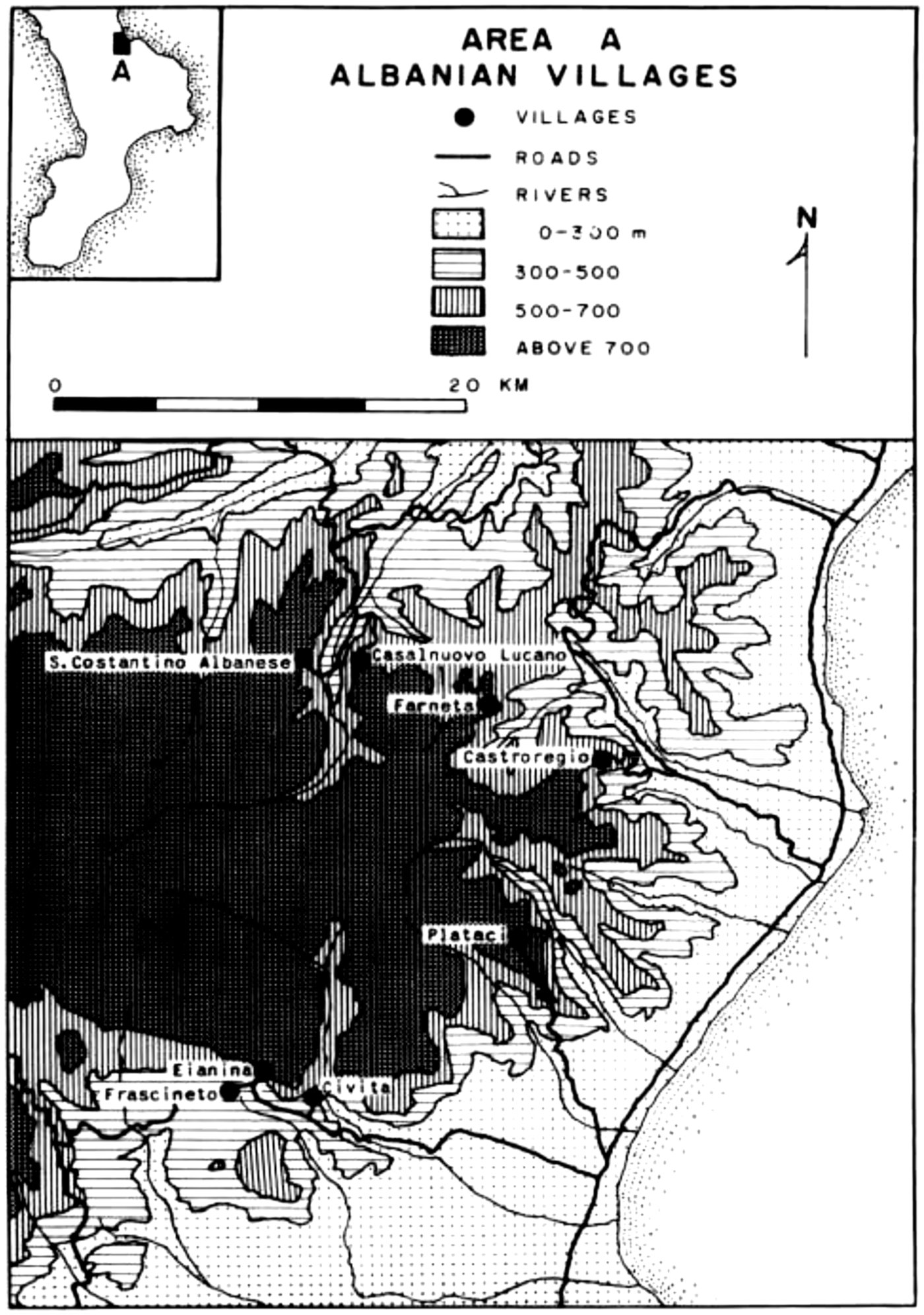
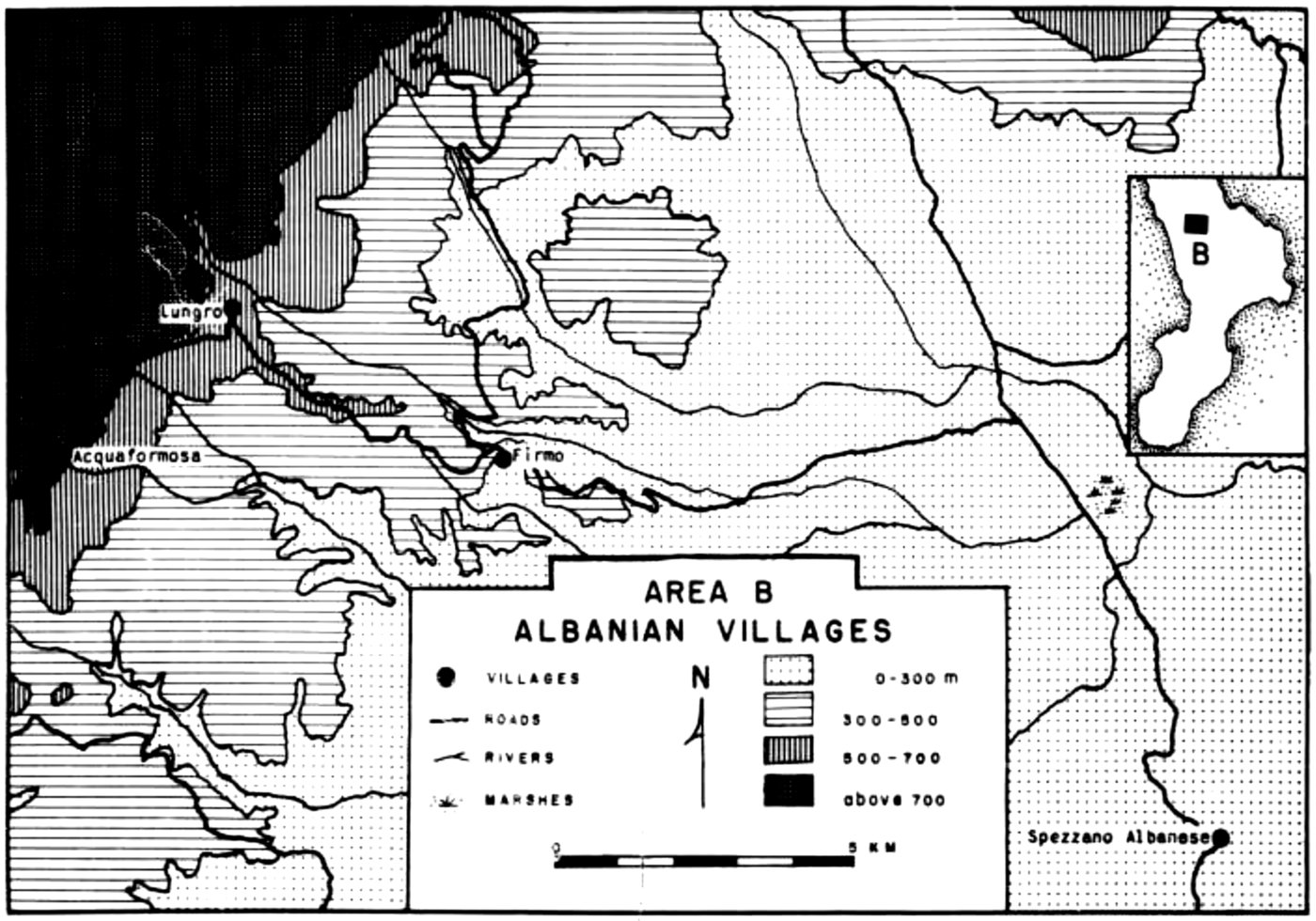
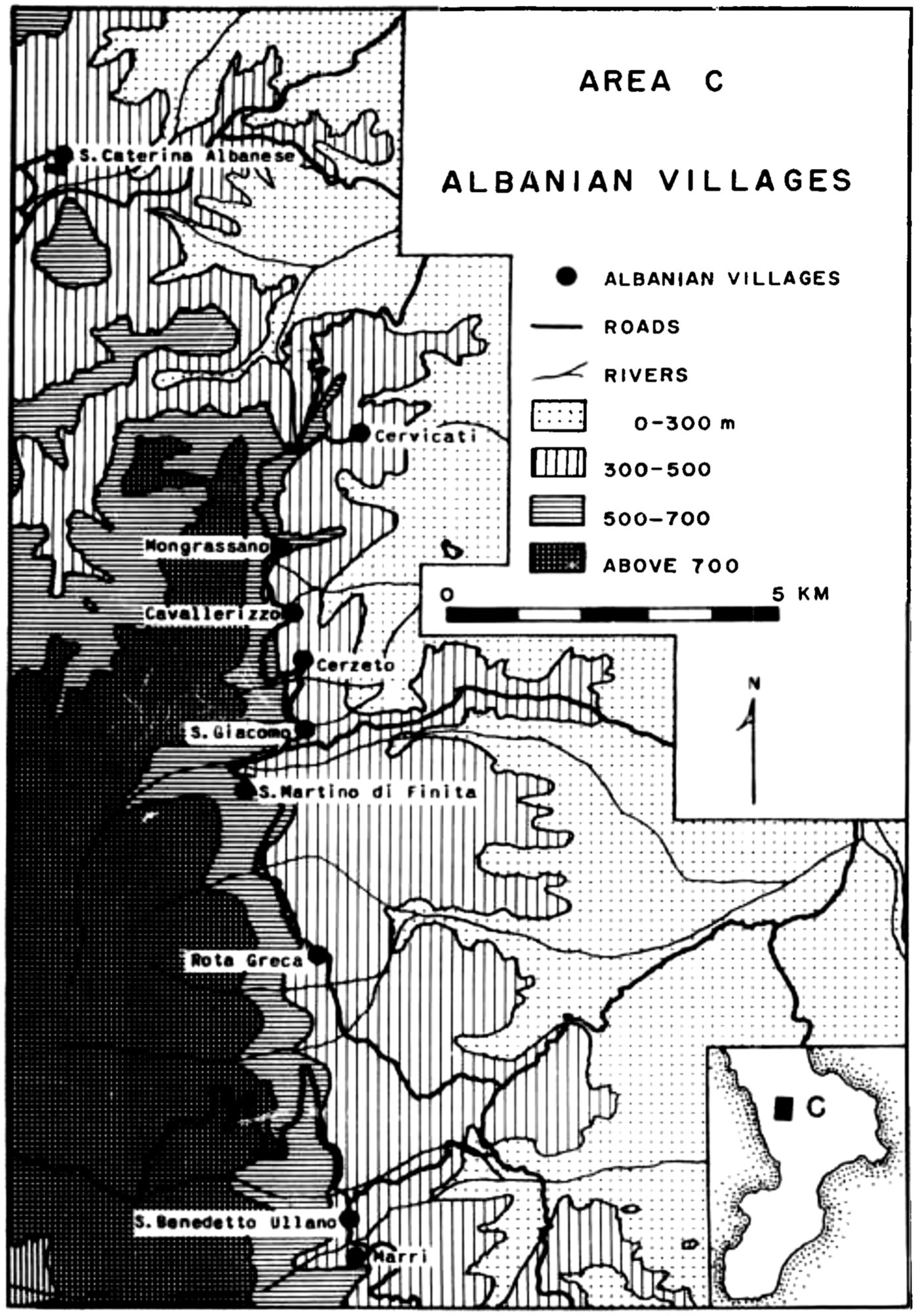
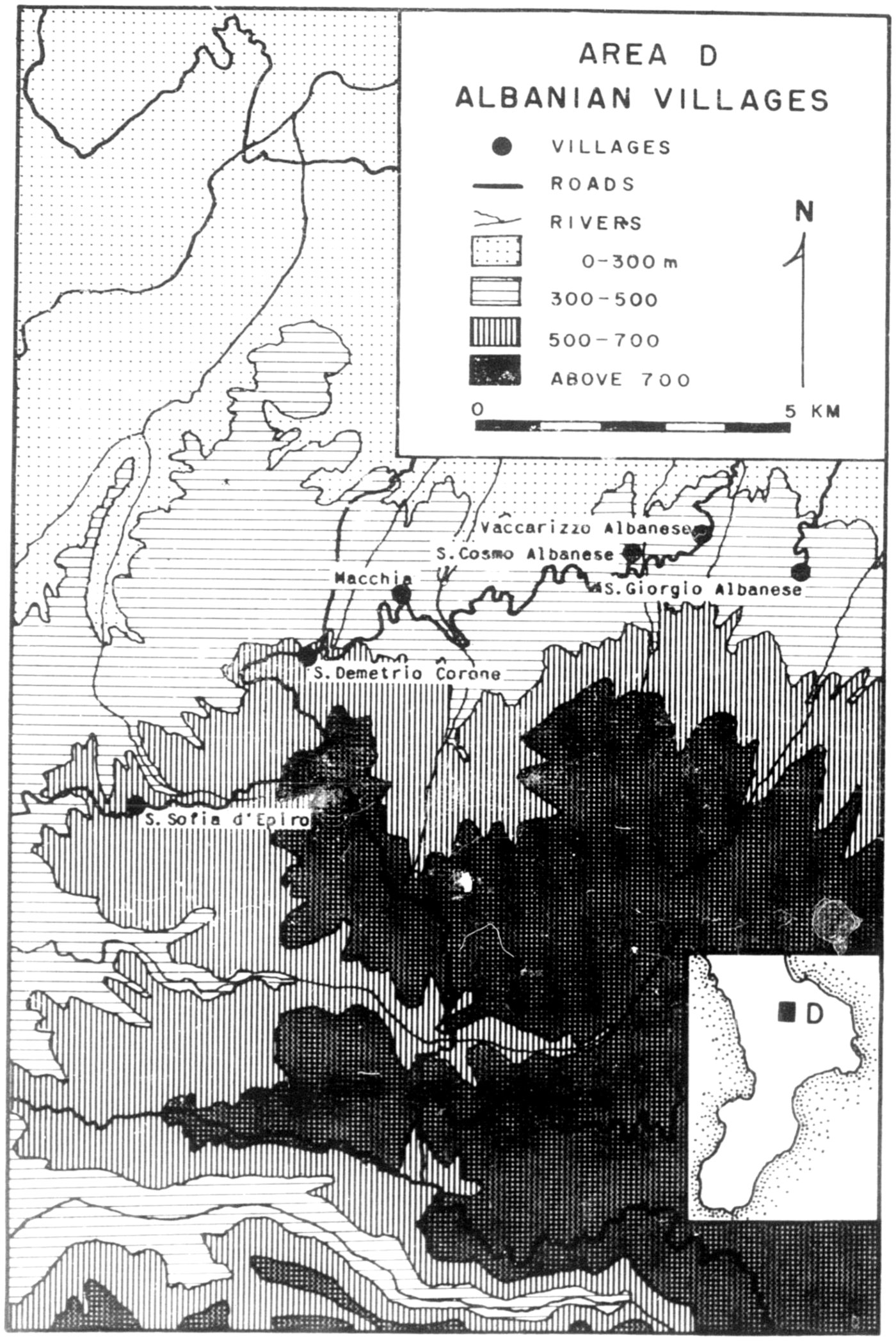
p. 80Appendix II. Altitude and Population of Italo-Albanian Villages in Southern Italy and Sicily
| Village (altitude in meters) | Province | Censusa Nov. 4, 1951 | Censusa Dec. 31, 1955 | |
|---|---|---|---|---|
| 1. | Acquaformosa (756) | Cosenza | 1,812 | 1,777 |
| 2. | Amato (465) | Catanzaro | 2,095 | 2,043 |
| 3. | Andali (625) | Catanzaro | 4,295 | 4,667 |
| 4. | Caraffa (358) | Catanzaro | 2,450 | 2,786 |
| 5. | Carfizzi (512) | Catanzaro | 1,441 | 1,463 |
| 6. | Castroregio (820) | Cosenza | 1,533 | 1,516 |
| 7. | Casalnuovo Lucano (848) | Potenza | 914 | 880 |
| 8. | Cervicati (496) | Cosenza | 1,576 | 1,541 |
| 9. | Cerzeto (470) | Cosenza | 2,895 | 2,975 |
| 10. | Civita (450) | Cosenza | 2,051 | 2,025 |
| 11. | Contessa Entellina (571) | Palermo | 2,894 | 2,998 |
| 12. | Falconara Albanese (602) | Cosenza | 2,372 | 2,393 |
| 13. | Firmo (369) | Cosenza | 2,612 | 2,699 |
| 14. | Frascineto (486) | Cosenza | 2,561 | 2,582 |
| 15. | Gizzeria (630) | Catanzaro | 5,486 | 5,757 |
| 16. | Lungro (660) | Cosenza | 4,711 | 4,843 |
| 17. | Marcedusa (314) | Catanzaro | 1,289 | 1,358 |
| 18. | Marri (572) | Cosenza | 1,675 | 1,648 |
| 19. | Mezzoiuso (531) | Palermo | 4,938 | 4,988 |
| 20. | Mongrassano (540) | Cosenza | 2,760 | 2,610 |
| 21. | Palazzo Adriano (680) | Palermo | 4,273 | 4,051 |
| 22. | Pallagorio (560) | Catanzaro | 2,272 | 2,379 |
| 23. | Piana degli Alb. (720) | Palermo | 7,239 | 7,215 |
| 24. | Plataci (930) | Cosenza | 1,832 | 1,859 |
| 25. | Rota Greca (510) | Cosenza | 1,958 | 1,701 |
| 26. | S. Benedetto Ull. (460) | Cosenza | 2,472 | 2,602 |
| 27. | S. Cosmo Albanese (400) | Cosenza | 1,096 | 1,064 |
| 28. | S. Costantino Alb. (650) | Potenza | 1,758 | 1,786 |
| 29. | S. Demetrio Corone (521) | Cosenza | 5,765 | 5,812 |
| 30. | S. Giorgio Alb. (436) | Cosenza | 1,993 | 1,983 |
| 31. | S. Martino di Fin. (550) | Cosenza | 2,526 | 2,350 |
| 32. | S. Nicola dell'Alto (556) | Catanzaro | 2,687 | 2,843 |
| 33. | Santa Caterina Alb. (463) | Cosenza | 2,195 | 2,152 |
| 34. | Spezzano Albanese (320) | Cosenza | 5,923 | 6,137 |
| 35. | Vaccarizzo Albanese (440) | Cosenza | 2,005 | 1,915 |
| 36. | Zagarise (581) | Catanzaro | 2,722 | 2,838 |
| Total | 101,878 | 103,234 |
a These statistical data are according to communes and some of the Albanian settlements are not included because they are not of commune status, according to: Istituto Centrale Di Statistica-Ministero Dell'Interno, Annuario Statistico Dei Comuni Italiani (Roma, 1958), pp. 47-50, 80-81.
[Webmaster's note: the totals are reproduced as printed. The village figures as printed add up to 101,076 and 102,236.]
p. 81Appendix III. Religious Rites and Languages of the Italo-Albanian Villages of Calabria and Sicily
| Villagea | Riteb | Languageb | |
|---|---|---|---|
| 1. | Acquaformosa | Greek | Albanian |
| 2. | Amato | Latin | Albanian |
| 3. | Andali | Latin | Albanian |
| 4. | Arietta | Latin | Albanian |
| 5. | Caraffa | Latin | Albanian |
| 6. | Carfizzi | Latin | Albanian |
| 7. | Casalnuovo Lucano | Greek | Albanian |
| 8. | Castroregio | Greek | Albanian |
| 9. | Cavallerizzo | Latin | Albanian |
| 10. | Cervicato [Cervicati] | Latin | Albanian |
| 11. | Cerzeto | Latin | Albanian |
| 12. | Civita | Greek | Albanian |
| 13. | Contessa Entellina | Greek | Albanian |
| 14. | Eianina | Greek | Albanian |
| 15. | Falconara Albanese | Latin | Albanian |
| 16. | Firmo | Greek | Albanian |
| 17. | Frascineto | Greek | Albanian |
| 18. | Gizzeria | Latin | Albanian |
| 19. | Lungro | Greek | Albanian |
| 20. | Macchia | Greek | Albanian |
| 21. | Marcedusa | Latin | Albanian |
| 22. | Marri | Latin | Albanian |
| 23. | Mezzoiuso | Greek | Italian |
| 24. | Mongrassano | Latin | Albanian |
| 25. | Palazzo Adriano | Latin | Italian |
| 26. | Pallagorio | Latin | Albanian |
| 27. | Piana degli Albanesi | Greek | Albanian |
| 28. | Plataci | Greek | Albanian |
| 29. | Rota Greca | Latin | Albanian |
| 30. | San Benedetto Ullano | Greek | Albanian |
| 31. | San Cosmo Albanese | Greek | Albanian |
| 32. | San Costantino Albanese | Greek | Albanian |
| 33. | San Demetrio Corone | Greek | Albanian |
| 34. | San Giacomo | Latin | Albanian |
| 35. | San Giorgio Albanese | Greek | Albanian |
| 36. | San Martino di Finita | Latin | Albanian |
| 37. | San Nicola dell'Alto | Latin | Albanian |
| 38. | Santa Caterina Albanese | Greek | Albanian |
| 39. | Santa Sofia d'Epiro | Greek | Albanian |
| 40. | Spezzano Albanese | Latin | Albanian |
| 41. | Vaccarizzo Albanese | Greek | Albanian |
| 42. | Vena | Latin | Albanian |
| 43. | Zagarise | Latin | Albanian |
| 44. | Zangarona | Latin | Albanian |
a A list of 36 Italo-Albanian villages is included in a study by Domenico Zangari, Le Colonie Italo-Albanesi di Calabria, storia e demografia secoli XV-XIX (Napoli, 1941), pp. 48-50. I have expanded this list by including the Italo-Albanian villages in Lucania and Sicily.
b This list is according to Petro Scaglione, Historia e Shqipetarevet t'Italise (New York, 1921), pp. 78-80. The villages listed as Albanian signify that that is the language of the home and among the Italo-Albanians. The "lingua franca" in all the villages is Italian.
— End —