To my only child,
Martha Jane Eustes, my grandchildren, my nieces and
nephews and their children, all
people of Maschitan heritage, and everyone interested
in the Albanian-Italians from Maschito, Italy
p. iiPreface
I have been asked by many people over the years about the small village of Maschito (Ma-skeet-o) and the Maschitan dialect. Generally the questions come from two sources: first, younger family members aware of their Italian heritage but ignorant of its Albanian-Italian roots; and second, people who are mystified upon hearing the strange-sounding dialect spoken by Maschitans, clearly unrecognizable as Italian.
Why is this dialect so different from some of the other Italian dialects? The dialect of Venice, for example, is clearly different from the classic Italian dialect of Tuscany but is nevertheless clearly Italian. Maschitan, however, is almost totally different.
Why has this dialect survived over the centuries?
Is it dying? Will we be the last generation to use it?
In this booklet I shall not only attempt to answer these questions but also to give a very brief review of Italian history and geography that all will find interesting.
I was assisted greatly in writing this by family members. One of these, my late brother Anthony, gave an oral history which was recorded a few years ago and is included here. His son, Bruce, edited the booklet. Errors or omissions, however, are entirely my own.
p. 1The Geography of Italy
Italy is a boot thrust into the Mediterranean, its toe pointed toward the tip of Sicily which it appears to be kicking. Lapping its shores are three seas, the Tyrrhenian to the west, the Adriatic to the east, and the Ionian to the south.
In the far north the majestic Alps ring the country in a great arc, forming a natural border between Italy and her neighbors - France, Switzerland, Austria, and Slovenia. Originating in the Alps and fed by its runoff is the Po, Italy's largest river. The plain which this river traverses from west to east is the largest flat plot of land in the country. But no sooner does the plain of the Po end than the Appennines begin. This chain of mountains runs straight down the center of Italy, ending at the very tip of the toe. Italy is a mountainous country.
Great cities lie in the north where the Alps turn into foothills and plain or run into the sea - Milan, Turin, Venice, Genoa - then, further south, and now influenced by the Appennines, Bologna, Florence, Siena. Appropriately, Rome is in the center. Two hundred miles south of Rome is the only great city of the southern mainland, Naples. The other great city of the south is Palermo on the island of Sicily.
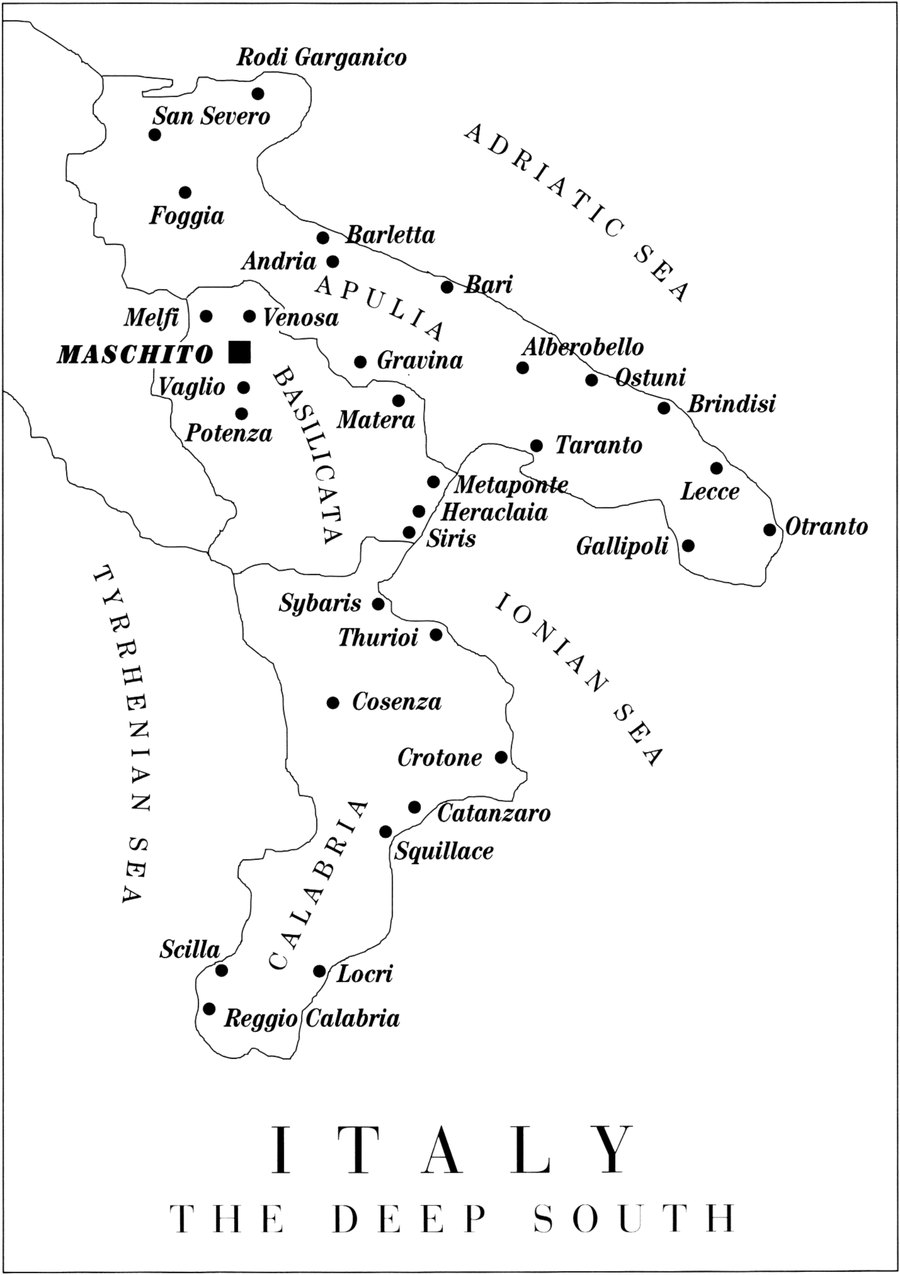
Maschito, in the foothills of the Appennines, is situated in the middle of the Italian boot, roughly 150 miles due east of Naples. It is in the province of Potenza which is the northern part of the region of Basilicata (formerly called Lucania). Basilicata takes up the instep of the boot. Flanking it to the west is the region of Campania, to the south Calabria, to the north Molise, and to the east Apulia. Some of these regions, together with Sicily, also include villages of people who speak the same dialect as do the Maschitans - and, as you might suspect - share the same Albanian-Italian heritage.
The narrow Adriatic Sea separates the Italian boot from its Balkan neighbors, Slovenia in the north and, in order running south, Croatia, Bosnia-Herzegovina, Serbia (Yugoslavia), Albania, and Greece.
pp. 2–3A Short History of Albania
Like many countries that have been oppressed by invaders over long periods of their history, Albania is backward and undeveloped by European standards, backward even by Balkan standards. A small country measuring only about 200 miles long and 50 miles wide (about the size of Maryland), Albania is at least as mountainous as Italy.
Two thousand years ago Albania was part of the Roman province of Illyria. Albania resisted the mighty Roman legions but was overcome and conquered in 168 BC. Rome ruled the civilized world and Illyria, although a rather insignificant piece of the vast imperial realm, was at least a prosperous colony. Poor Albania has not prospered since.
After the fall of the Roman Empire in the west Albania was ravaged by marauding Visigoths and Huns and subject to rule for nearly a thousand years by a variety of overlords, starting with the eastern, or Byzantine Roman Empire, and subsequently by Bulgaria and Serbia.
In the Middle Ages a new overlord, the Turks, conquered the land and ruled for another 500 years. The Albanians fought, as they had before against other invaders, and a great national hero, George Kastrioti Skanderbeg, fought them off for 25 years, rallying the people and winning many battles. But after he died, the Turks completed their conquest.
Nearly three out of four Albanians are Muslims, having taken the religion of their Turkish conquerors. The remainder are Greek Orthodox and Roman Catholic.
Albania finally gained its independence from the Turks in 1912 but kept it for a mere 27 years until Mussolini invaded early in World War Two. Occupied by Italians and Germans during the war, Albania once again gained independence after the defeat of the Axis Powers. But a harsh sort of independence it was. Two thousand years of foreign domination by Romans, Byzantines, Slavs, and Turks - must have seemed rather tame by comparison to national "freedom" under the Communist regime of Enver Hoxha which suppressed the people ruthlessly. Hoxha installed a Stalinist system and unleashed a wave of terror, nationalizing private property, wiping out the landed class, confiscating through taxation the assets of the bourgeoisie, persecuting the churches, and summarily executing people by the thousands. Not even the Huns did so much damage. With the fall of Communism in the late 1980s, anarchy ruled in the sorry country, and the spectacle of Albanians by the thousands packing ships and attempting forced entry into Italy is one that is difficult to forget.
Today the small, poor, backward country struggles to enter the 20th century while the rest of her European neighbors are poised to enter the 21st.
p. 4A Short History of Italy
The land we call Italy has probably the most incredible history of any European country, perhaps any country in the world. It has given to Western civilization a priceless treasure of art, architecture, literature, science, law, medicine, civic planning, engineering, music, religion. Over the millennia, with only a few sterile periods, it has been the center of style and fashion and taste, the place from which emanated most of the great ideas on which Europe was based. Italy has produced geniuses in virtually every area of human endeavor.
Italy had a great civilization, created by the Etruscans, long before the Romans. Thus, when the Romans conquered the Etruscans, they had at hand a reservoir of art and architecture and civic planning which they adopted, much as they adopted that of an even greater civilization, the ancient Greeks. The pre-Roman Greeks had established great cities on the coast of Southern Italy and Sicily, among them Neapolis, or "new town," known to us as Naples.
With the development of Rome and the Empire, Roman civilization was spread throughout the Western world and into the Near East and North Africa as well. It is a civilization that in many respects is still with us today.
The Western Roman Empire fell to the barbarian tribes in the middle of the 5th century but the empire itself lived on for another thousand years in its eastern manifestation, with its capital at Constantinople (now Istanbul), founded by the Emperor Constantine. Meanwhile, Italy proper, overrun by barbarians, lapsed along with the rest of Europe into the Dark Ages, the city of Rome laid waste by Vandal and Hun, the great monuments of the Romans falling into ruin.
From Dark Ages to what we call the Middle Ages and up to the present century, Italy was fragmented into many warring duchies, principalities, and city-states, never a nation but certainly an object of plunder. Various parts of the peninsula were ruled and despoiled at one time or another not only by Germanic barbarians, but also by Byzantines, Normans (descendants of the Vikings), Spaniards, Saracens, and Austrians. But the people in Italy retained a sense of their great past, a faint remembrance kept alive by the stupendous monuments and roads p. 5 and aqueducts that were still visible despite a thousand years of plunder and neglect. Moreover, with few exceptions the conquerors were unable to impose their culture, such as it was, and eventually became Italians. Most of them assumed Italian ways willingly. Everyone, after all, had fought to get into Italy. It was the center of the world, the place they wanted to be. Even barbarians could recognize this.
The faint remembrance of their great past, awakened and reinforced by discoveries of ancient manuscripts, was instrumental in a profusion of human achievement the likes of which the world had never before seen. We call it the Renaissance, or rebirth. Begun in the 14th century mainly in Florence, the Renaissance spread over the Italian mainland and later throughout all of Europe. It has been described by Jacob Burckhardt in his classic Die Kultur der Renaissance in Italien (The Civilization of the Renaissance in Italy) as the end of the Middle Ages and the beginning of the modern era. It was, he wrote, "the education of Europe." The Renaissance gave us immortals such as da Vinci, Raphael, Michelangelo, Donatello, Brunelleschi, Palladio, Botticelli, Galileo, Machiavelli, Lorenzo de' Medici, Bernini, Vivaldi, and many more. Disunited as it was, Italy remained the fountainhead of European civilization as had Rome before it.
Notwithstanding this cultural supremacy, Italy remained under the heel of foreigners. Under Garibaldi and his redshirts, it was finally reunited in 1861 - when the United States was in the throes of the Civil War. Established as a kingdom under King Victor Emmanuel, who abdicated after World War Two, Italy has existed as a nation for not much more than 130 years.
Today Italy is prosperous. Industry thrives in the triangle formed by Milan, Turin, and Genoa. Craftsmen and artists throughout the land produce the "Italian look" that has become a yardstick of excellence and good taste both in consumer and industrial goods. Tourism booms everywhere, from the northernmost Alps to the southern shores of Sicily. Italy's storied sites await discovery by more than thirty million tourists each year. Italian food is popular everywhere in the Western World. Italy again is a world power, this time, however, not in a military sense but in a civilizing one.
p. 6The Land in Which the Maschitans Settled
Southern Italy, now the poorest part of the country but in ancient times the richest, has known many settlers in its long history. Imposed on the indigenous people were ancient Greeks (mainly from 900 BC to 400 AD), Ostrogoths and Visigoths (5th century), Byzantine Greeks (from the 8th to the 12th centuries), Saracens (Middle Ages), Normans (Middle Ages), together with Spaniards and French. There were also settlements of Waldensians, a religious group from Piedmont in northern Italy, and of course, the Albanians.
As in the rest of Italy, the settlers in the south originally established their own identities but soon lost them, speaking whatever local dialect prevailed, assuming the customs of the local people - in short, they became Italians. The blood that flows in the veins of these southern Italians is a hodge-podge of all these groups.
The Albanians, however, were an exception. If their blood is now largely Italian through centuries of intermarriage, they have somehow managed to retain their identity as a separate group. When the first migratory waves fleeing the Turks came to southern Italy, they established small villages, almost always on a hilltop, and kept their language and customs largely intact. They were neither driven out, as were the Saracens, nor merged culturally into the general population, as were the other groups, but remained as an identifiable group. They were not hated, as were foreign invaders, particularly the French and Spaniards, and posed no threat to the Italians. Having lived on Italian soil for over 500 years, their identity as a distinct group has never been threatened by expulsion but only by the same cultural integration that has made Italians out of all the peoples who have come to Italy.
In modern times Mussolini's fascist regime forbade the speaking of dialects in public squares and buildings, thus forcing the use of Italian. The process continued with compulsory education and has been accelerated by advances in transportation, radio, and especially by television. The dialect of the Maschitans and the other Albanian-Italian villages is becoming increasingly unnecessary, spoken mainly by the older generation among themselves, and by outposts in the New World where Albanian-Italians have settled.
p. 7 Intermarriage probably began with the very first settlers who were largely male and took local Italian girls for wives. It has continued over the centuries and is taking a heavy toll on the Maschitan dialect. When a speaker of Maschitan marries an Italian speaker, they must communicate in one language or another, and the language is almost always Italian.
The fact that the language still survives as the 21st century approaches is due to three factors: first, the Albanians who came to Italy settled their own villages, mostly on hilltops and mostly isolated by the mountainous terrain of southern Italy; second, the Albanians aroused no animosity among the Italians in the area (indeed, their flight from Turkish rule probably stood them in good stead, all of Europe fearing the Turk); and third, the Albanians, although they adopted Italian culture in general, wanted to keep the one cultural trait that set them apart, their language.
Skanderbeg, the Great Hero of the Albanians
By the 15th century the Turks had brought under subjection nearly all of the Balkan Peninsula except for a small coastal strip which is included in present-day Albania.
George Kastrioti (Skanderbeg) was one of four sons of one of the princes of Albania, John Kastrioti. All four brothers were sent to Istanbul as hostages and were trained in the Turkish military. Although his three brothers were killed at an early age, Skanderbeg survived and became one of the Sultan's favorite generals. Before a battle in Serbia, Skanderbeg defected, returning to his native land where he began a long period of resistance to the armies of the Turks.
In 1443 Skanderbeg proclaimed a holy war against the Turks. The Albanians, at that time staunchly Catholic, rallied to him. In 1449 Sultan Murad II sent an army under his best general to crush the upstarts, but Skanderbeg and his Albanian forces defeated them at the border. The Christian rulers of Europe delighted in this victory, threatened as they all were by the relentless Moslem onslaught, but sent only felicitations, not troops. The pope pleaded with them to help defend this citadel of Christendom against the infidel but to no avail. Skanderbeg and his Albanians had to stand alone.
p. 8 Every year Turkish armies appeared in Albania. Every year Skanderbeg defeated them. But the struggle was an uneven one, the weight of the mighty Turkish army against little Albania. Desperately seeking help, Skanderbeg made an alliance with King Alfonso I of Aragon, King of Naples, who sent a garrison to Skanderbeg's capital of Kruje.
In 1466 Sultan Mehmed II personally led a force of 200,000 to besiege Kruje but could not take it. The following year he was back again, and again Skanderbeg's forces resisted successfully. But the Albanians suffered a severe blow in 1468 when Skanderbeg contracted a fever and died, a hero mourned by his whole nation and much of the Christian world. Although resistance continued under his son, John, the Turks took Kruje in 1478 and by 1501 had completed the conquest of all Albania.
The memory of Skanderbeg lives on not only in Albania but in the Albanian-Italian villages of Italy. In Maschito a street is named for him. In Rome he is memorialized with an equestrian statue, an honor granted only to great military heroes, in the Piazza Albania.
The Migrations of Albanians to Italy
Albanians came to Italy in three migrations.
In 1448, Alphonse I, King of Naples, taking advantage of the alliance he had concluded with Skanderbeg, called on the Albanians for help in suppressing a revolt in one of the towns of his kingdom. Skanderbeg complied and the force he sent successfully put down the revolt. Afterwards the Albanians, mindful of Turkish pressure on their homeland, appealed to the king for permission to stay in Italy. Their petition being granted, the Albanians proceeded to settle 12 villages. Thus the first migration was made up of troops who stayed. History is not clear whether these soldiers sent for their families or took wives among the local Italians. Nevertheless, they were in Italy to stay, and the following year settled four more villages, this time in Sicily.
History repeated itself about 10 years later when King Ferdinand, who had succeeded his father Alphonse on the throne of Naples, requested the help of Skanderbeg in suppressing another revolt. Skanderbeg sent 5,000 Albanians who crushed the rebellion in two decisive battles. Like their predecessors, these soldiers also wished to stay in Italy, and for their p. 9 services Ferdinand granted them land near the city of Taranto in Apulia. Here they settled 15 villages in the rolling landscape east of Taranto.
The third migration occurred over a period of years between the time of Skanderbeg's death in 1468 and the fall of Kruje in 1478. By the time the Turks had completed their conquest of Albania in 1501 many of the people had fled, some evacuated by Venetian ships, others heading south to Greece, and the rest to southern Italy.
The history of the Albanians in Italy is not detailed. In the early accounts of the founding of the Albanian settlements during the first two migrations there are figures given for the number of soldiers who came but no other estimates. Did their families come later, swelling their numbers? We don't know. Nor are there figures for the third migration, which probably was the largest. Did many of the Albanians return to their native land when it became clear that the Turks had taken over permanently? Again, we don't know.
The population of the villages in those early years is also unknown. Within the regions of Calabria, Basilicata, and Apulia on the mainland and the island of Sicily there were probably 70 or 80 Albanian villages. Today these villages range in population from 200 to 2,000. If one assumes that the average population per village in the 15th century was 500, then the total would have been 35,000 to 40,000. While this is a rough estimate, it is indicative that the original settlers arrived in sufficient numbers to perpetuate their identity, which they have in some respects done to the present day.
But not all the Albanian villages have retained their cultural characteristics. Many of the villages known to have been of Albanian origin now retain only slight traces of their heritage. Some of these do not even acknowledge their background until prodded by curious offspring or tourists.
The Migration of Albanian-Italians to America
Although there have been Italians in the United States since Revolutionary times, the main emigrations took place in two waves. The first followed unsuccessful attempts at Italian reunification in 1848 and consisted mainly of political refugees from the north. The second, which p. 10 lasted from about 1880 to 1920, consisted mostly of economic refugees fleeing the poverty of the south and looking for a better life. As a consequence of Italy's reunification in 1861 and the final extinction of foreign rule, these southerners, some of whom were Albanian-Italians, had high hopes for emancipation from their almost feudal existence but were bitterly disappointed. They soon learned they had merely replaced one set of oppressors for another. Now, instead of Spanish rule, they were in effect ruled by Piedmontese from the north. This was the final straw, and the ties that bound them to Italy were broken.
Many of the Albanian-Italians who emigrated to the United States came to California, especially to the Fresno area, usually after getting on their feet in New York. Frequently the men left first leaving their mostly young wives behind. These were the "white widows" of the Italian south - what we would today call "single parents," though the condition was temporary - dependent on whatever money their husbands could send, living in a poor land without the support of a man, causing a certain amount of social tension because of their man-less status, raising their children as best they could, and waiting expectantly for the letter from America that would tell them that now was the time to come, ticket or fare enclosed.
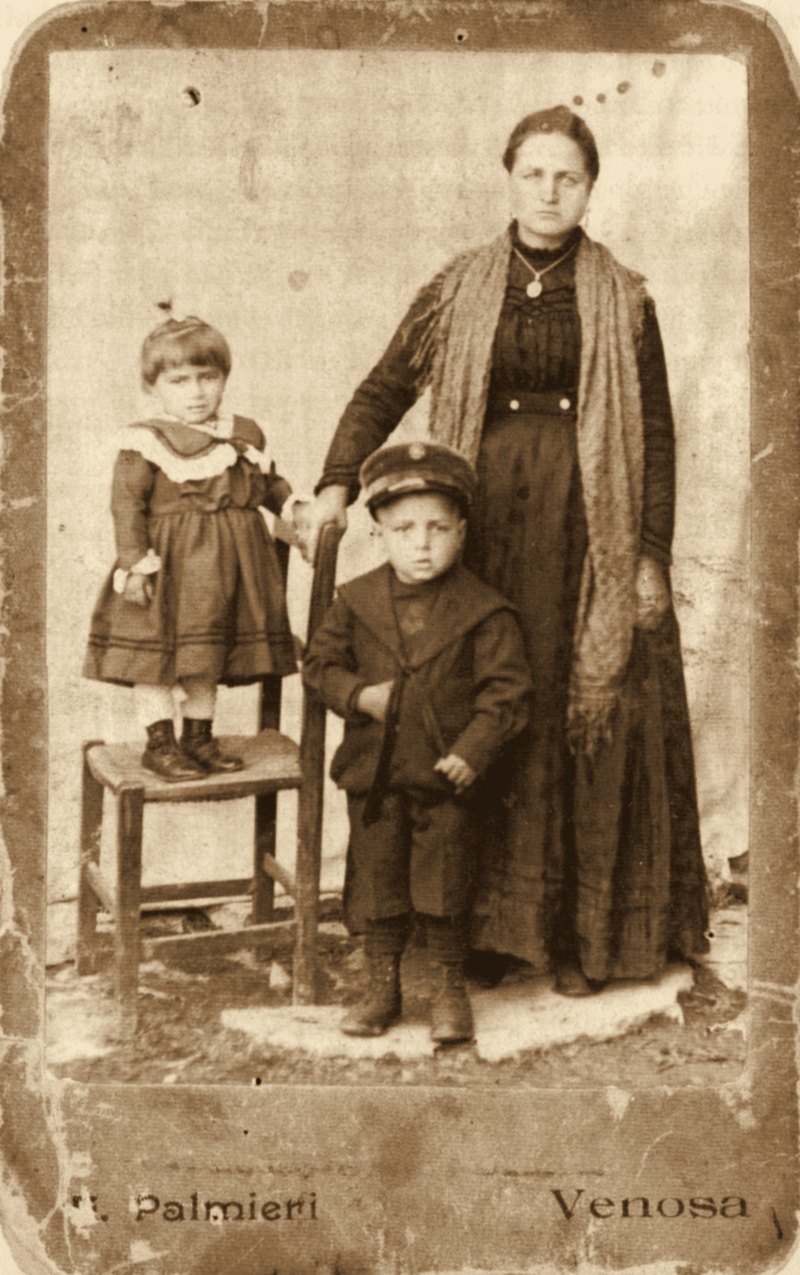
As I write this I am looking at a wonderful old photograph of one such "white widow" and her two children. The woman is young, slim, exceptionally handsome with piercing blue eyes and hair taken back in a severe bun. Her face has more than good looks - it has strength and character. The woman in the picture is my mother, Maria Joanna, who died in 1977, my brother, Anthony (born Antonio), and my sister, Elizabeth (born Elizabetta). The photo was taken in 1903 or 1904 in Venosa, a town of some size about five miles from Maschito, probably because there was no photographer in Maschito. My father, Giuseppe, had emigrated to New York a few years earlier and my mother, like the other "white widows," was awaiting her own journey to a strange new world.
In America the immigrants, thrifty and hard working, sloughed off the poverty of the Mezzogiorno and soon basked in the relative affluence of their new home - a classic case of a group of people pulling themselves up by their bootstraps. They received no government stipends, no "English-as-a-second-language" programs, no multi-lingual ballots, no welfare payments. If they received any help at all it was from their fellow p. 12 immigrants. Moreover, even had there been welfare programs available, I'd venture to say they would have been too proud to apply.
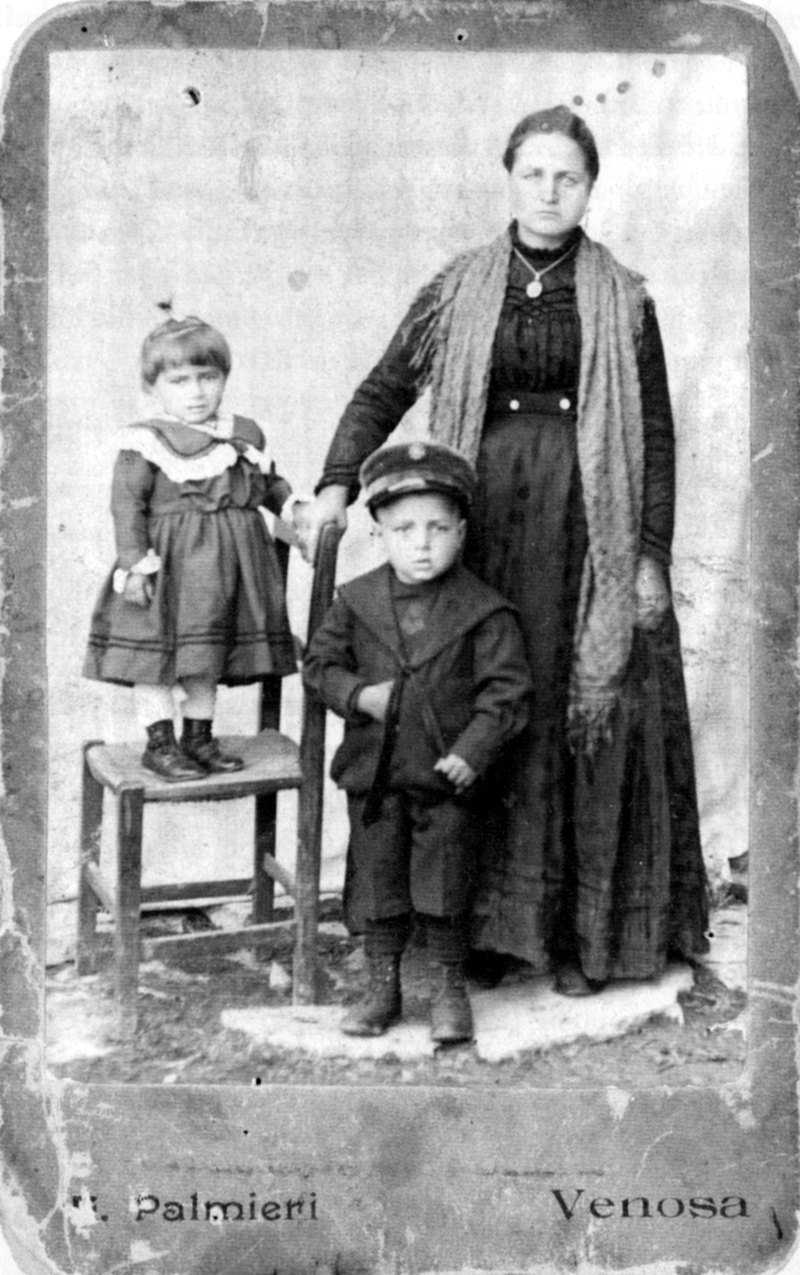
My brother Anthony was four or five years old at the time the picture was taken. He died in 1995 at the age of 96. (My sister Elizabeth, 94, may be the oldest person in the Fresno area who was born in Maschito.) Before he died my brother told his story of the passage from Maschito to Fresno which took place in 1906.
An Emigrant's Story
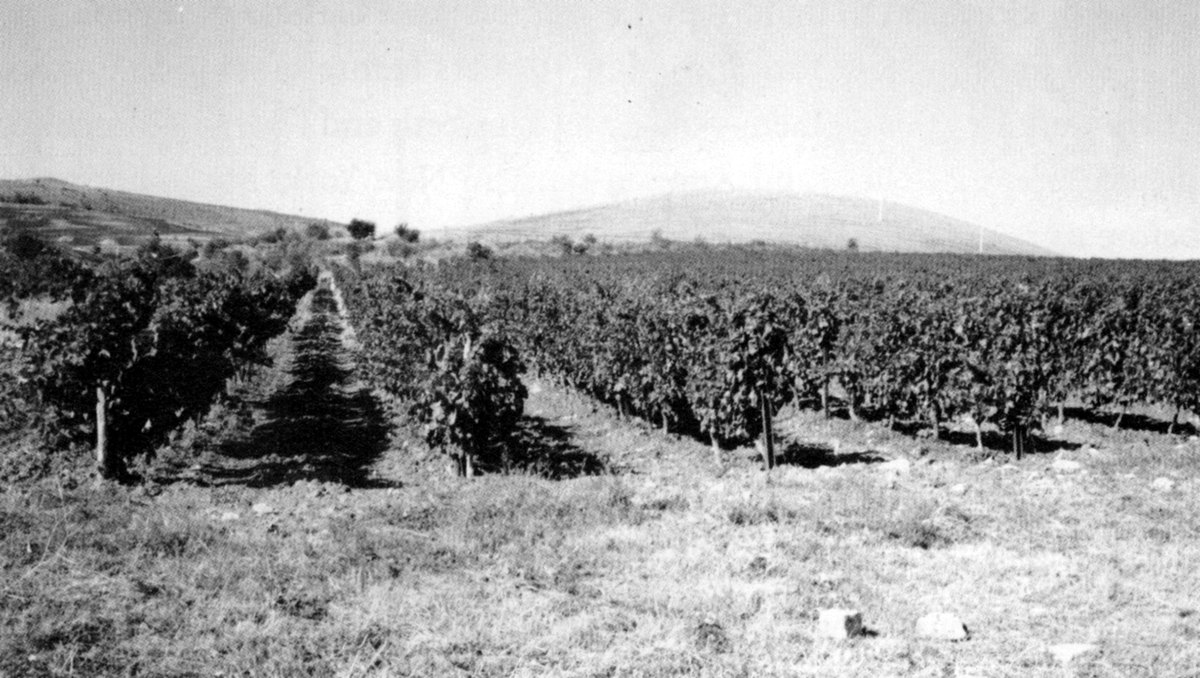
"I remember quite a bit about Maschito. It was a small town. We had vineyards but we lived in town. That's the way it was done there. The small landowners didn't live on their farms; they lived in the village.
"At harvest time a lot of workers, Marinese, would come over from Marina, near Bari, to pick the grapes. A lot of these people also came to the Fresno area when they emigrated.
"I remember every year when the wine was ready buyers from France and Germany and the Scandinavian countries would come through. Maschito had a reputation for good wine. All the wine growers would have their samples out and the foreigners would taste. Usually they'd buy a lot. The Frenchmen would buy the wine for blending with their own, but the northerners would buy for straight consumption. I think there were more vineyards then around Maschito than there are now. I think they mostly grow wheat these days.
"We had no running water in our house. When you needed water you'd have to go fetch it. We'd get one bath a week, on Saturday afternoon. There was a communal bath house in town where everyone would go.
"One day a friend of mine and I walked to Venosa because we thought they were having a fair there. Venosa is about five miles from Maschito, but the ground is hilly and it was a long walk for a couple of little boys on a hot day. When we got there we found there was no fair after all. The walk home was really long.
"I remember my father leaving for America. My mother and my sister and I had to stay behind until he got settled and earned some money. When the big day finally came for us to leave, we rode in a horse-drawn buggy from Maschito to Naples. It was an all day trip.
p. 13 "In Naples we had to stay in a hotel one night before boarding the ship the next day. That was something. I saw indoor plumbing for the first time. My sister and I kept turning the faucets in the bathroom on and off, fascinated by how easy it was to get water. My mother had to cuff us on the ear to get us to stop. It was a lot of fun.
"On the ship we had a little compartment, I think it was just our own area blocked off with blankets for privacy. Every day, between meals, a man would come around with a big basket filled with freshly baked pizza. The first day I begged my mother for one and she bought it for me. It was the same story the next day. But on the third day she refused. I think they cost a nickel and we didn't have a lot of money. But I discovered that when the pizza man came, he'd set his large basket down right next to our compartment and take a smaller basket through the area. It was easy for me to reach out and snitch one, which I did regularly.
"We kids had plenty of food on the ship. In my case not only did I have a pizza snack every day, but most of the adults were seasick and couldn't eat their meals, so we had as much food as we wanted.
"After a week or so at sea I developed some sort of a skin rash on my arms and they put me in the ship hospital. That was fun because I was waited on all the time. The rash didn't heal completely by the time we p. 14 reached Ellis Island and my mother bought a pair of long gloves. She was worried I wouldn't get through the medical inspection and thought the gloves would hide the rash. They did. But the doctors apparently knew all the tricks and found it anyway. I suppose they didn't think it was too serious because I got through all right.
"In New York we lived in a cold-water tenement in the Bronx. It was not too pleasant. My father worked at various jobs and my mother did sewing at home for Jewish clothiers. The tenements had bare wood floors. The landlords were especially mean and would inspect the apartments weekly. They demanded that the floors be scrubbed regularly, so my mother had to work hard all day Saturday getting this and other chores done. Saturday was the one day she did no cooking and we had to fend for ourselves for a day. I'd go to a German bakery and buy a big bag of day-old doughnuts for a few pennies.
"On Friday afternoons I'd go around to five or six Jewish homes. My job was to light their stoves which they were not allowed to do on the Sabbath. I'd get a few pennies from each family.
"We had a little neighborhood gang. All the members of our gang were Brooklyn Dodger fans. We'd go over to Ebbets Field and sneak in. No kids ever paid. And we'd fight other groups. Nothing serious like today ... no knives or guns, just fist fights. Mostly we'd fight Jewish and Irish gangs. The Irish kids liked to fight. We'd have some good battles with them.
"We lived in New York for about 10 years before moving to Fresno. There were six of us by then - my sister Elizabeth and I born in Maschito, then Marie, Pat, Nick, and Ann, all born in New York. My father went before us again and got things lined up. Then my mother and we kids followed.
"Some families envied us. California was a dream in those days, too, and many wanted to go but couldn't afford the trip. My mother and father saved regularly, though, and accumulated enough cash. Even so, money was short. I was 14 at the time and needed a railroad ticket, but I was small for my age and sneaked by without one on the New York to Chicago run. My mother brought food with us but she'd also buy from food vendors at the various stations. There were all kinds of vendors selling all kinds of food.
p. 15 "When we got to Chicago we had to switch railroads. Here I couldn't sneak by and my mother had to buy a ticket for me. It was a lot of money in those days, maybe $40 or $50 dollars. I remember she was very upset about it.
"The trip from Chicago to Fresno was long. We had to sleep on hard wooden benches. And the baby, Ann, was only two weeks old. My mother, of course, took care of her, but my sister Elizabeth and I had to help.
"After we crossed into California I saw my first Indians. It was exciting, a real adventure.
"We finally arrived in Fresno. My father was there waiting for us at the station. We were in a new place again, far from Maschito, far from New York. But it was our new home."
Are We Italians or Albanians?
When I was a young girl I remember my sister, Marie, coming home from school one day and announcing to me with a certain tone of shock, "We're not Italians, we're Albanians!"
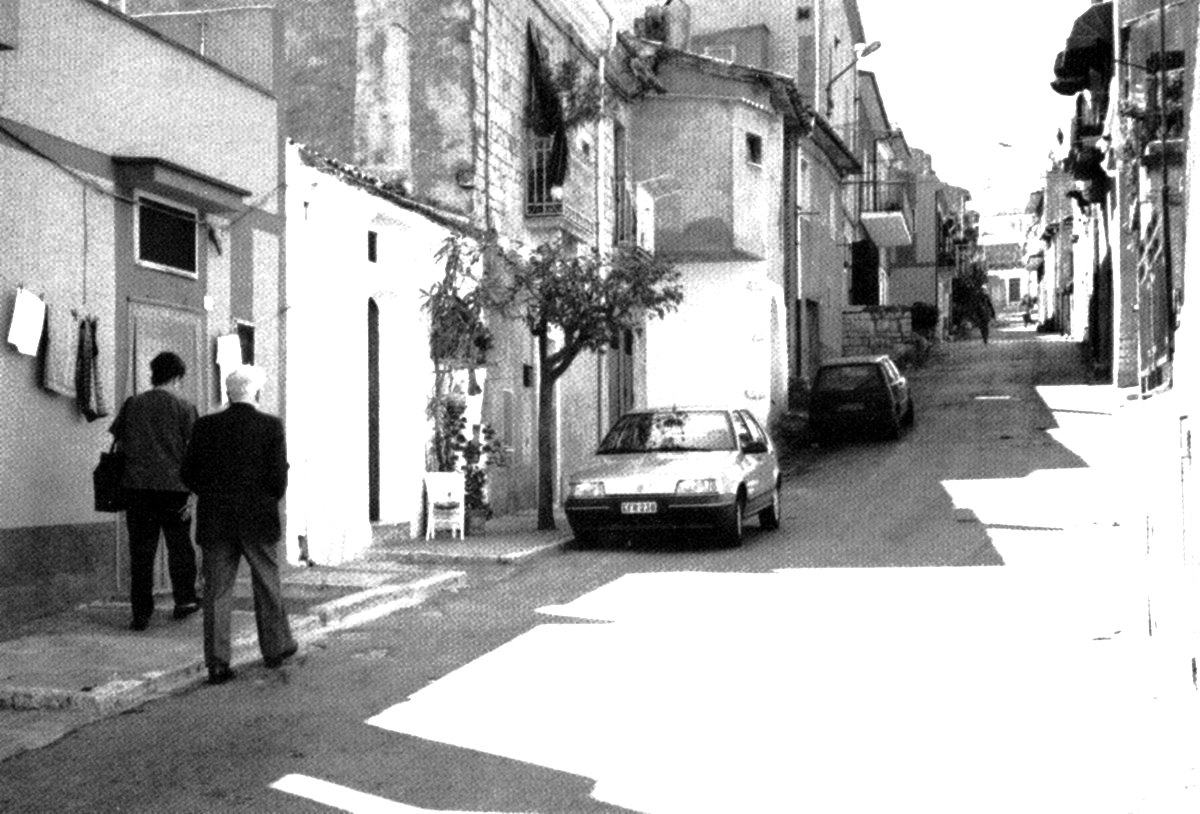
p. 16 "What do you mean, Marie?" I asked with disbelief. "Who told you that? It's the stupidest thing I ever heard."
"Josephine Lambrazio told me. She said the Maschitans lived in Italy but were really from Albania. That's why we don't speak real Italian."
Needless to say we couldn't wait to ask our parents questions, especially the big question - "Are we Italian or Albanian?"
The answer was unequivocal. It went something like this. "We are Italian. Yes, we still speak our dialect, but that was brought over with the original Albanians 500 years ago. Over that period there were many mixed marriages. We are definitely Italian."
My mother told her version of the founding of Maschito. Seven Albanian men, Roman Catholics fleeing the Turks, started the village. The name Maschito comes from a combination of the Italian words for "masculine" and "town" - "masculino" and "citta" - thus "mascitta" or Maschito, literally "town of males." These seven men married girls from neighboring villages but kept their language.
Andy Caglia, who with his brother Frank was born in Maschito, says his mother used to tell him the same story, lending it some credence. If it is indeed true, the offspring of those first settlers were already half Italian. Subsequent intermarriages over the centuries must have further diluted the Albanian strain so that today very little is left. The language, though, remains, the one identifying characteristic of those first settlers.
Whenever I get a chance I speak the Albanian-Italian dialect, which I learned at home from my parents. I enjoy doing so very much. I particularly enjoy meeting people who can speak it. It is a connection with our past, the language of our ancestors. I often consult a dictionary of the Albanian language and frequently recognize words that are the same or similar to those in the Maschitan dialect. However, I am quite sure the dialect we Maschitans speak today is quite different from Albanian. After all, half a millennium has passed since the first Albanians settled on Italian soil. The language has changed, as does every living language, not only in Maschito and the other Albanian-Italian villages of southern Italy, but also in Albania itself. Furthermore, over the generations the dialect has become heavily influenced with Italian words and phrases.
Those of us who still speak the Maschitan dialect are afraid we will be the last generation to do so. In Maschito itself the older people still speak p. 18 the dialect among themselves but the younger generations speak Italian. My nephew, Bruce La Centra, who edited this booklet for me, recently visited Maschito with his wife. Bruce speaks neither Maschitan nor Italian. He says his wife, of North Dakota German-American background, who learned Italian because of a love for the country and its people, had to act as his translator. But the language she used to speak with locals was Italian, not Maschitan.
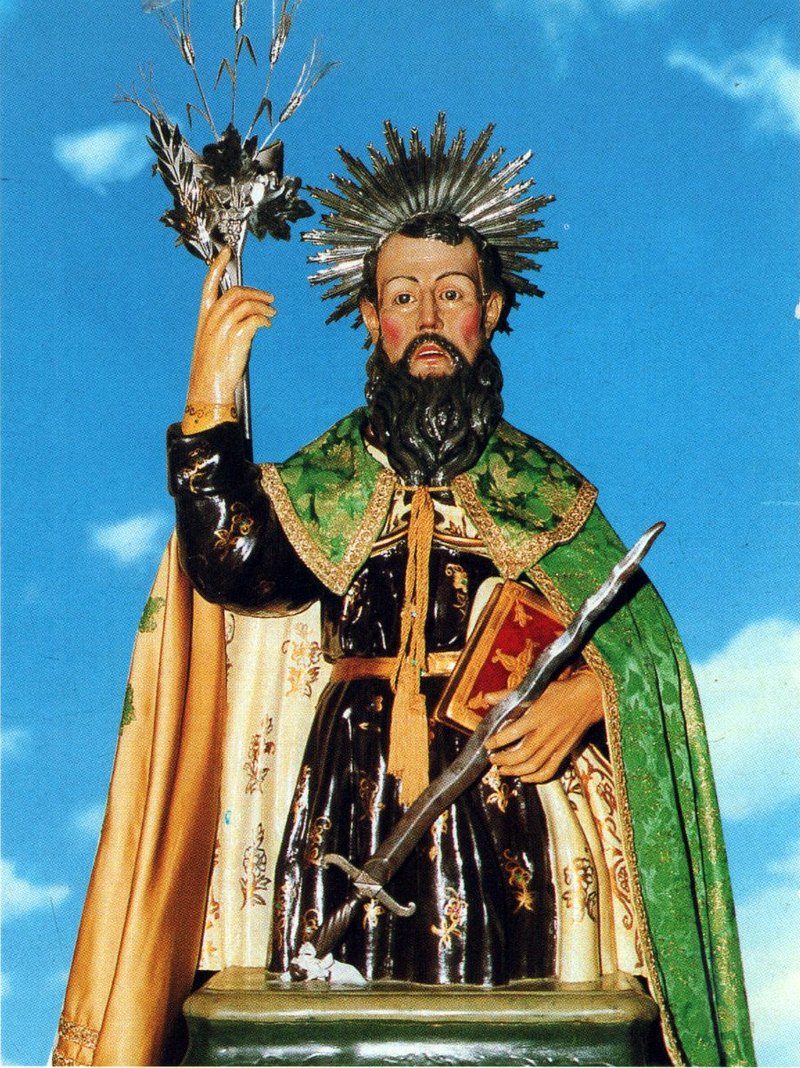
[Webmaster's note: since this booklet was published in 1996, the Fresno statue has been moved from St. Alphonsus Church.]
Commendable efforts to keep the Albanian language alive in Italy are being made by the University of Bari and the Albanian University in Basilicata. These efforts, however, seem like last gasps. Much as the Celtic language has virtually disappeared from Ireland, the Albanian language is disappearing from southern Italy, notwithstanding the valiant attempts of academics.
Frank and Andy Caglia, together with a number of people of Maschitan descent, have formed what they call the "Ad Hoc Committee." Its purpose is to help keep both the language and the customs of the Maschitans alive. Every September in Fresno the committee sponsors a mass and picnic in memory of the great Italian patron saint of Maschito, St. Elia, who lived during the 6th century. Many of us and our descendants look forward with great anticipation to this yearly celebration and the opportunity to meet people whose parents came from the same place as ours did.
On his trip to Maschito, Bruce La Centra says he was taken by Maschitan cousins, the Spaduccis, to see the local church, an impressive structure. Prominent among the statues was one of the illustrious St. Elia. There is also a statue of St. Elia in St. Alphonsus church on Kearney St. in Fresno, an exact duplicate of the original in Maschito.
How do we Albanian-Italians think of ourselves today? I cannot presume to speak for all of us, but I might not go too far astray if I put it this way.
We are proud of our Maschitan background.
We are perhaps a little more proud of our Italian heritage. It was, after all, Italy that gave our ancestors refuge in their time of need, Italy where our ancestors lived for 500 years, Italy whose culture we are heir to.
But today, here in the United States of America where we have prospered as we never did in Albania or in Italy, we are proudest of all of being American.
p. 19Albanian-Italians in the Fresno Area
Interest in Maschito is probably higher than it has ever been among local people who trace their ancestry there. Why is this so? For one reason, those of us born here have an intense curiosity about our roots. Unlike our parents or grandparents who emigrated from Maschito and were preoccupied with the difficult task of carving out a life in a new country, we have the leisure to think more about the past, to wonder, to research, even to travel to the land of our ancestors. For another reason, there are so many families of Maschitan background in the Fresno area. I alphabetically list some of the family names here (those that were Anglicized at Ellis Island are shown in parentheses following the original Italian version). I do so with a certain trepidation that I will offend some by inadvertent omissions. Perhaps I will one day be able to publish an updated version, and with that in mind I ask that kind readers pass on information they may have about family names not listed here.
- Abbruzzese (Bruce)*
- Astone
- Barbano
- Caglia
- Camarodo
- Cenci
- Chafitelli
- Chiaritto
- Civiello
- Cuviello
- De Mera
- DeLuca
- Donato
- Faretta
- Feramisco
- Gentile
- Gileo
- Guglia (Williams)
- Jura
- La Centra
- Langiano
- Lumbrazo
- Maggiore
- Manduano
- Marchese
- Mastrantuano
- Mazzeo
- Milano
- Musto
- Ochinero
- Paladino
- Palumbo
- Renna
- Romano
- Ronzano
- Savino
- Sinerchio
- Soranno
- Spaducci
- Telesco
- Vernova
- Volpa
*Francesco Abbruzzese (whose name was Anglicized to "Frank Bruce" by immigration officials at Ellis Island) was not Maschitan but from the neighboring hilltop village of Forenza, five miles away. In a classic case of intermarriage he wed Elizabetta Milano from Maschito, had to learn the dialect because his wife did not speak Italian, and thus became a sort of honorary Maschitan.
p. 20Further Reading
Books on Italy and famous Italians are so numerous it is hardly necessary to list even a short selection. Every library is filled with them.
Books on Albania are not so plentiful. One excellent source is Encyclopaedia Britannica which gives a good account of the history of the country including the period when the Turks began their assault and the subsequent struggle of the Albanians under Skanderbeg to retain their liberty. I have borrowed liberally from this account in the section on Skanderbeg.
The World Book Encyclopedia is another good source of which I have made use.
The Italo-Albanian Villages of Southern Italy by George Nicholas Nasse, professor of geography at the California State University, Fresno, is a fine source of information. Professor Nasse was obliged to skip the area in which Maschito is located when doing his research and neglects even to include it in his listing of 36 villages, a curious omission. It is also only fair to point out that Professor Nasse did his research from 1956 to 1960 and published his work in 1964. Because many changes in the cultural life of southern Italy have taken place since then, the professor's work is now somewhat dated. Notwithstanding, it is the only publication I know of that deals in any depth with the subject, and I am indebted to Professor Nasse for much of the information I have used in this booklet. The publication is available from the Printing and Publishing Office, National Academy of Sciences - National Research Council, 2101 Constitution Avenue, Washington, DC. The Library of Congress Catalog Card Number is 63-65444.
[Webmaster's note: Professor Nasse's study, with its photographs and maps, can now be read on this site: The Italo-Albanian Villages of Southern Italy.]
— End of booklet —