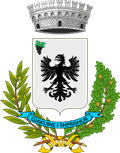
On the family house in MaschitoThe plaque of 1912
The citizens of Maschito had carved here the names of the brothers Rosario and Luigi Giura, born at the close of the eighteenth century to Francesco Saverio and Vittoria Pascale: the first, a valiant jurist and upright magistrate, deputy to the Neapolitan Parliament in 1848, who died an exile in Nice in 1854; the second, engineer, writer and teacher, remarkable in every respect, Minister of Public Works, 1864. May they stand as an example of citizenship and a noble lesson to their native town, ever mindful of its first people, who fled here for love of liberty from the oppressed kingdom of Albania.
23 September 1912
Translated from the Italian. The inscription was composed by Giustino Fortunato. [Webmaster's note: Luigi was Minister of Public Works in 1860 and died in 1864. The plaque's 1854 for Rosario agrees with other sources; one transcription of his tomb inscription in Naples reads 3 September 1853.]
The engineerLuigi Giura (1795–1864)
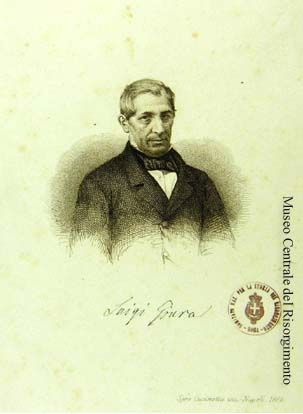
Luigi Giura, Rosario's older brother, was born in Maschito on 14 October 1795. After his first schooling in Basilicata he went to Naples to live with his maternal uncle Vincenzo, who steered him toward mathematics, mechanics and hydraulics. He also studied drawing and architecture at the Academy of Fine Arts. In 1811 he placed first in the entrance examination of the new School of Bridges and Roads, and in 1814 he qualified as an engineer and architect.
In 1826 and 1827 the Kingdom of Naples sent him, with three young colleagues, on a study tour of Italy, France, England and Switzerland to learn the newest engineering methods. In 1828 he was commissioned to build an iron-chain suspension bridge over the Garigliano River. The Real Ferdinando bridge, finished in 1832, was the first iron-chain suspension bridge in continental Europe. Giura worked with the Mongiana ironworks in Calabria on the iron for its chains, and designed machines to draw the chain links and to load-test them.
The bridge stood for more than a century, until its deck was blown up on 14 October 1943, during the fighting on the Gustav Line, as German troops retreated ahead of the Allies. It was restored in 1998 and is now protected as a national monument. On 25 October 2014 the Italian post office honored it with a stamp, "Ponte Real Ferdinando sul Garigliano," issued with a first-day postmark from Minturno.
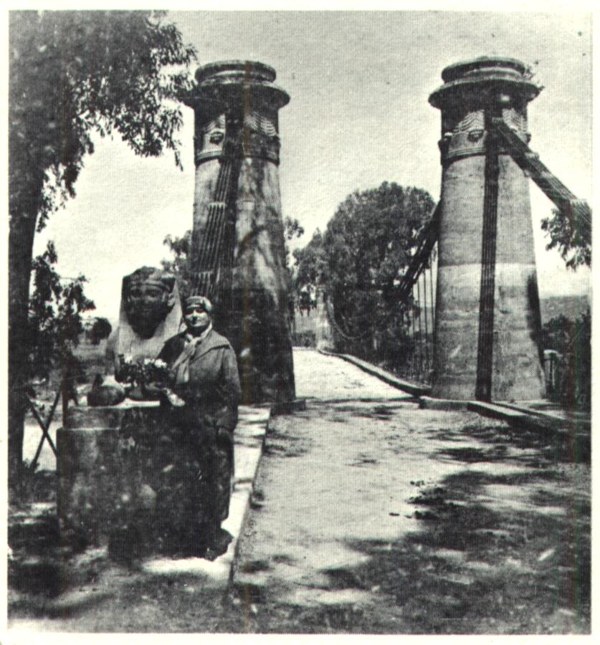
Photo: public domain, via Italian Wikipedia.
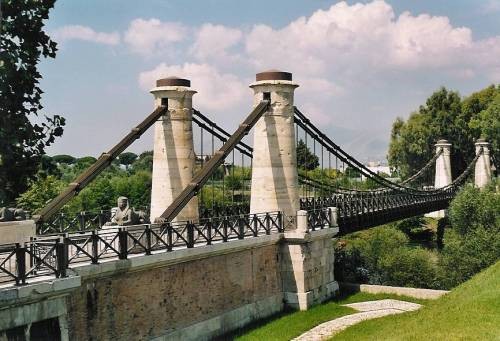
Photo: Domenico Iannantuoni (adsic.it), via Wikimedia Commons, licensed under CC BY-SA 3.0.
Giura went on to build a second chain bridge, the Maria Cristina over the Calore River at Solopaca (1832–35), cleared and surveyed the ancient Roman tunnel that drained Lake Fucino, tested and approved Italy's first railway, from Naples to Portici, and in 1839 became Inspector General of the Corps of Bridges and Roads. When Garibaldi entered Naples in 1860, Giura was named Minister of Public Works in the provisional government, serving from 6 September to 3 November 1860. In failing health, he soon returned to private life, though he later served on the Provincial Council of Naples. He married Enrichetta Grasso, and they had five children. He died in Naples on 1 October 1864, in his sixty-ninth year. A monument to him was raised the following year in the section for illustrious men of Poggioreale cemetery.
The magistrateRosario Giura (1801–1854)
Rosario Giura was born in Maschito in 1801, the son of Francesco Saverio Giura, a lawyer, and Vittoria Pascale. He was educated in the Piarist schools and earned his law degree while still very young. He entered the judiciary of the Kingdom of Naples and rose to its highest office, Procurator General.
Rosario was remembered as a magistrate who could not be bent. When King Ferdinand II issued an order, contrary to law, excusing an accused man from surrendering to jail, Giura formally objected. The King took it as a personal challenge and sent him off to a post in Calabria. The people, who admired his honesty, elected him to the Neapolitan Parliament in 1848.
In a parliament where most deputies kept quiet for fear of reprisal, Giura spoke out against the government. Facing arrest, he escaped into exile in 1849, traveled through Europe, and settled in Nice, where he spent his last years writing on politics, society and the philosophy of law. He died there in September 1854.
In 1860, the year Nice became French, his brother Luigi brought his remains home to Naples, where he rests among the city's illustrious men.
Their fatherFrancesco Saverio Giura (1771–1834)
The brothers' father, Francesco Saverio Giura, was a doctor of law in Maschito. His memorial stone, in Maschito, tells us that his own parents were Rosario Giura and Elisabetta Campera. The magistrate Rosario was evidently named for his grandfather.
FRANCISCVS XAVERIVS GIVRA
ROSARII F. ET ELISABETHAE CAMPERAE
MASCHETI HONESTO LOCO NATVS IV NON. OCT. A. S. MDCCLXXI
HIC SITVS EST
VIXIT AN. LXII M. V. D. IV
HVNC PRAESTANTEM EXSTITISSE VIRVM SPECTATAE FIDEI
RARIQVE EXEMPLI
NON TEMERE QVIS INFICIETVR
IPSEQVE LIBERALIBVS ARTIBVS EXCVLTVS
IN IVRE CIVILI APPRIME DOCTVS
DOCTORISQVE LAVREAM ADEPTVS
CONSILIO CIVES AMICOSQVE ENIXE IVVIT OPIBVSQVE EGENOS FOVIT
MERITO ITAQVE CVNCTIS AB HIS DEFLETVS DEFLENDVSQVE
EHEV QVANTVS MOEROR VXORIS LIBERORVM NECESSARIORVMQVE EIVS
REQVIESCE IN DOMINO ANIMA VT FAS EST CREDERE IN CAELVM EVOCATA
VIRTVTISQVE PRETIO FRVERE
Francesco Saverio Giura, son of Rosario and Elisabetta Campera, born of a respectable family at Maschito on the 4th of October, in the year of salvation 1771, lies here. He lived 62 years, 5 months and 4 days.
That he was an outstanding man, of proven faithfulness and rare example, no one will lightly deny. Refined in the liberal arts, exceptionally learned in civil law, and having earned the laurel of a doctor, he gave his fellow citizens and friends his counsel without stint, and supported the needy from his own means. Deservedly, therefore, he is mourned by all, and will be mourned still. Alas, how great the grief of his wife, his children and his kin!
Rest in the Lord, O soul, called to heaven, as we may rightly believe, and enjoy the reward of your virtue.
Translated from the Latin. [Webmaster's note: the stone gives his birth date and his age at death, but not the date of death; counting forward gives about March 1834. His wife, not named on the stone, was Vittoria Pascale.]
Sources
- Atanasio Pizzi Basile, "Un magistrato arbëre senza ombre: Rosario Giura da Maschito," Scesci Pasionatith, 21 April 2022.
- Atanasio Pizzi, "Storia di Luigi Giura, geniale ingegnere arbereshe del XIX secolo," Albania News, 24 July 2012.
- R. Parisi, "Giura, Luigi," Dizionario Biografico degli Italiani, vol. 57 (Rome, Treccani, 2001).
- Antonio Capano, Considerazioni storiche su Maschito (PZ) tra l'antichità e l'età moderna (Agropoli, 2021).
- Italian Ministry of Culture, "Ponte Real Ferdinando" (cultura.gov.it).
Have more about Luigi or Rosario Giura, or photographs of the plaque, the bridge or the family house? Please email me.